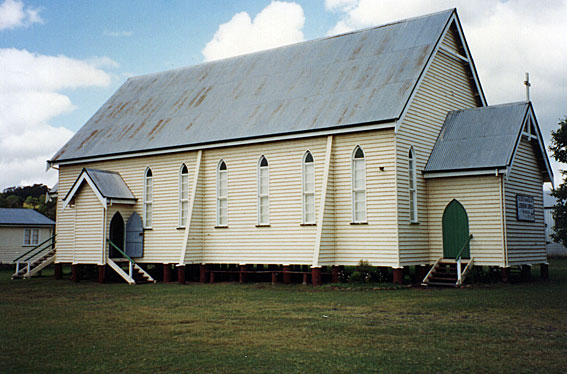
Zion Lutheran Church, Minden
[Photograph by Howard Baker (1990s)]
Zion Lutheran Church, Minden
[Photograph by Howard Baker (1990s)]
Historical and Technical Documentation by Geoffrey Cox
© OHTA 2011, 2014, 2017 (last updated June 2017)
German immigrants settled in this fertile farming district between Ipswich and the Great Dividing Range soon after the Franco-Prussian war in 1870. The area was originally known as the Rosewood Scrub, and Minden was named after the German town of the same name, from which many of the settlers had come. The Zion Evangelical Lutheran congregation at Minden was organised in 1878. The land on which the church stands was transferred to the congregation in 1880, and they built the first church in that year. It was enlarged in 1889.1 The congregation joined the Lutheran Church of Australia (L.C.A.) in 1966, and the Australian Evangelican Lutheran Church (A.E.L.C.) in 1992.2
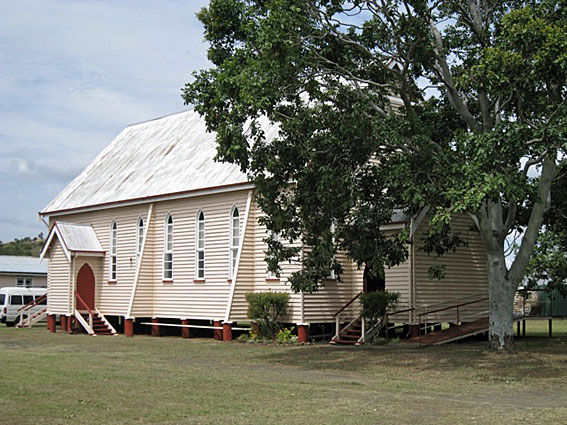
Zion Lutheran Church, Minden
[Photograph by Geoffrey Cox (September 2014)]
First Organ.
It is reported that a pipe organ was bought during the time of Pastor Goessling (1879-86), and that it served for fifty years before being replaced by 'a modern instrument,'3 presumably the present one. No other details have survived of this instrument.
Present Organ.
The present organ in Zion Church was built by Whitehouse Bros of Brisbane and installed in June 1931 at a cost of £238.12.6.4 The façade comprises two flats of non-speaking pipes, with the lowest stopped wooden bass pipes arranged awkwardly on either side of the console in such a way that the casework on the two sides of the organ is disconnected from the front.
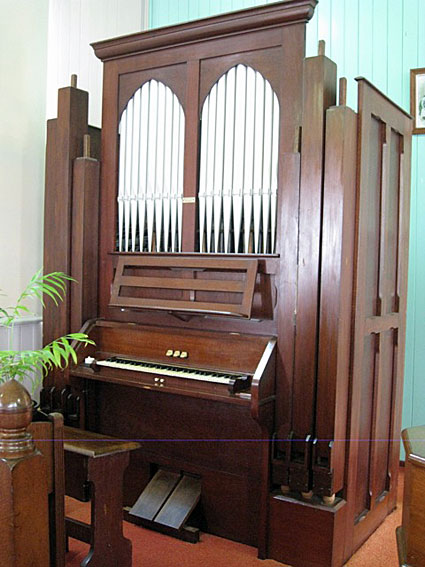
The 1931 Whitehouse Bros organ
[Photograph by Geoffrey Cox (September 2014)]
The tropic-pinned keyboard, with its distinctive mahogany key cheeks and rounded accidentals, derives from the 1892 Henry Willis & Sons organ at the Exhibition Building, Bowen Park, Brisbane.5 The stop-keys are of the triangular-block type common on Whitehouse organs of the period.
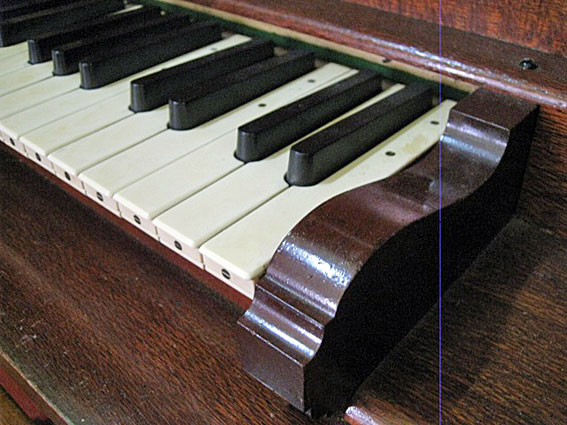
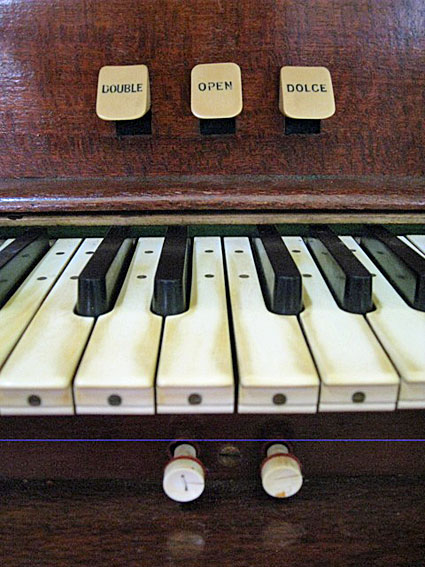
Console details of the 1931 Whitehouse Bros organ
[Photographs by Geoffrey Cox (September 2014)]
The presence of a blowing mechanism using foot-treadles in the style of a harmonium is a feature that was common on many similar instruments built by the Positive Organ Co. Ltd, London, around the turn of the century, also using melodic stops. The Whitehouse firm would have been familiar with these instruments at Holy Trinity Anglican Church, Mackay (subsequently moved to West End Methodist Church and St Philip's Anglican Church, Annerley) and at the Catholic Apostolic Church, South Brisbane (now in the gallery at Holy Trinity Anglican Church, Fortitude Valley).
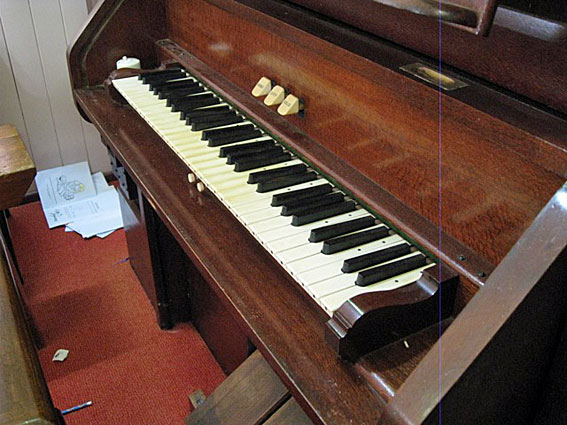
The keyboard of the Minden instrument
[Photograph by Geoffrey Cox (September 2014)]
This was one of at least four similar instruments built by the Whitehouse firm, all of one manual with no pedals, and comprising three stops (including a melodic bass), and an octave coupler. The earliest two, for St Augustine's Anglican Church, Hamilton (1918) and St Mark's Anglican Church, Albion (1919), had a manual compass of four octaves (F-F). Only scant details of the third instrument, for St John's Anglican Church, Cairns (1927), have survived. Given that the firm often built instruments in pairs, it is likely to have been the same as the Minden instrument. Minden was the last of the four, and it has different stop nomenclature and a different compass from the earliest two.
| MANUAL Double Open [Diapason] Dolce [= Salicional] COUPLER Octave Coupler |
16 8 8 |
(Melodic Bass) (to middle C only)* (stopped wooden bass, 17 notes C-e) (stopped wooden bass, 17 notes C-e) [operated by two thumb pistons: on/off] |
Pneumatic action
Cone-pallet chest
Attached stop-key console
Compass: 58 notes
Totally unenclosed
No pedals
Optionally blown by foot-treadles.
* bottom octave borrowed from the
stopped wooden bass of the other two stops.6
The organ was completely restored in 2017 by Pierce Pipe Organs of Brisbane. A new blower was supplied to replace the existing one, while the the original foot-blowing mechanism was retained and restored.7
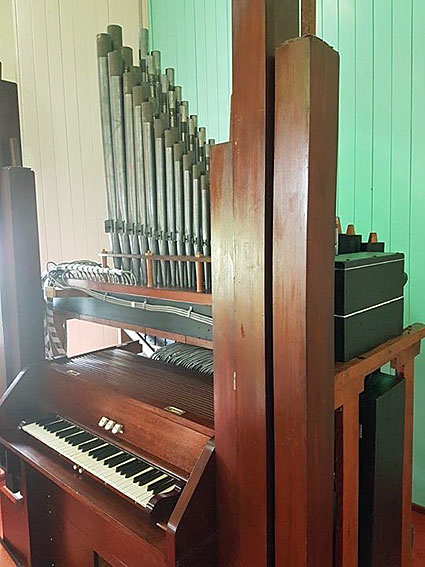
The organ undergoing restoration in 2017
[Photograph by Simon Pierce (May 2017)]
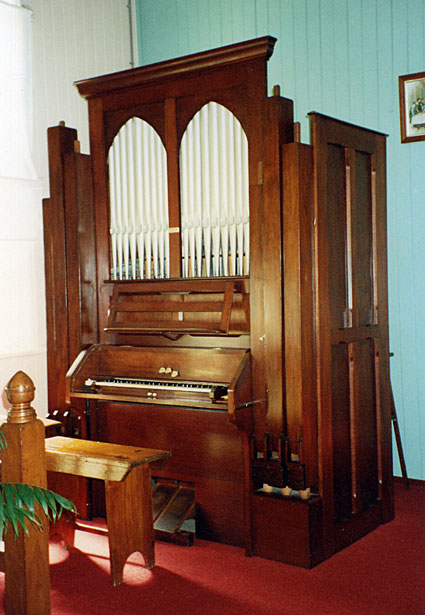
The 1931 Whitehouse Bros organ
[Photograph by Howard Baker (1990s)]
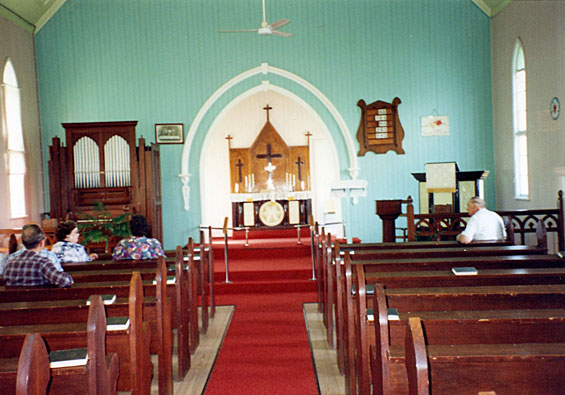
The interior of Zion Lutheran Church
[Photograph by Howard Baker (1990s)]
______________________________________________________________________
1 'Lutherans' Jubilee: Celebrations at Minden,' The Sunday Mail (23 October 1938), p. 14.
2 D. Steinhardt, 'The Minden Story,' The Australian Evangelical Lutheran Church Newsletter (July 2006), pp. 3-4. See also: F. Otto Theile, One Hundred Years of the Lutheran Church in Queensland (Brisbane: UELCA, 1938), p. 219.
3 'Lutherans' Jubilee: Celebrations at Minden,' The Sunday Mail (23 October 1938), p. 14.
4 Whitehouse Bros Ledger (1922-1940), p. 552.
5 Observation by John Maidment, September 2014.
6 Specification noted by G. Cox, 1974 and 2014.
7 'News from the Organ Builders: Two Single-Manual Restorations,' Organ Australia, no. 2 (2016), pp. 35-36.