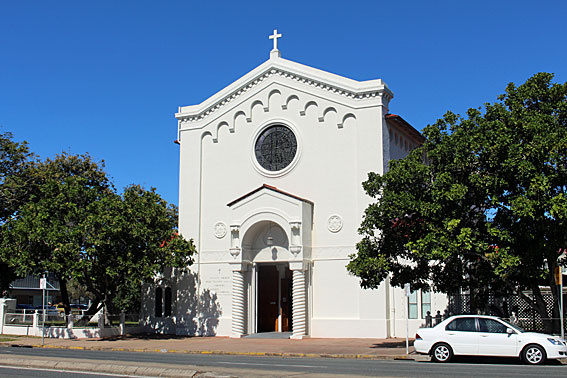
Holy Trinity Anglican Church, Mackay
[Photograph by Trevor Bunning (July 2015)]
Holy Trinity Anglican Church, Mackay
[Photograph by Trevor Bunning (July 2015)]
Historical and Technical Documentation by Geoffrey Cox
© OHTA 2012, 2018 (last updated June 2018)
Mackay was founded as a port in 1863 to export wool from the expanding pastoral industry of the hinterlands. It is named after Captain John Mackay, who had established a cattle run at Greenmount, twenty kilometers inland, in the early 1860s. Sugar was first planted in the region in 1865, and this has become the dominant industry.
Anglican services were initially held in the Court House from 1863 onwards, and a harmonium was purchased 'to make the services more attractive'. The first Holy Trinity church was built on the present site in 1870-71, although it lasted only a few years, collapsing in 1878. Following the creation of the Anglican Diocese of North Queensland in 1878, Mackay became part of the new Diocese, having previously belonged to the Diocese of Brisbane although, paradoxically, areas further north had still been controlled by the Diocese of Sydney until this time.
The second Holy Trinity Church was built in 1879, a wooden building in Gothic style designed by the colonial architect, Mr F.D.G. Stanley. It survived until being destroyed in the disastrous 'Mackay Cyclone' in January 1918. It was for this second church that the first two organs were built in the 1890s and 1911 respectively. A temporary church occupied the site from 1918 until the present building was opened in December 1926.1
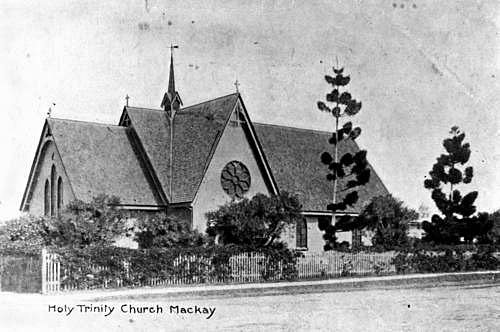
Second Holy Trinty Church, Mackay
[Photograph: John Oxley Library, State Library of Queensland, Neg: 41979]
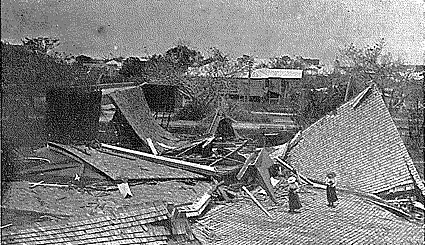
Holy Trinity Church after the 1918 cyclone
[Photograph from Centenary booklet
of Holy Trinity Church, Mackay, 1867-1967.]
The present Holy Trinity church building, the third on this site, was designed by the architect, Lange L. Powell. It was built in 1925-26 employing a blend of Romanesque, Spanish Mission and Mediterranean architectural styles.2
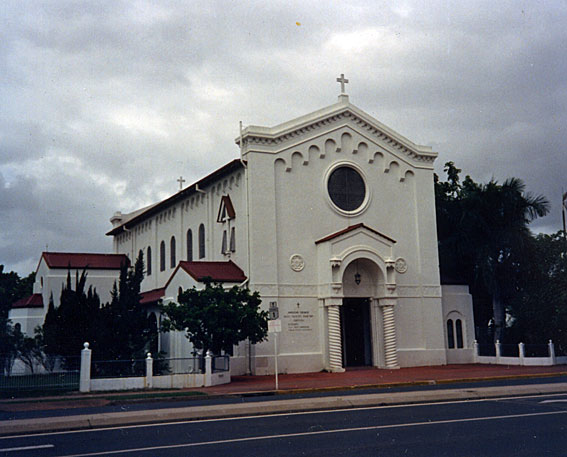
The present Holy Trinity Anglican Church
[Photograph by Howard Baker (1990s)]
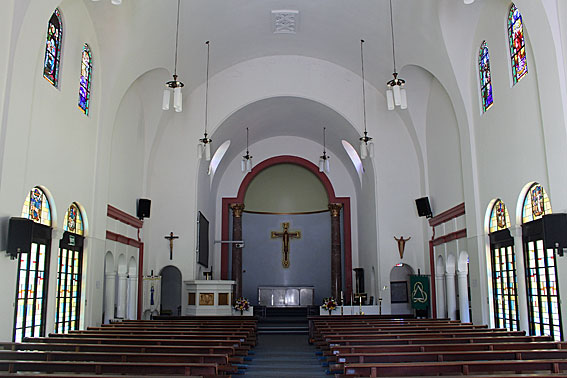
Interior of the present Holy Trinity Church
[Photograph by Trevor Bunning (July 2015)]
First Organ (previous church).
The first pipe organ in the previous Holy Trinity Church was built by the Positive Organ Co. Ltd, London.3 It had been selected directly from the manufacturers by a Mr George Joseph Perkins of Mackay, reportedly at a cost of £150.4 The date of installation in Mackay can be narrowed to the 1890s,5 and possibly even to the end of that decade, as George Fincham of Melbourne provided an estimate of £220 for a single-manual organ for Holy Trinity Church in January 1898.6
Following difficulties in maintaining the instrument, it was sold to the West End Methodist Church in Brisbane,7 who purchased it through Messrs Whitehouse & Marlor in 1901.8 After being replaced at West End in 1909, it found its way to St Philip's Anglican Church, Annerley, where it was destroyed by fire in 1954.
Second Organ (previous church).
The second pipe organ at Holy Trinity Church, Mackay, was built by B.B. Whitehouse & Co., Brisbane. It was opened in Mackay in October 1911, and is now located at All Hallows' Convent Chapel in Brisbane.
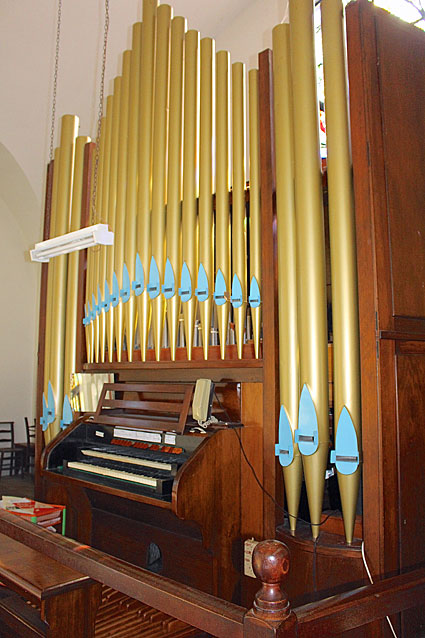
The Whitehouse organ in the present church
[Photograph by Trevor Bunning (July 2015)]
Present Organ.
The organ in the present church was built in 1956 by Whitehouse Bros of Brisbane at a cost of £4,081.9 Like the instrument built by the same firm a few years earlier for the Presbyterian Church in Mackay, it is one of the later examples of the standardised pneumatic-action organs built by the Whitehouse firm from the early 1910s onwards. Located in the gallery, it enjoys a favourable acoustic in this spacious and reverberant building.
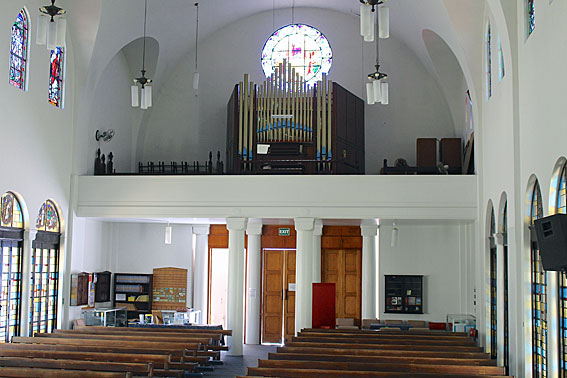
The Whitehouse organ in the gallery of the present church
[Photograph by Trevor Bunning (July 2015)]
Around 1976 there were intentions to electrify the action of the organ, but these were not carried out.10 The instrument was overhauled and extensively revoiced in 1989 by W.J. Simon Pierce of Brisbane, reportedly 'doubling its sound output.'11
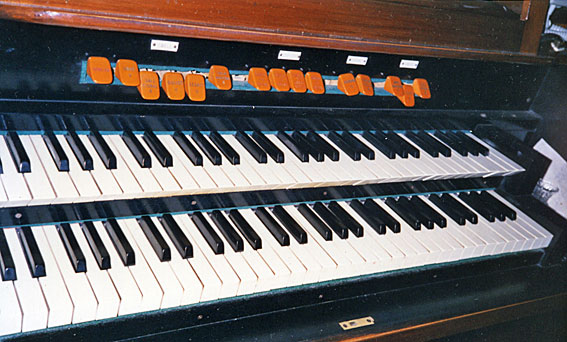
Console of the 1956 Whitehouse organ
[Photograph by Howard Baker (1990s)]
Two stops were added to the Great in 2015 by W.J. Simon Pierce of Brisbane, on a new two-rank cone-pallet soundboard joined to the original Great soundboard. The Stopped Diapason 8ft rank came from St Paul's Anglican Church, Ipswich, where it had been added by B.B. Whitehouse & Co. in 1914.12 At the same time, the original Flute 4ft (actually a Spitz Flute) was revoiced as a Fifteenth 2ft.13
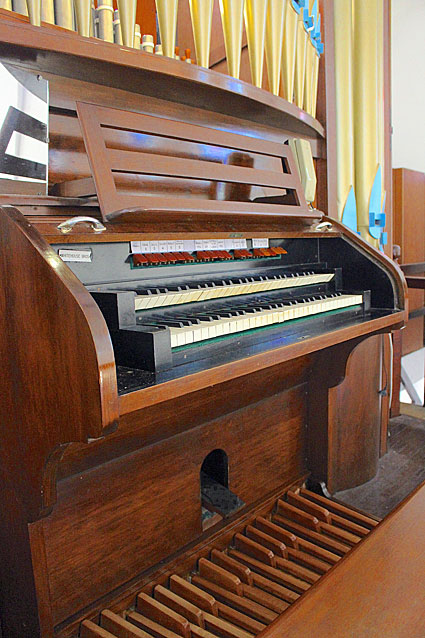
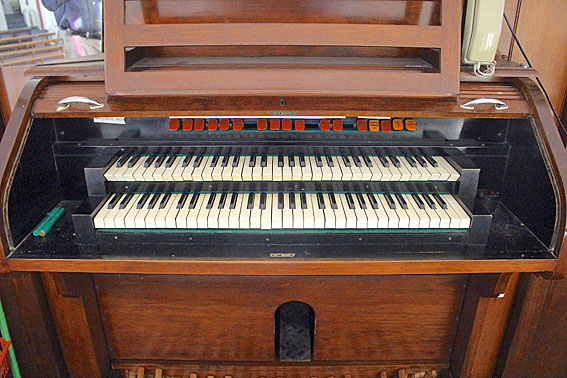
Console of the Whitehouse organ with 2015 additions
[Photographs by Trevor Bunning (July 2015)]
Repairs were undertaken by Pierce Pipe Organs in June 2018 following water damage.14
The current specification is as follows:
| GREAT Open Diapason Stopped Diapason Salicional Principal Fifteenth SWELL Violin Diapason Gedact Salicional Dulcet Oboe PEDAL Bourdon Violincello COUPLERS Swell to Great Swell to Pedal Great to Pedal Swell to Great Super |
8 8 8 4 2 8 8 8 4 8 16 8 |
[2015; ex. St Paul's, Ipswich, 1914] [from Swell] [2015] [2015; formerly Flute 4ft] [gvd bass] |
Swell tremulant
Tubular-pneumatic action
Attached stop-key console
Radiating concave pedalboard
Balanced swell pedal
Compass: 61/30.15
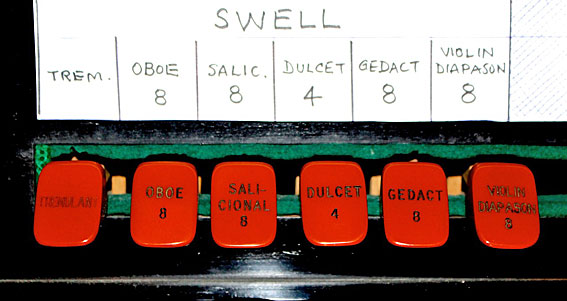
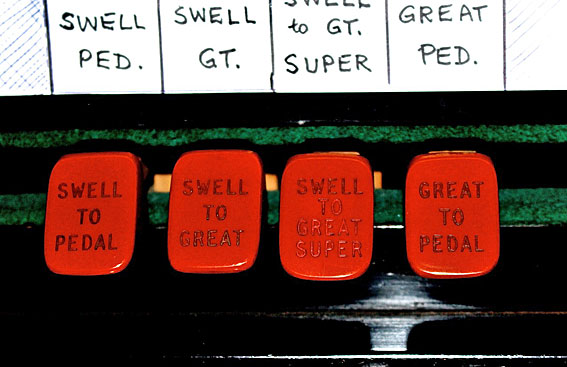
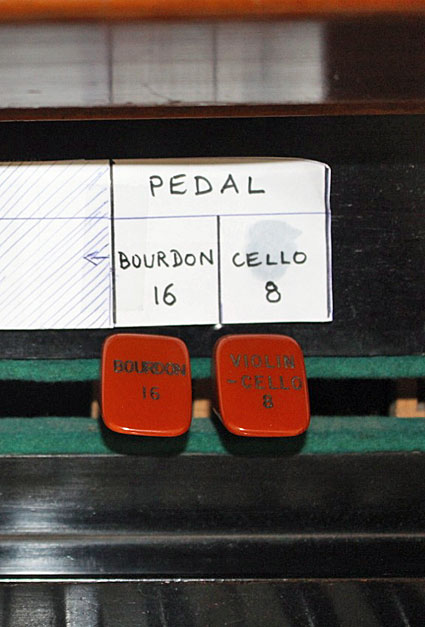
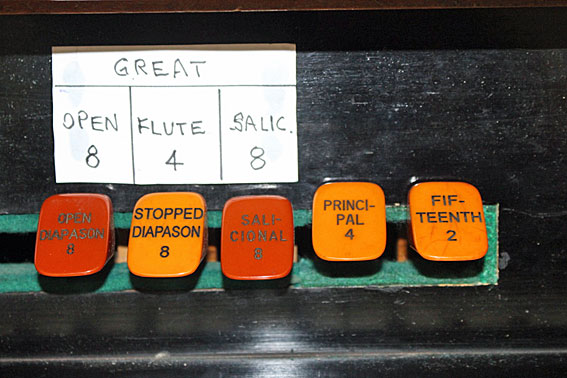
Stopkeys, including the 2015 additions
[Photographs by Trevor Bunning (July 2015)
___________________________________________________________________
1 John Henry Williams, Anglican Parish of Holy Trinity, Mackay: Centenary 1867-1967 (Mackay, 1968).
2 Queensland Heritage Council, Queensland Heritage Register, location 601111.
3 Collected Organ Specifications of Bernie Brohan (circa 1952), and Notebooks of Edward R. Salisbury (organist at St Phillip's Anglican Church, Annerley, 1928-30).
4 Personal communication to G. Cox from Edward R. Salisbury, January 1973, based on an unidentified [Brisbane] newspaper clipping, reportedly dated 7 January 1940.
5 Williams, op.cit., pp. 13, 24. According to Mr E. R. Salisbury (personal communication to G. Cox, 1974), the organ was installed at Mackay during the incumbency of The Revd Abel Turner (June 1891-October 1900).
6 George Fincham Letter Book 15, pp. 295-96 (18 January 1898); Letter Book 11, p. 378 (19 May 1898).
7 Personal communication to G. Cox from Edward R. Salisbury, January 1973, based on an unidentified [Brisbane] newspaper clipping, reportedly dated 7 January 1940.
8 The Brisbane Courier (4 October 1901), p. 6; Minutes of Trustees Meetings, West End Methodist Church (29 August 1901) - supplied by the Methodist Historical Society, Brisbane, courtesy of Rev. Alan Heiner, 20 September 1974.
9 Whitehouse Bros Summary List.
10 Personal communication to G. Cox from David Vann, c.1976; Electrification was nevertheless reported in the 1976 edition of the present author's Gazetteer of Queensland Pipe Organs, and this was blindly repeated in The Organ Voice, vol. 31, no. 3 (September 2004), p. 14.
11 Organ Society of Queensland Newsletter, vol. 16, no. 6 (June 1989), p. 53.
12 Personal communication to G. Cox from Simon Pierce, July 2015.
13 Simon Pierce, 'New Work in Queensland and New Zealand,' Organ Australia (Winter 2015), p. 41.
14 Personal communication to G. Cox from Simon Pierce, 16 June 2018.
15 Specification noted by G. Cox, July 1974; 2015 additions from sources given above.