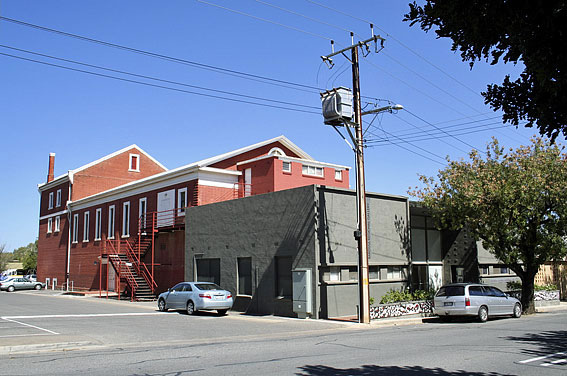
Barossa Regional Gallery, Tanunda, viewed from the north-east
[photograph by Steve Kaesler (2010)]
Historical and technical documentation by John Maidment
© OHTA (last updated September 2014)
Barossa Regional Gallery, Tanunda, viewed from the north-east
[photograph by Steve Kaesler (2010)]
The building housing the Barossa Regional Gallery was opened on 16 May 1913 as the hall of the Tanunda Club. It was designed by the prominent firm of Adelaide architects English & Soward in a stripped classical style employing red brick and stucco. The architects' design for the hall and its façade was submitted in two versions but the façade was never erected; the design is preserved at the Hall. The building was to be 25 metres long, 12.45 metres wide and with a stage 12 metres deep and it was built at a cost of £3,200 by Mr B. Freytag.1 The building became the Soldiers Memorial Hall after the First World War. In the 1960s, an unmatching cream brick façade was erected. When the building was refurbished as the Barossa Regional Gallery, this façade was rendered and painted and the front interior spaces refurbished as galleries for the display of art. The hall itself, which currently seats around 350 people, still awaits full restoration and repainting of the interior. It incorporates a lofty and well-lit hall space equipped with a rear gallery, with a proscenium arch leading on to the stage area, which is surmounted by a fly tower and a room beneath that is used to house the local liedertafel choir. The ceiling and proscenium surrounds are made from pressed metal. It has excellent acoustics, being of the classic 'shoebox' shape.
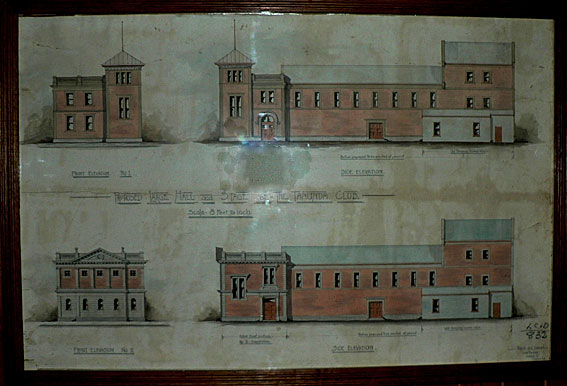
Drawing by English & Soward for the completed hall of The Tanunda Club
[photograph by John Maidment (18 March 2006)]
The organ was built for Adelaide Town Hall by the notable London firm of organbuilders Hill & Son. It produced estimates for a new organ on 31 March 1871 which was corrected to 16 June 1872, initially to cost £1,000 but corrected to £1,500. On 17 June 1872, a final estimate was prepared, which became the firm's job number 1564. In 1875, there were concerns about the affordability of the organ and Hill & Son again reduced the size of the instrument, but fortuitously the funds were found for the full scheme to proceed.2

The organ at Adelaide Town Hall c.1890
[(collection of John Maidment)]
The organ was opened on Tuesday 2 October 1877 by Melbourne City Organist David Lee assisted by W.R. Pybus. It had been erected by Robert Mackenzie, from Melbourne.3
In 1885-86, Fincham & Hobday, based in Adelaide, made the following changes:
Great Twelfth 3ft changed to a Gambe 8ft; Twelfth made into a Harmonic Piccolo for the new Solo Organ
Choir Dulciana 8ft, Voix Celeste 8ft and Clarionet 8ft transferred to the new Solo Organ and new pipework provided for a Bourdon 16ft, Dulciana 8ft and Clarionet 8ft. A new Tuba Mirabilis 8ft added on tubular-pneumatic action and voiced on heavy-pressure wind (possibly from the Barker lever reservoir – bottom 30 notes extant, in storage).
A new enclosed Solo Organ, played from a new fourth manual, and operated via tubular-pneumatic action, placed at the rear of the organ behind the unenclosed Choir Organ. This comprised:
Flute 8ft
Dulciana 8ft (Hill & Son: ex Choir)
Voix Celeste 8ft (Hill & Son: ex Choir)
Flute 4ft
Harmonic Piccolo 2ft (Hill & Son Great Twelfth 3ft transposed and revoiced)
Glockenspiel [2rks] b21.22 (ranks extant, in storage)
Bassoon 16ft TC (part of this rank now in the Joscelyne organ at St James-the-Great, East St Kilda)
Clarionet 8 (Hill & Son: ex Choir)
Orchestral Oboe 8ft
Vox Humana 8ft (provided by Hill & Son – rank extant, in storage)
Additional couplers were provided, tremulants, and a stop labeled Tonerre, which depressed all the keys of the swell manual when drawn, presumably to produce simulated thunder for storm pieces.4
In 1939, J.E. Dodd added a wooden Viola 16ft to the Pedal Organ and lowered the pitch through the insertion of a new bottom pipe for most ranks and transposing the Hill pipework up one semitone.5
1877 Hill & Son including 1885 Fincham & Hobday & 1939 Dodd additions - Drawstop Layouts
1875 Hill & Son Grand Organ - Stop Layout |
||||||
Left Jamb |
Right Jamb |
|||||
Clarion 4 |
Oboe 8 |
Cornopean 8 |
||||
Double Trumpet 16 |
Mixture III |
Fifteenth 2 |
Clarion 4 |
Posaune 8 |
Sharp Mixture II |
|
Rohr Flute 4 |
Principal 4 |
Hohl Flute 8 |
Full Mixture III |
Fifteenth 2 |
Twelfth 2 2/3 |
|
Pierced Gamba 8 |
Open Diapason 8 |
Lieblich Bourdon 16 |
Harmonic Flute 4 |
Principal 4 |
Stopped Diapason 8 |
|
Trombone 16 |
Violoncello 8 |
Bourdon 16 |
Open Diapason No. 2 8 |
Open Diapason 8 |
Double Open Diapason 16 |
|
Double Open Diapason 32 |
Open Diapason 16 |
Swell to Choir |
Lieblich Flute 4 |
Flageolet 2 |
Clarionet 8 |
|
Swell to Great Octave |
Swell to Great Sub Octave |
Swell to Great |
Lieblich Gedact 8 |
Voix Céleste 8 |
Gemshorn 4 |
|
Choir to Pedal |
Swell to Pedal |
Great to Pedal |
Cone Gamba 8 |
Dulciana 8 |
||
1875 Hill & Son including 1885 Fincham & Hobday & 1939 Dodd additions - Drawstop Layouts |
|||||||
Left Jamb |
Right Jamb |
||||||
* |
Solo to Swell |
Solo to Great |
Clarinet 8 |
Orchestral Oboe 8 |
Vox Humana 8 |
||
Solo to Choir Sub |
Solo to Choir Super |
Solo to Choir |
Piccolo harmonic 2 |
Glockenspiel II |
Bassoon 16 |
||
* |
Tremulant to Swell |
Tonerre |
Voix Céleste 8 |
Dulciana 8 |
Flute 4 |
||
Clarion 4 |
Oboe 8 |
Cornopean 8 |
Flute 8 |
Tremulant to Solo |
* |
||
Double Trumpet 16 |
Mixture III |
Fifteenth 2 |
Clarion 4 |
Posaune 8 |
Sharp Mixture II |
||
Rohr Flute 4 |
Principal 4 |
Hohl Flute 8 |
Full Mixture III |
Fifteenth 2 |
Gambe 8 |
||
Pierced Gamba 8 |
Open Diapason 8 |
Lieblich Bourdon 16 |
Harmonic Flute 4 |
Principal 4 |
Stopped Diapason 8 |
||
Viola 16 |
Trombone 16 |
Violoncello 8 |
Choir to Great |
Open Diapason No. 2 8 |
Open Diapason 8 |
Double Open Diapason 16 |
|
Bourdon 16 |
Double Open Diapason 32 |
Open Diapason 16 |
Swell to Choir |
Lieblich Flute 4 |
Flageolet 2 |
Clarionet 8 |
|
Pedal Octave |
Swell to Great Octave |
Swell to Great Sub Octave |
Swell to Great |
Lieblich Gedact 8 |
Bourdon 16 |
Gemshorn 4 |
|
Solo to Pedal |
Choir to Pedal |
Swell to Pedal |
Great to Pedal |
Cone Gamba 8 |
Dulciana 8 |
Tuba Mirabilis 8 |
|
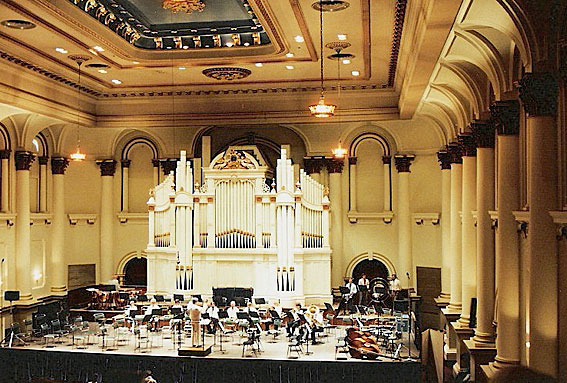
The organ at Adelaide Town Hall, photographed in the 1980s, showing the redecoration of the
organ case and façade pipes
[source unknown]
In 1969-1970 the organ was rebuilt by Laurie Pipe Organs Pty Ltd, advised by Dr J.V. Peters, City Organist. This involved the removal and destruction of all the original Hill & Son key and stop actions and the entire wind system. These were replaced with modern components and pneumatic balanciers were used within the windchests to lighten the touch, in place of the original Barker lever. Additional ranks were added, older pipework was either discarded or transposed and a new console supplied. Electro-pneumatic action was used for the Pedal stops. A vestigial wind system using individual blowers for each department was initially installed and the stop actions utilized the newly-developed SLIC motors.6 Regrettably, by the early 1970s the instrument was mechanically deficient and the splendour of the Hill sound had been largely lost. It was decided in the late 1980s to replace the instrument and it was removed from the hall in 1990 and placed in storage by Adelaide organbuilder George Stephens. The new Adelaide Town Hall organ opened in 1990 was built by J.W. Walker & Sons, Ltd of Brandon, Suffolk and incorporated the carved lyres, urns and pediment sculpture from the Hill organ case.
The OHTA South Australian Committee was aware of the conditions of sale of the organ, and maintained a watching brief from its dismantling. As no sale eventuated, and the future of the instrument was seen to be in jeopardy, OHTA formally registered its interest in the instrument in February 1994. The major obstacle to acquisition was the need to find a location for the organ, preferably in South Australia. Discussions were held with various parties in the Barossa Valley. In October 1994, the District Council of Tanunda indicated it was prepared to accept, in principle, the placement of the organ in the Soldiers Memorial Hall subject to various guarantees. As a consequence, a formal approach was made to the Adelaide City Council to acquire the organ and ownership was relinquished to OHTA on 21 March 1995.
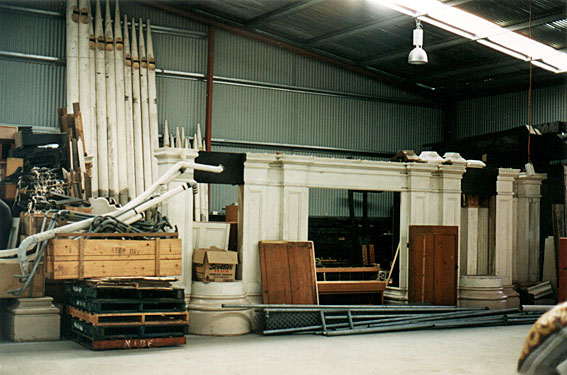
The Hill & Son organ in storage at Mt Lofty
[photograph by David Shield (1996)]
Temporary storage for the organ was found on the property of Mr George Lucey at Mt Lofty. Over the next two years the organ was laid out and the original tonal structure determined by placing the pipes in their racks above the chests. The process of fundraising and nature of the restoration were thoroughly canvassed at this time.
In 1997 a feasibility study was planned involving the partial erection of the instrument. An open day was held in Tanunda on Sunday 14 September to allow the people of the Barossa Valley to view the organ and express their opinions. As a result, on 14 January 1998, the Soldiers Memorial Hall Committee gave its approval for the OHTA to proceed with the proposal to place the Hill & Son organ in Tanunda. It was most fortuitous that the organ could be located here as the hall had sufficient height to accommodate the organ (around 12 metres tall) with a large area beneath the stage that could be utilized for the mechanisms and bottom pipes of the 32ft Double Open Diapason.
The owner of Chateau Tanunda winery offered storage so, after three years in the Adelaide Hills, the organ was moved to the Barossa Valley. From this point a number of things were put in train. Cost estimates were devised, appeal brochures developed, tax deductibility sought, and fund raising began. In March 2000, the Friends of the Hill & Son Grand Organ were formed. This group has not only organized events to raise funds for the project but have stripped paintwork from façade pipes, casework and swell box, checked and corrected any faults in the woodwork and re-erected the casework in the Hall. The Friends have created a community around the instrument to support and ensure its promotion and use in the future.7
Reconstruction of the organ back to its 1877 form required considerable research. The very fine 1890 Hill & Son organ at SS Peter & Paul's Catholic Cathedral, Goulburn, NSW was used as a model for the replacement action, particularly the Barker lever. Other Hill & Son organs, at Sydney Town Hall, and in the UK at St Mary's Anglican Church, Tottenham, London, provided useful information.

The lower building frame and console erected at the factory of George Stephens, Lonsdale
[photograph by John Maidment (2006)]
The building frame was erected in George Stephens' organ factory at Lonsdale, South Australia, and the dimensions of the two large double-rise wind reservoirs were calculated from the available space. These were very carefully reconstructed by George Stephens, incorporating feeders, for hand-blowing, and metal counter-balances. The main reservoir supplies wind to the pipework and the smaller one to the Barker lever, operating on higher wind pressure.
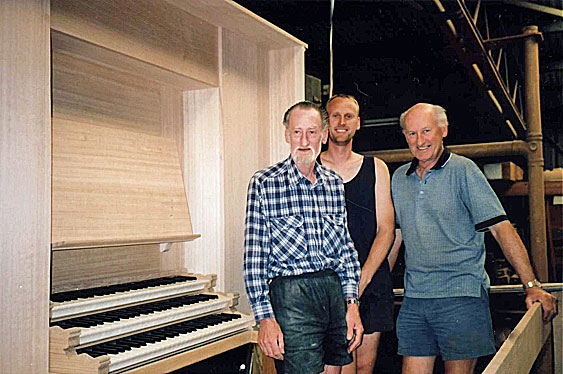
John, Graham and George Stephens with the reconstructed Hill console shell, Lonsdale
[photograph by Steve Kaesler (2006)]
The console was also reconstructed at this time. Excellent photographs survived of the destroyed original and it was possible to use these as a model. The stop layout had also been recorded. New stop jambs, music desk and flat-concave pedalboard were made in Australian oak, and new manual keyboards were supplied by P&S of Brandon, UK, incorporating scrolled key cheeks to Hill & Son patterns, and key profiles matched to other examples of the firm's work. The key platings are in ivory resin as the use of new ivory is now prohibited. In 2013-14 the drawstops were inserted in the console. These are original Hill & Son examples from the 1877 organ reused in 1970. The original ivory stop faces also miraculously survived in storage. Promised by Steve Laurie to the Adelaide City Organist Dr J.V. Peters, he died in the early 1970s and these survived in Laurie's possession and were handed over to OHTA by him in the late 1990s. Only five of these required replacement, some owing to damage, and some as the originals had been lost much earlier on. A new organ bench in Hill & Son style was constructed by David Nitschke while a facsimile Hill & Son brass nameplate was prepared from scanned images of existing examples and produced in brass by a computer-aided cutting device. This has been let into the woodwork above the music desk.
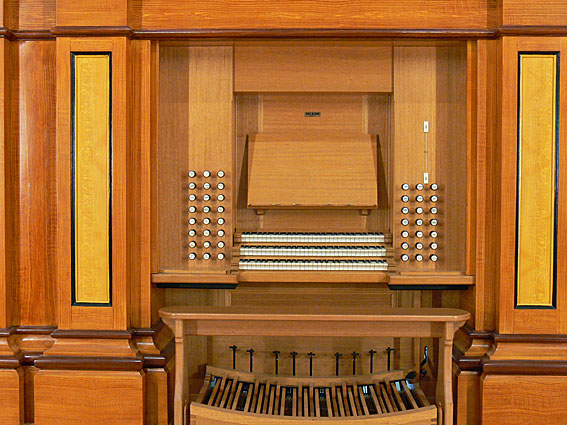
The completed console
[photograph by John Maidment (27 July 2013)]
A new Barker lever machine was made for the Great Organ. This is the first to be made outside Europe or the USA probably since the end of the 19th century. The workmanship is intricate and details copied off the Goulburn organ. Interestingly, it was not possible to test the results until it was installed in the organ at Tanunda, and hooked up to the action and wind.
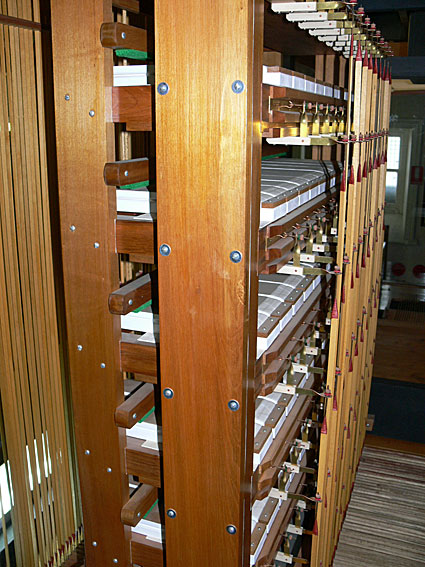
The new Barker machine
[photograph by John Maidment (18 July 2014)]
In 2006, George Stephens closed his factory, so it was necessary at that stage to move all of the mechanical components to Tanunda. Before the move took place, the central part of the stage floor was lowered, as the organ descends almost three metres beneath the level of the main floor. The lowered floor section was stoutly supported on steel posts and concrete pads.
When the main part of the organ was moved, the very tall rear stage door enabled the heavy double-rise wind reservoirs to be craned into position from outside the hall. The building frame was also erected at this time.
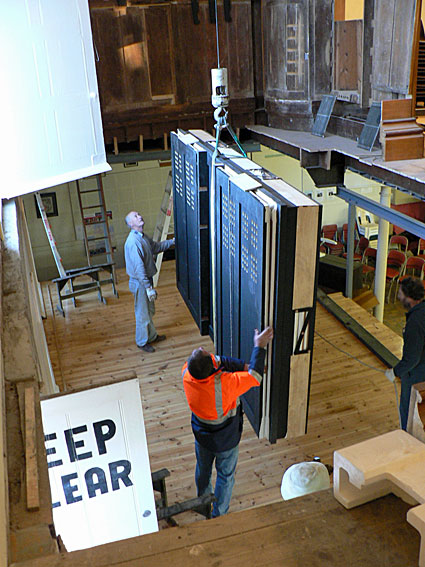
The larger reservoir being craned into position at the Barossa Regional Gallery: note the lowered floor
[photograph by David Shield (28 June 2006)]
The condition of the four sets of slider windchests required immediate attention. These had been very crudely patched in 1970 with chipboard, even using this material for the faceboards – all this was crumbling and falling apart. The tables were full of splits and had been pegged with a colossal quantity of screws while the upperboards had warped. The double pallets had been screwed together. This work was aided by a substantial donation from the Ian Potter Foundation and was carried out in Melbourne by Wakeley Pipe Organs Pty Ltd 2007-2009. The defective windchest tables for the manual divisions were removed and replaced in thick marine ply, which was also used to face the underside of the upperboards. The double pallets were restored, the holes that had been drilled to accommodate clamps were filled, and new faceboards (in solid timber), pulldown wires and pulldown plates installed. Later, new sliders were made for the Great and Swell in a synthetic material as the originals (and some replacements) had warped.
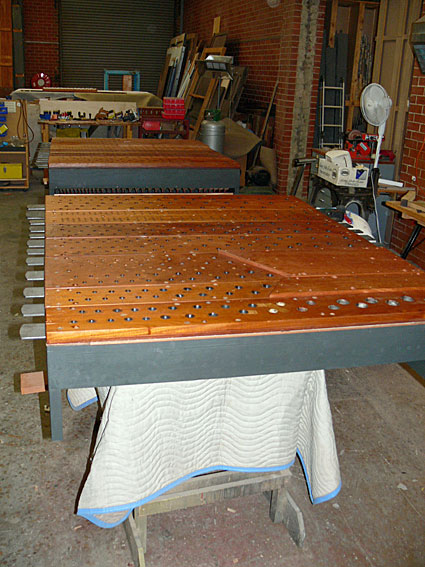
The Great windchests after restoration at the workshop of Wakeley Pipe Organs Pty Ltd, Bayswater, Vic
[photograph by John Maidment (20 February 2009)]
A huge amount of action work had to be reconstructed. The project was most fortunate to have the assistance of a highly-skilled metal worker Irwin Beitz, based in Tanunda. The quality of his work is outstanding in every way and possibly superior to what Hill & Son may have constructed originally. New wooden trackers had to be made up, the ends wound with fine cord and fitted with tapped wires. The original roller boards that survived for the manual divisions were carefully repinned. Very complex new actions were made for the Pedal Organ, these descending to the lower level and then dividing across the organ. It was fortuitous that marks on the building frame and floor plate indicated where square rails had been placed. Manufacture of the new octave and sub-octave couplers for the Swell Organ was again very complex.

Complex actions runs from the rear of the organ showing the sub-octave and octave couplers
[photograph by John Maidment (27 July 2013)]
The stop actions, too, were immensely complex and involved making the connections between the drawstops at the console and the sliders at the windchests. This was carried out using a combination of wooden and steel components. A small diagram discovered amongst the papers of Adelaide organbuilder J.E. Dodd indicated that weights were fixed adjacent to the Swell windchest to facilitate the easy manipulation of the stops, so these were reconstructed. The nine composition pedals also required reconstruction and fortuitously the combinations that these activated were recorded in an Adelaide newspaper in 1877. Fitting of these together involved the fitting of more than 180 felted wooden blocks in a very confined space.
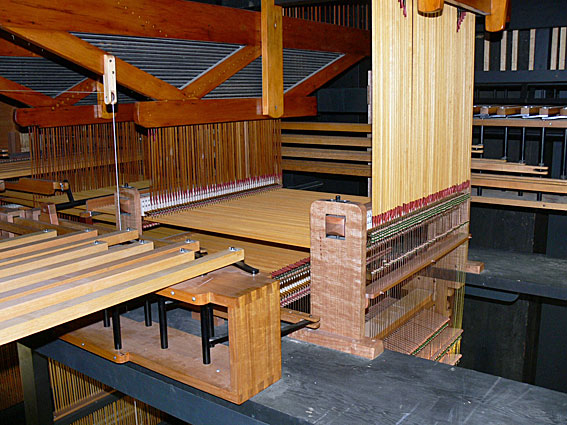
Great and Swell stop actions and square rails for manual actions
[photograph by John Maidment (27 July 2013)]
Assembly of the organ and installation of the windchests, swell box, wind trunking, action and framing took place over a long period of time. Many of the components took considerable time to reconstruct as this required considerable research and patience. Some of the components, such as the windchests, were extremely heavy and had to be hoisted into position very carefully using a block and tackle.
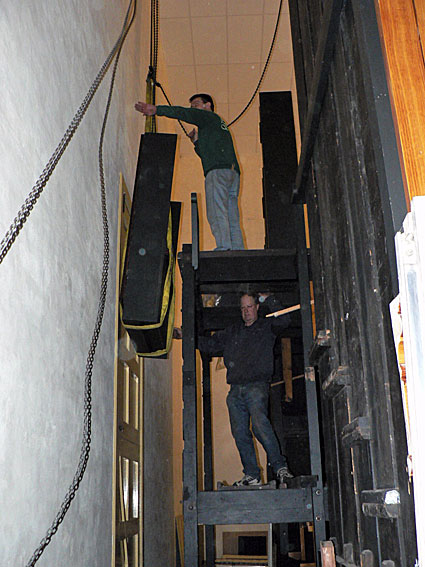
Raising one of the windchests for the Swell Organ
[photograph by David Shield (21 June 2008)]
The majority of the 1877 Hill & Son pipework survived, but six ranks had vanished entirely. These included the Great Twelfth 3ft, converted to the Solo Harmonic Piccolo in 1885 and removed in 1970, the Choir Clarionet 8ft (later removed to the Solo Organ in 1885), the Choir Dulciana 8ft and Voix Celeste 8ft – removed to the Solo Organ in 1885, the Choir Flageolet 2ft and the Pedal Violoncello 8ft (all removed in 1970 and presumably destroyed). Additionally, the tapered pipes of the Choir Cone Gamba and Gemshorn had been cut down and moved to the Pedal Organ in 1970, discarding 28 pipes at the top of the compass for each rank. All of the metal pipework was expertly reconstructed by Tim Gilley, using Hill & Son scalings, metal composition and construction. This was assisted by a generous grant from the Annie Danks Trust. A new Flageolet 2ft, in wood and metal, was reconstructed by George Stephens based upon the Echo Flageolet at Sydney Town Hall, and a second-hand wooden Pedal Violoncello 8ft, made by Hill & Son in 1891 for an organ once in Manly Presbyterian Church, Sydney, was acquired.
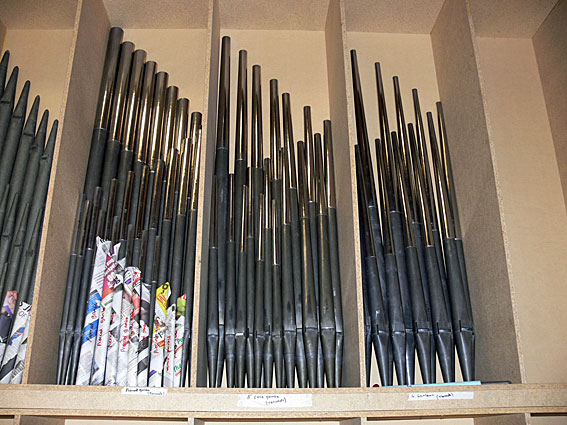
Three of the reconstructed ranks (Pierced Gamba, Cone Gamba, Gemshorn)
at the workshop of Tim Gilley, Bayswater, Vic
[photograph by John Maidment (12 December 2008)]
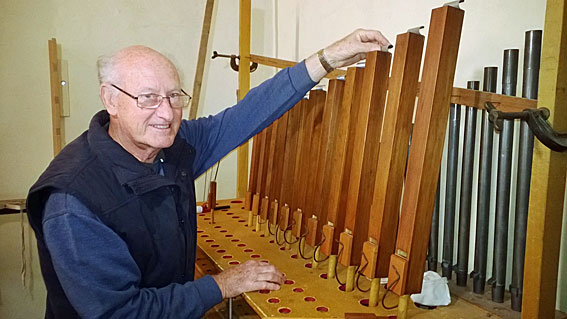
George Stephens voicing the new Flageolet 2ft for the Choir Organ
[photograph by Steve Kaesler (16 June 2014)]
The eight ranks of reed stops were in a parlous state, having suffered from a most unfortunate pitch change in 1939 that involved the addition of a new bottom C pipe and the transposition upwards of the remaining material. Various slots had been cut into the resonators at different times, while the reed tongues required recurving and the shallots refacing. Harmonic trebles had been fitted to the Great and Swell chorus reeds in 1970 and these have been removed and replaced by natural-length resonators. The reed pipes had lost much of their original quality, but this has been fully recovered through expert attention by John Gray, from the South Island Organ Company Ltd, Timaru, New Zealand, where the pipes were shipped for this work to take place.
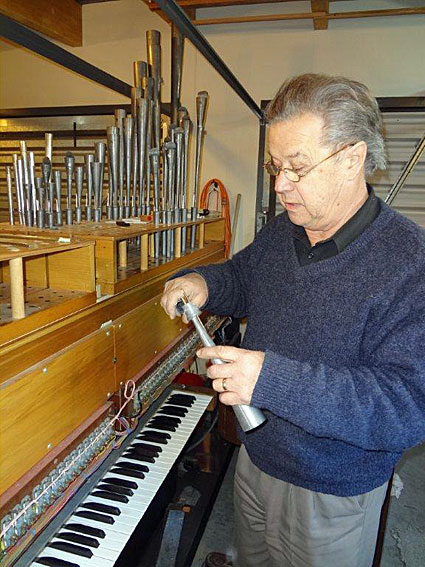
John Gray restoring the Swell Cornopean, Timaru, NZ
[photograph by John Hargraves (1 August 2013)]
The overall pitch of the organ has now been restored to C = 530 (A = 445) at 16 ° Celsius, which in winter descends almost to C = 523 (A = 440), which is known as concert pitch. This has had a remarkable effect upon the overall blend, balance and quality of sound.
Once the two large wind reservoirs were in place, eight runs of wooden trunking had to be made to connect through to the C and C# sides of the individual windchests. These were very long and complex, and the manual trunks were fitted with six sets of anti-concussion bellows in the style of Hill & Son to obviate any unsteadiness. New metal conveyances were made to link the façade pipes (all of which speak) through to the Great Organ windchest. Hand-blowing levers were also fitted to enable the organ to be blown as it was originally. These are operated by very long levers placed at the bottom right hand side of the organ at floor level, and intricately made brass cups enable them to operate smoothly. A drawstop labelled WIND was also added at the console; this is connected to a brass bell that serves to alert the hand blowing to start.
The organ looked visually dismal at Adelaide Town Hall after the casework and façade pipes were covered with a thick coat of white paint in the 1930s, seemingly in an attempt to modernize its appearance. The splendidly stencilled pipes were made to look like rows of cigarettes standing on end, and the casework, elegantly grained in light and dark oak, looked bland and ineffective. The façade pipes have all been redecorated to the original patterns and colours revealed under the white paint. The three flats of pipes above the console were initially redecorated by Marc Nobel, in Melbourne. He also restored and painted the carved wooden keystone centrally placed in the casework, affectionately dubbed 'Ethel Adelaide Hill'.
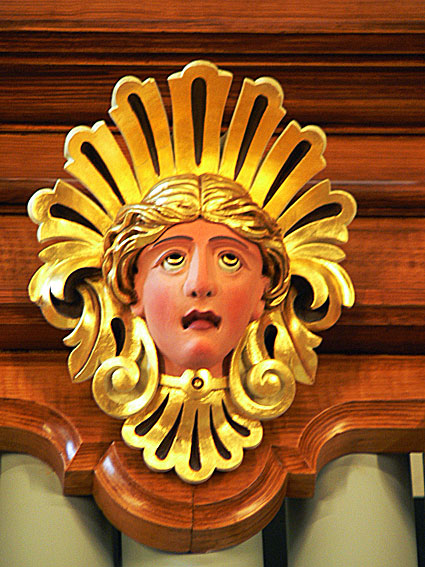
The carved and painted keystone surmounting the organ case
(photograph by Trevor Bunning (16 May 2009)]
The casework had earlier been rubbed back and cleaned by the Friends of the Hill & Son Grand Organ and it was then re-grained by Lyell Rosenzweig, a craftsman based in the Barossa Valley. In 2013, he completed the work on the larger façade pipes and gave the casework a final polish, fully revealing the splendour of the original design. The four urns and two lyres surmounting the case posts were also reconstructed by David Nitschke and copied from the originals which now clothe the 1990 Walker organ at Adelaide Town Hall. It was decided not to reconstruct the very elaborate pediment sculpture that was retained at Adelaide.
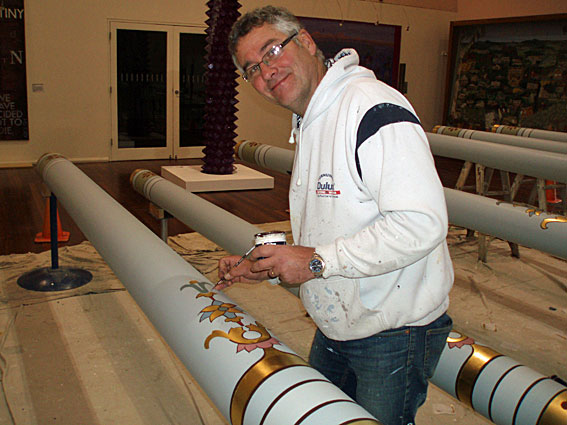
Façade pipe decoration being completed by Lyell Rosenzweig
[photograph by Steve Kaesler (July 2013)]
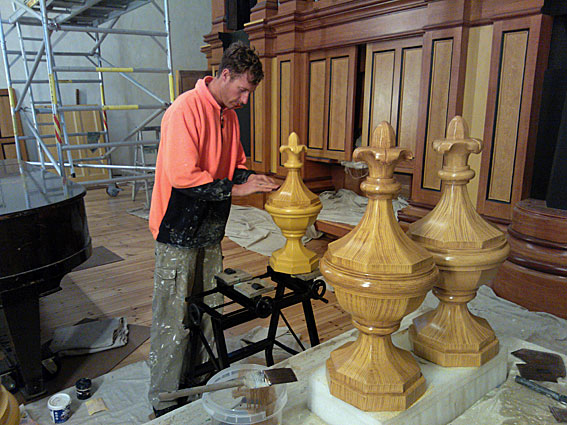
Redecoration of the reconstructed urns and lyres made by David Nitschke
[photograph by Steve Kaesler (18 June 2013)]
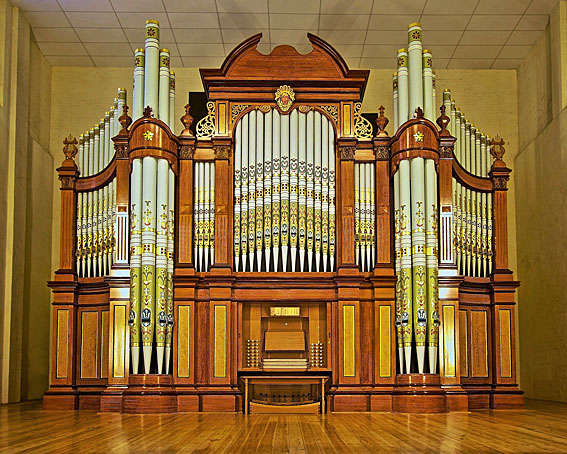
Completed decoration of the organ case and façade pipes
[photograph by Valley Imagery (19 July 2014)]
Finally, much work has taken place in the stage area of the building to enable the organ to be accommodated and function to perfection. The whole area has been repainted, the floor sanded and sealed, new electrical systems and lighting installed, and a new ceiling over the stage fitted, and the roof above replaced. The areas devoted to the organ beneath the stage are surrounded by glass panels so that the mechanisms (including the Barker lever and pedal actions) may be viewed. As the organ occupies a space around 12 metres high, steel ladders have been erected at the rear to intersect the four levels safely and are surrounded by metal safety guards.
The organ occupies five levels, all intersected by a vertical steel ladder:
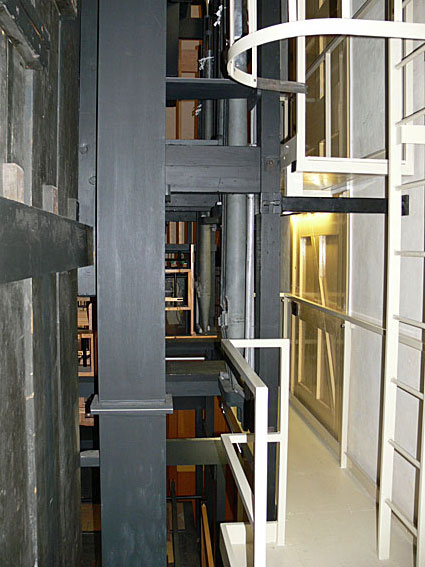
Rear view of organ (from C# side) showing vertical ladder
[photograph by John Maidment (18 July 2014)]
The blower is located on the floor under the organ, housed in a silencing cabinet.
At the next level, the main reservoir, blowing handles, Barker lever, Pedal actions and the bottom 12 notes of the 32ft Double Open Diapason are placed.
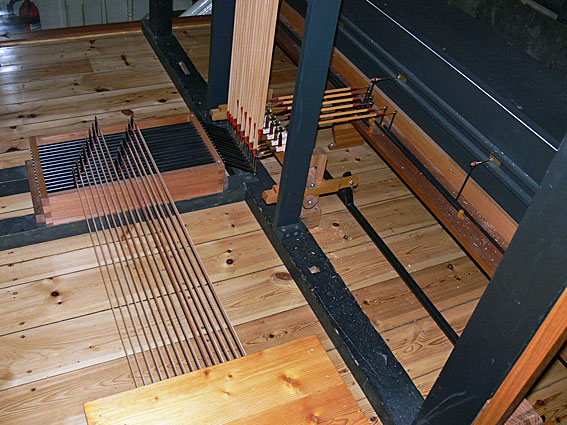
Detail of Pedal roller board and action to 32ft
[photograph by John Maidment (18 July 2014)]
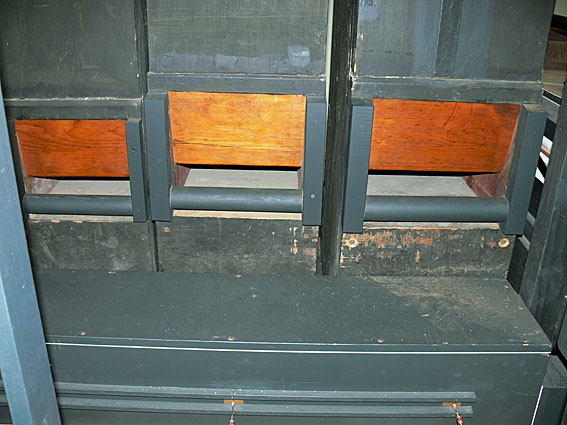
Mouths of the 32ft Double Open Diapason
[photograph by John Maidment (18 July 2014)]
At the level of the stage floor, the two main Pedal windchests are placed, divided C and C#. In the centre, the console is placed, with the key and stop actions sited to the rear.

Detail of Pedal Trombone (showing wooden boots) and Violoncello behind
[photograph by Steve Kaesler (27 June 2014)]
At the next level, the Great and Choir Organ windchests are placed, divided C and C# and all intersected by wide passageboards down the centre of the chests and between the two divisions.
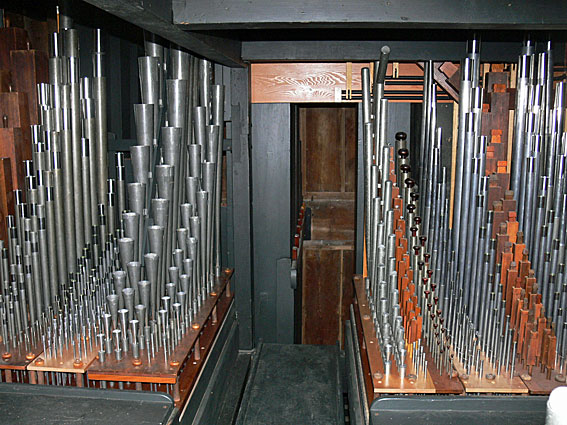
Great (left) and Choir (right) windchests and pipework, viewed across lateral passageboad
[photograph by John Maidment (18 July 2014)]
At the top of the instrument, the Swell Organ is placed, sited in a typical Hill 'dovecote' box, with the longest pipes in the middle of the windchest, horizontal shutters, and tuned via doors down the side of the box. This is placed for optimum tonal projection, and has passageboards located on all four sides of the box, the one at the front fitted with wooden hand rails.

The Swell reeds viewed through the right-hand tuning door
[photograph by Steve Kaesler (27 June 2014)]
The whole is intersected by the very long wooden wind trunks fitted with concussion bellows to stabilize the wind.

The Swell C wind trunk and concussion bellows at the top
[photograph by John Maidment (11 June 2012)]
This is the most important accurate reconstruction of a late-19th century English concert organ ever to have taken place. Hill & Son built around 15 such instruments up to 1900, but regrettably very few survive in a state approaching the original, and many have been destroyed.
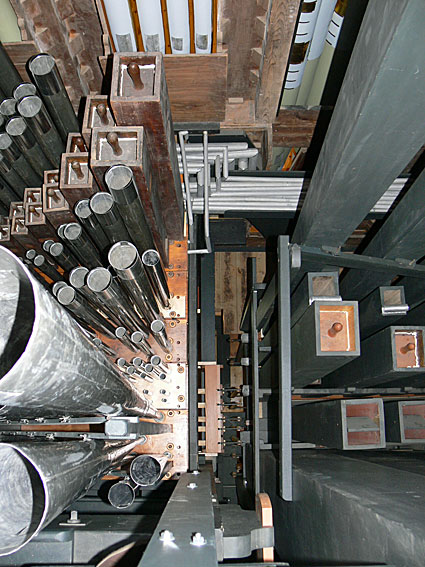
View down C side of Great windchest showing Great and Pedal pipework, conveyances and stop action
[photograph by John Maidment (July 2014)]
The restored organ was reopened at concerts given on 30 and 31 August 2014, the organist being Dominic Perissinotto, from Perth, WA.
GREAT 58 notes |
|
|
4 composition pedals to Great
3 composition pedals to Swell
2 composition pedals to Pedal
Lever swell pedal
Mechanical key and stop action, with Barker lever assistance to Great and couplers
Optional hand or electrical blowing with wind indicator at console
Drawstop labelled 'Wind' with bell to alert hand blowing to start
Wind pressures: all pipework on 3 inch wind; Barker lever on 6 inch wind
Great Full Mixture: C – c○: 1⅗, 1⅓, 1; c#○ – c1: 2, 1⅓, 1; c#1 – a3: 4, 2⅔, 2
Great Sharp Mixture: C – c○ ⅔, ½ ; c#○ – c1: 1, ⅔; c#1 – c2: 1⅓, 1; c#2 – f3: 2⅔, 2; f#3 – a3: 4, 2⅔
Swell Mixture: C – f#○: 1⅗, 1⅓, 1; g○ – a#1: 2, 1⅓, 1; b1 – a3: 4, 2⅔, 2

Left-hand stop jamb showing restored stop labels
[photograph by Steve Kaesler (25 June 2014)]
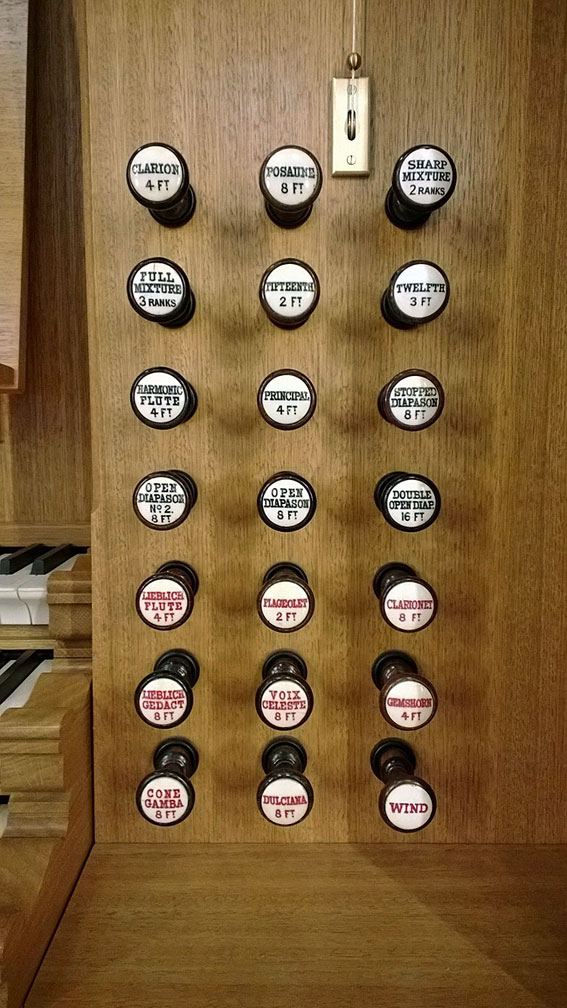
Right-hand stop jamb showing restored stop labels
[photograph by Steve Kaesler (25 June 2014)]
Organbuilder
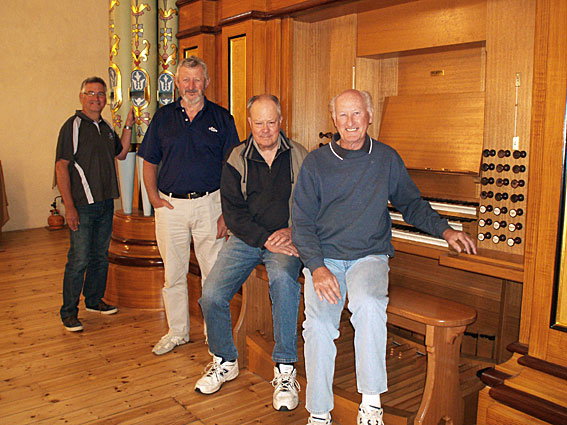
Lyell Rosenzweig, David Nitschke, Irwin Beitz and George Stephens at the restored console
[photograph by Steve Kaesler (13 April 2013)]
Assistance in the project has been provided by:
Donors to the project
The Organ Historical Trust of Australia acknowledges the generous donations of $10,000 or more from the following major sponsors:
Also acknowledged are the significant in-kind contributions from the following companies and organisations:
View the progress reports of the restoration here.
View the report on the opening of the restored organ here.
View the Conservation Report here.
1 http://theclubhousebarossa.com.au/?page_id=67, accessed 18 August 2014
2 http://www.ohta.org.au/resources/Hill-records/Estimate-Book-2.htm
http://www.ohta.org.au/resources/Hill-records/Shop-Book-2.htm
3 South Australian Register 3 October 1877, p.6
4 Details noted by John Maidment from the Fincham & Hobday correspondence housed in the George Fincham archive at the State Library of Victoria; also during a visit to the organ January 1966 and later notes on the fate of the material
5 Edward Godfrey, 'The Organ in the Town Hall of Adelaide, South Australia', The Organ vol.XXV no 97 (July 1945), pp.36-40.
6 Notes by John Maidment during visits to the organ in 1972, 1973
7 Information kindly supplied by David Shield