Holy Trinity Catholic Church
Westbury
c.1880 William Anderson; opened February 1881.
Ren 2007 Laurie Pipe Organs. 2m., 17 sp.st., 3c., tr.
Gt: 8.8 divided.8.8.4.4.2-2/3.2.8. Sw: 16.8.8.4.2.8.8. Ped: 16.
Historical and Technical Documentation by John Maidment
© OHTA (last updated May 2011)
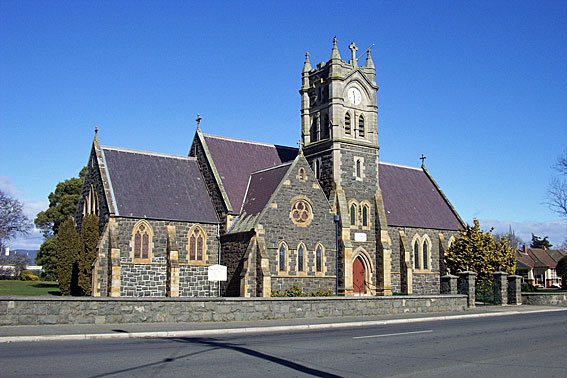
Holy Trinity Catholic Church, Westbury: exterior from north-east
[photograph by Evie Parol (24 August 2007)]
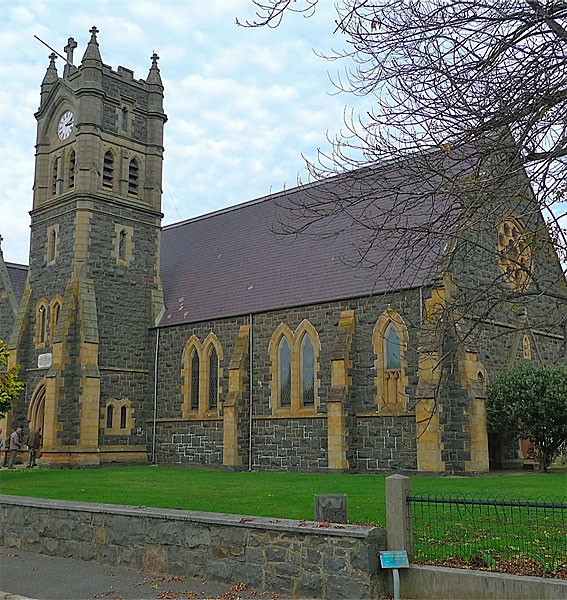
Holy Trinity Catholic Church, Westbury: exterior from north-west
[photograph by Trevor Bunning (30 April 2011)]
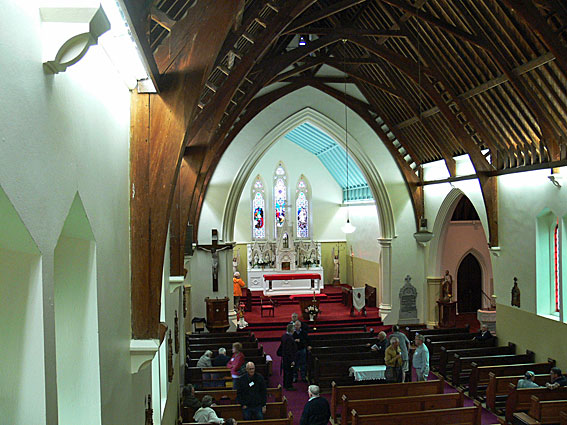
Holy Trinity Catholic Church, Westbury: interior from west gallery
[photograph by John Maidment (30 April 2011)]
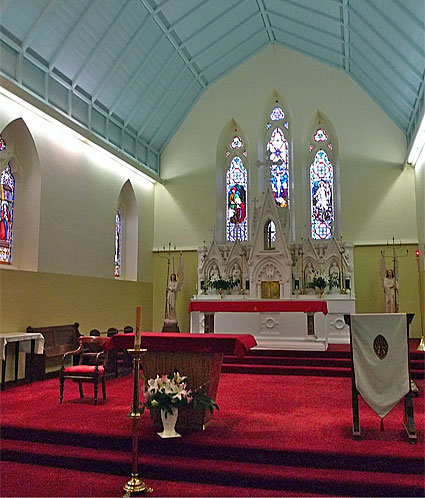
Holy Trinity Catholic Church, Westbury:
interior showing high altar, reredos and stained glass
[photograph by Trevor Bunning (30 April 2011)]
This large cruciform bluestone church in the Decorated Gothic style was begun in 1869 and the building consecrated in 1874. It was designed by Henry Hunter, Tasmania's most prolific Victorian architect. The tower was added early this century.1 The marble high altar and reredos were designed by Alexander North.
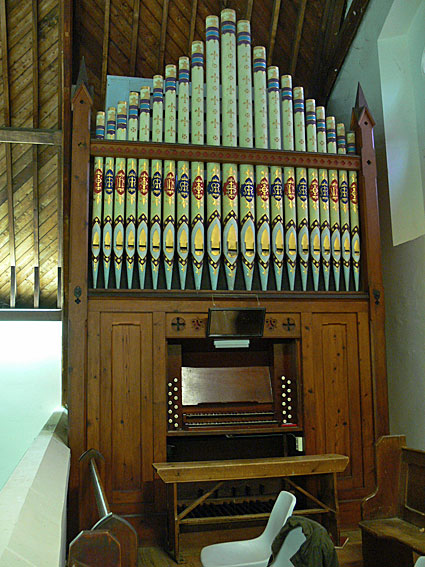
Holy Trinity Catholic Church, Westbury: organ
[photograph by John Maidment (30 April 2011)]
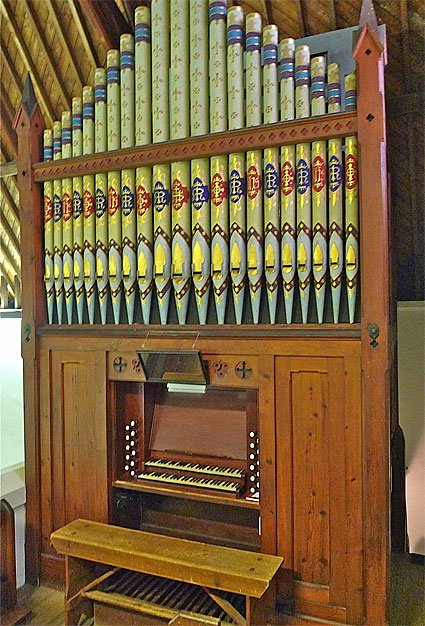
Holy Trinity Catholic Church, Westbury: organ
[photograph by Trevor Bunning (30 April 2011)]
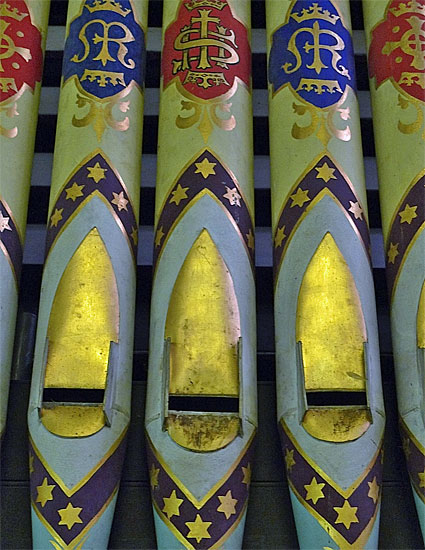
Holy Trinity Catholic Church, Westbury: detail of pipe stencilling
[photograph by Trevor Bunning (30 April 2011)]
The organ was built by Melbourne organbuilder William Anderson (1832-1921) and opened in February 1881; its cost was £500.2 The opening of the organ was described in a contemporary report:
The grand organ purchased by the Rev. Father Hogan for the Church of the Holy Trinity was solemnly inaugurated on Sunday last by ceremonies of a very imposing character. The instrument itself was built by Mr. Anderson, of Flinders-lane, Melbourne, and is 9ft. 4in. Wide by 14ft. Deep, and 17ft. High. It is encased in varnished pine, the front pipes being beautifully painted and ornamented with religious monograms. There is a double row of keys and nineteen stops. The organ gallery, at the west end of the church, was too narrow to allow of it being placed there, so that it stands for the present at least on an elevated platform on the ground floor, and cost £465. The united choirs of the Church of the Apostles, Launceston, and of the Holy Trinity, Westbury, were under the leadership of Herr Carl Schmitt, the orchestra being conducted by Mr. George Collins, of Launceston. The Mass sung on the occasion was Farmer's, in B flat, composed especially for the consecration of St. Barnabas' Church, Nottingham, built by the late Bishop Willson, of Hobart; and all who were present on Sunday last must have been charmed with the manner in which the full choir executed such beautiful music. Miss Ellis presided at the organ, and deserves great praise for the ability displayed on that occasion.3
It is one of the few surviving original works of its maker, retaining its pipework, action, console and ornately diapered façade pipes, their decoration based upon designs from Pugin's The Glossary of Ecclesiastical Ornament and Costume of 1844.4 It is comparable with the 1888 William Anderson organ at the Uniting (formerly Methodist) Church, Daylesford, Victoria which also survives in a state of high originality. Renovation work was carried out by Richard Duncan, of Laurie Pipe Organs Pty Ltd, in 2007 at which time repairs were made to the pipework and action.5 While in need of a comprehensive restoration, the instrument produces a very bright and coherent sound, with a particularly pleasing Great chorus and a very fiery Swell Cornopean.
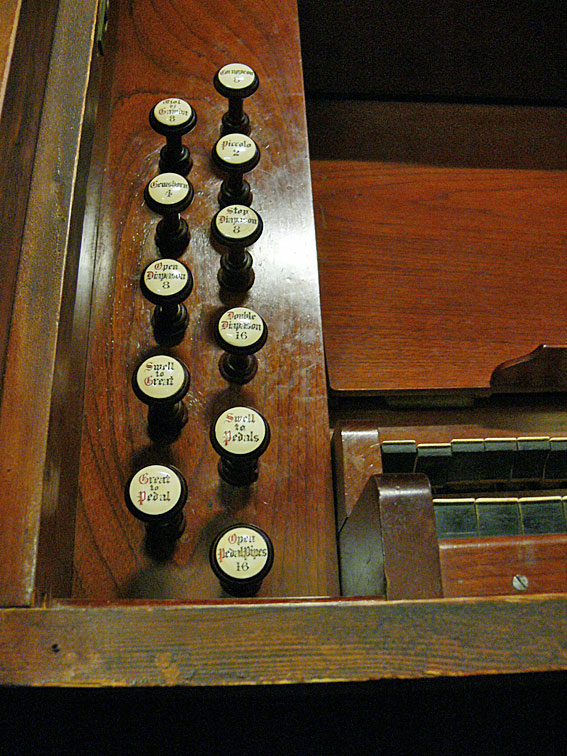
Holy Trinity Catholic Church, Westbury: left hand stop jamb
[photograph by John Maidment (30 April 2011)]
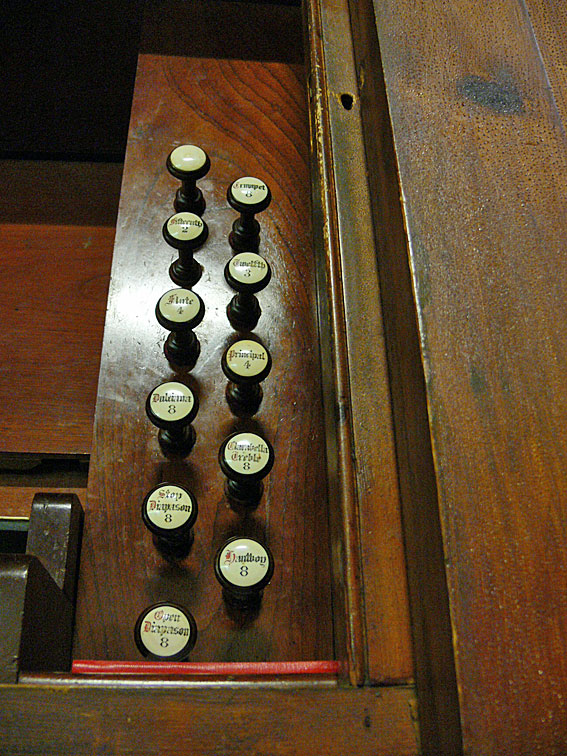
Holy Trinity Catholic Church, Westbury: right hand stop jamb
[photograph by John Maidment (30 April 2011)]

Holy Trinity Catholic Church, Westbury: pedal action and feeders
[photograph by John Maidment (30 April 2011)]
It appears that the drawknobs for the Viol di Gamba and Hautboy have been interchanged. The Viol di Gamba is now placed on the Swell Hautboy slide, but the slide on the Great labelled Hautboy is vacant. There is an additional blank knob on the Great jamb placed above the Trumpet, but its purpose is unclear. There are no pipes present for the Great Trumpet, Swell Double Diapason and Hautboy.
GREAT
Open Diapason
Stop Diapason [bass]
Clarabella
Dulciana
Principal
Flute
Twelfth
Fifteenth
Trumpet
Hautboy
blank knob
SWELL
Double Diapason
Open Diapason
Stop Diapason
Viol di Gamba
Gemshorn
Piccolo
Cornopean
PEDAL
Open Pedal Pipes
COUPLERS
Great to Pedal
Swell to Pedal
Swell to Great
|
8
8
8
8
4
4
3
2
8
8
16
8
8
8
4
2
8
16
|
CC-BB
TC
TC
TC
*
*
*
**
|
5 composition pedals
* prepared-for trigger swell lever
** on reed slide mechanical key and stop action
compass: 58/306
1 Priceless Heritage: Historic Buildings of Tasmania (Hobart: Platypus Publications, 1964), pp.120, 131.
2 Brian Clark & Michael Johnson, Pipe Organs of Tasmania. 3rd ed. Hobart, Tas.: Hobart Organ Society, 2002, see under organ 64
3 The Mercury, 24 February 1881, p.3
4 Information kindly supplied by Brian Andrews. These patterns were later extensively employed by Anderson for organs sited in Catholic churches with their cartouches enclosing the monograms IHS, MR and sometimes the saint's initials, such as SJ (= St James).
5 Mark Tuckett, 'The William Anderson Organ at Holy Trinity Catholic Church, Westbury, Tasmania; "A Devious Plot Foiled" ', OHTA News, vol. 32, no. 1 (January 2008), pp.20-24
6 Ibid.