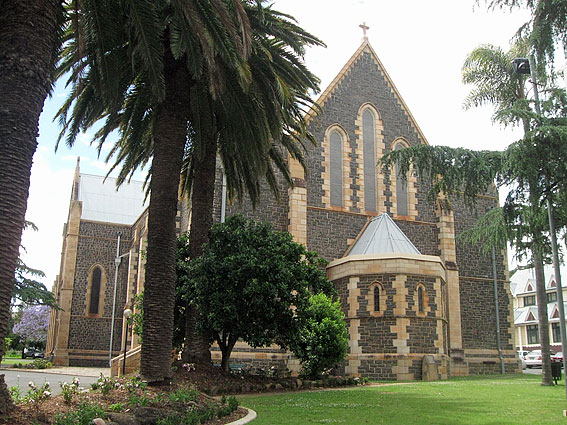
St Luke's Anglican Church, Toowoomba
[Photograph by Phillip Gearing (December 2008)]
St Luke's Anglican Church, Toowoomba
[Photograph by Phillip Gearing (December 2008)]
Historical and Technical Documentation by Geoffrey Cox
© OHTA 1998, 2011 (last updated December 2011)
The first building on the site of the present St Luke's Anglican Church, Toowoomba, was a small timber slab construction, built as a church and school in 1857. At that time, nearby Drayton was a larger settlement. By the time Toowoomba became the centre of the Darling Downs in the late 1860s, the Church of England had established St James' Church, Toowoomba, not far away, as the major church. St Luke's languished until 1891, when Toowoomba was divided into northern and southern regions. In 1892, the Diocesan Architect, J.H. Buckeridge, a pupil of J.L. Pearson, was commissioned to design a new church. The foundation stone of the present bluestone building was laid in 1895, and the church was dedicated in 1897. The chancel and north transept were added in 1959, replacing a former temporary wooden chancel. The south transept remains to be built.1
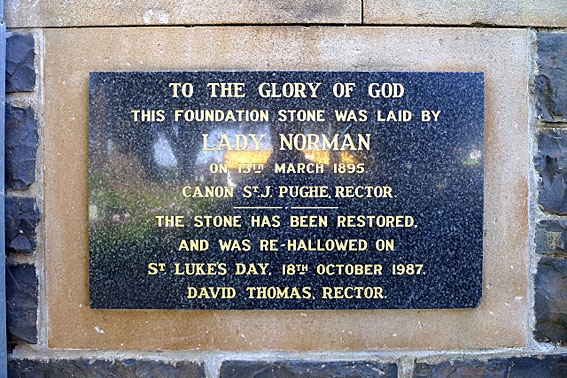
Foundation stone of the present church, 1895
[Photograph by Trevor Bunning (November 2011)]
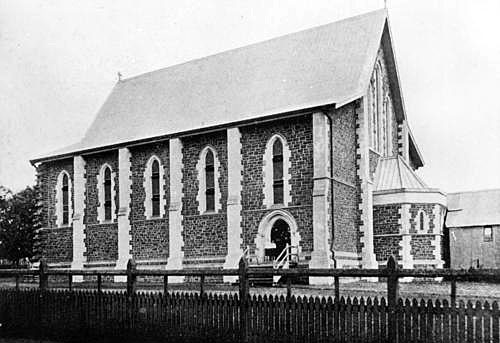
St Luke's Church of England, Toowoomba, c.1902
[Photograph: John Oxley Library, State Library of Queensland]
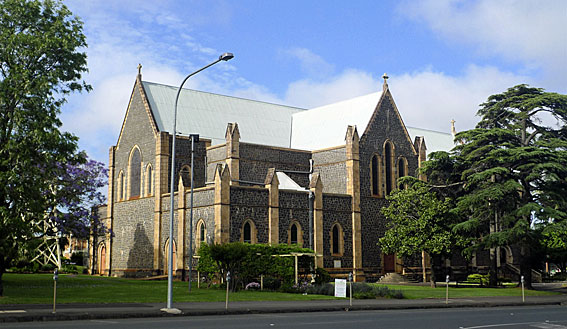
North transept and other additions made in 1959
[Photograph by Trevor Bunning (November 2011]
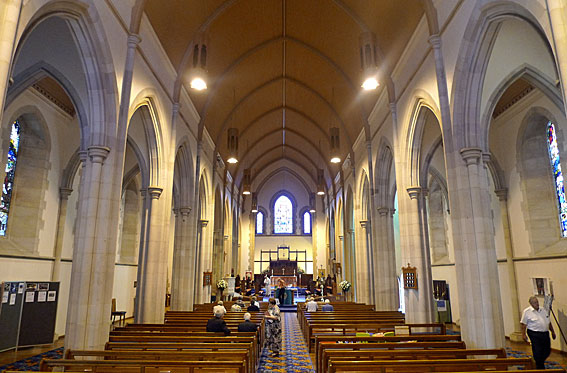
General interior view of St Luke's Church, Toowoomba
[Photograph by Trevor Bunning (November 2011)]
The organ was built in 1907 by Norman & Beard of London. The order-book entry was dated 19 November 1906, and the cost (including delivery) was given as £744. The instrument was to be erected by Messrs B.B. Whitehouse & Co of Brisbane, and the original specification was as follows:
| GREAT Open Diapason [No 1] Open Diapason [No 2] Clarabella Dulciana Principal Harmonic Flute Clarinet [Ten.C] SWELL Bourdon Geigen Principal Lieblich Gedact Salicional Voix Celeste [Ten.C] Gemshorn Mixture Horn Oboe PEDAL Open Diapason Bourdon Bass Flute COUPLERS Swell to Great Swell Octave Swell Octave to Great Swell to Pedal Great to Pedal |
8 8 8 8 4 4 8 16 8 8 8 8 4 III 8 8 16 16 8 |
wood wood wood/metal wood wood A wood A pneumatic pneumatic pneumatic mechanical mechanical |
Swell tremulant
Compass: 58/30
3 composition pedals to Great Organ
3 composition pedals to Swell Organ
Lever swell pedal
Pneumatic action.2
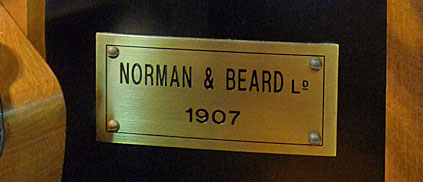
The Norman & Beard nameplate, 1907
[Photograph by Trevor Bunning (November 2011)]
The organ was shipped by the steamer Chanda, and arrived in Brisbane on 11 September 1907.3 It was opened and dedicated at St Luke's, along with new choir stalls, on Thursday 17 October. A newspaper report of the day provides details of the occasion:
TOOWOOMBA, October 17.
The annual festival of St Luke's Church of England was continued this evening, when a service was held in the church for the purpose of dedicating the new pipe organ and choir stalls. The service was of a simple nature and was conducted by Archdeacon Rivers, assisted by the rector, the Rev Canon Oakeley. The choir rendered the anthem "He watching over Israel," the lady members of the choir being arranged for the first time in their most becoming surplice and dress with college cap. The Archdeacon preached an appropriate sermon.
The new stalls are made of cedar from a design supplied by Mr Wm Hodgen, A.R.I.B.A., architect, Toowoomba, and the construction was carried out by Mr. Hiram Philp, of Toowoomba. The stalls were erected as a memorial to the late Mr. J. R. Warner (one time land commissioner at Toowoomba), who acted as church-warden for many years, and always took a keen interest in the welfare of the church. The stalls are capable of accommodating fifty-six persons, and harmonise with the other church decorations. The new pipe organ is a handsome instrument. It was partly built by Messrs. Norman and Beard, of Norwich, England, and partly by the Queensland agents for that firm, Messrs. B. B. Whitehouse and Co., of Brisbane. The construction of the instrument was in the capable hands of Mr. J. H. Whitehouse (of Messrs. Whitehouse and Co.), and everything was carried out without a hitch under his guidance. The organ has nine swell stops, seven great organ stops, three pedal organ stops, five couplers, and one tremulant stop. The organ has two manuals and pedals, and the usual accessories, contains close on 1100 pipes, and there are two sets of bellows, which have the latest pneumatic action. The various parts of the organ are securely protected. So that vermin cannot damage the organ proper. Mr. Whitehouse considers the organ the best in the State for its size, the tone being excellent, and the reed and flute work of the best. The fittings and mouldings in connection with the organ were carried out by Messrs. Rosenstengel and Kleimeyer, Toowoomba.
The organ was purchased for £750, the money being the bequest of the late Mrs. F. C. Brodribb, and was erected to her memory. The cost of bringing the instrument out, the erection, and other charges, amounting to close on £400, was borne by the church. The rector (Canon Oakeley), Messrs. F. G. Hooper (rector's warden), W. J. Spalding (people's warden), and J. H. Jones (member of the council), have been untiring in their efforts to bring all arrangements to a successful issue, and the satisfactory result must be pleasing to all concerned.4
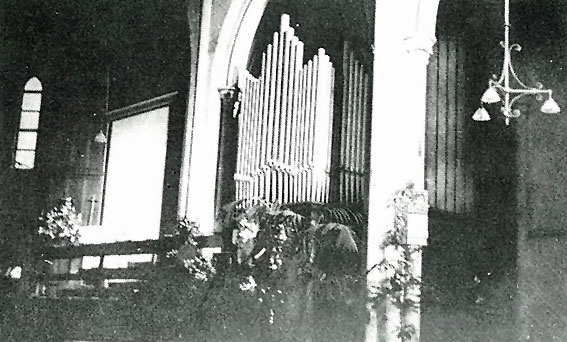
The organ in its original position in the nave at St Luke's
[Photograph from Max Brightman (ed.), The Organ and Organists
of St Luke's Anglican Church, Toowoomba (1995)]
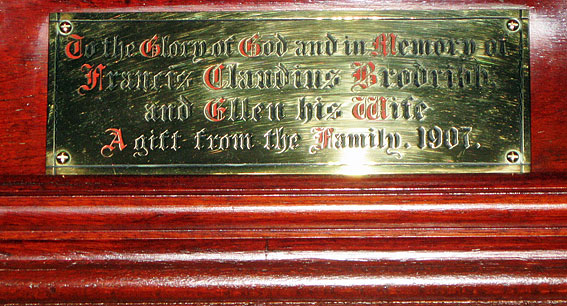
The Brodribb memorial plaque (1907)
[Photograph by Phillip Gearing (December 2008)]
The organ was installed originally in the south-east corner of the nave. Following the opening on Thursday 17 October 1909, a recital was given on the instrument by Mr George Sampson, organist of St John's Cathedral, Brisbane, on St Luke's Day, Friday 18 October. The organ was originally hand blown, and it was not until the 1950s that an electric blower was supplied.5
Following the enlargement of the church in 1959, the organ was re-located to the present organ loft by H.W. Jarrott of Brisbane in 1960. Jarrott provided a new detached console with balanced swell pedal, extended the manual compass to 61 notes, and electrified the action. He also provided additional couplers and three additional pedal stops (Acoustic Bass 32ft, Quinte 10-2/3ft, Principal 8ft) by extension from the existing ones. On the console, he prepared for two further Great stops (Stop Diapason 8ft & Fifteenth 2ft), which were never added.6
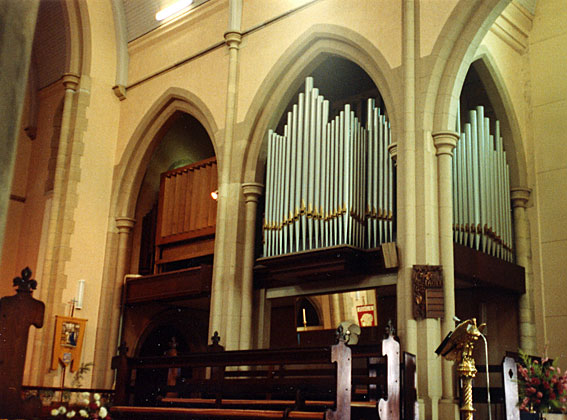
The organ re-located to the new loft in 1960,
showing the exposed swell box at that time
[Photograph by Howard Baker (early 1990s)]
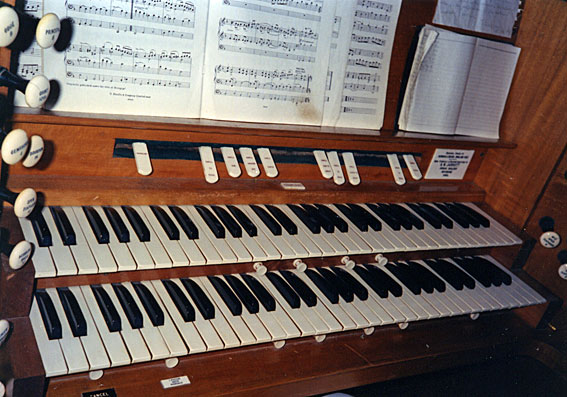
The Jarrott console of 1960
[Photograph by Howard Baker (early 1990s)]
The organ was maintained for many years by Mr Walter Emerson, organist of St Luke's Church from 1953 to 1977, but by the early 1990s its condition had deteriorated seriously.7 The historic worth of the instrument was recognised through formal classification by the National Trust in 1993, and this led to a thorough renovation of the instrument in 1994-95 by W.J. Simon Pierce of Brisbane.8

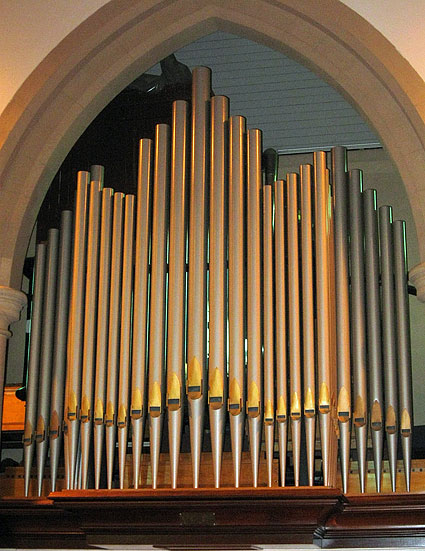
The organ following the rebuild of 1995,
[Photographs by Phillip Gearing (December 2008)]
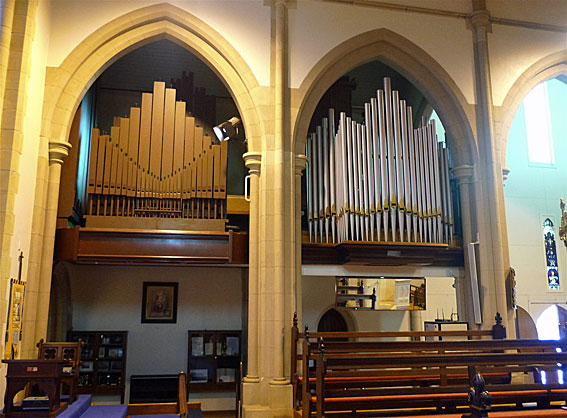
Pedal pipes relocated to the loft on the left in 1995
[Photograph by Trevor Bunning (November 2011)]
The work undertaken in 1994-95 by W.J. Simon Pierce included full restoration of pipework and soundboards, improvements to the wind system (with the blower re-located in the organ loft), refurbishment of the 1960 console (including new glass doors), returning of the manual compass to 58 notes, and the addition of a Great Trumpet 8ft stop. Jarrott's Pedal Quinte 10-2/3ft was deleted, and some Pedal Open Diapason pipes that had previously been located in the sanctuary were re-located to the organ loft. The Swell and Great soundboards were repositioned to speak down the nave by being turned ninety degrees. An earlier plan to add a third manual to the organ, using materials previously constructed by Walter Emerson, was abandoned.9 In 1997, a new pneumatic stop action was fitted by Simon Pierce, modeled on the original Norman & Beard stop action that had been removed in 1960.10
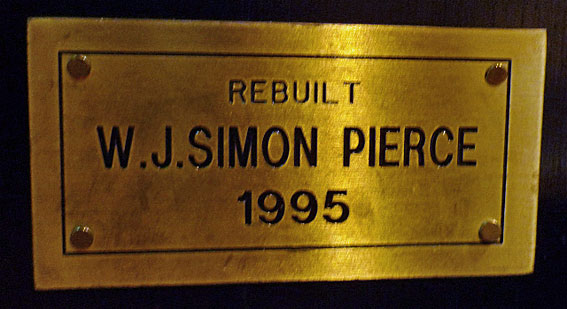
Organ builder's nameplate marking the rebuild of 1995
[Photograph by Trevor Bunning (November 2011)]
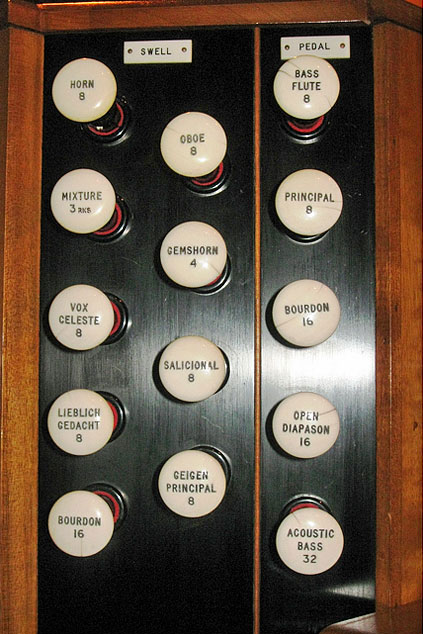
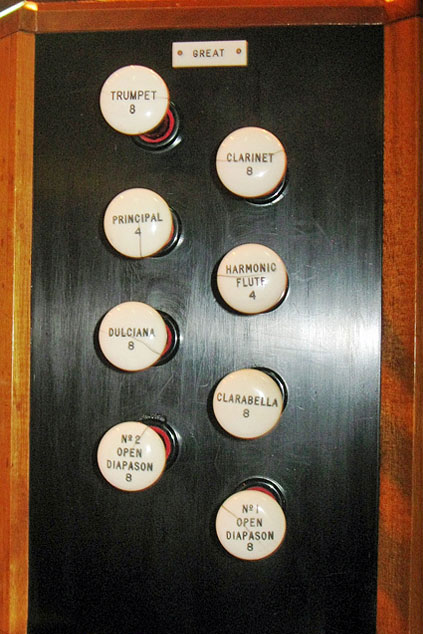
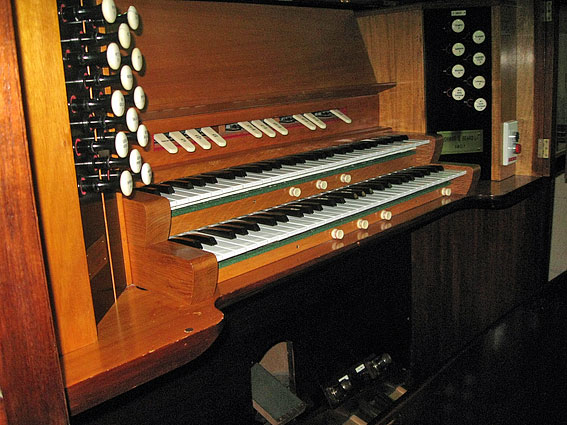
Console details following the rebuild of 1995
[Photographs by Phillip Gearing (December 2008)]
| GREAT Open Diapason No 1 Open Diapason No 2 Clarabella Dulciana Principal Harmonic Flute Clarinet [Ten.C] Trumpet SWELL Bourdon Geigen Principal Lieblich Gedacht Salicional Vox Celeste [Ten.C] Gemshorn Mixture Horn Oboe PEDAL Acoustic Bass Open Diapason Bourdon Principal Bass Flute COUPLERS Great to Pedal Swell to Pedal Swell to Great Swell Sub Swell Unison Off Swell Super Swell Sub to Great Swell Super to Great Great Super |
8 8 8 8 4 4 8 8 16 8 8 8 8 4 III 8 8 32 16 16 8 8 |
A & B A B A B |
[1995] [1960] [1960] [1960] [1960] [1960] [1960] |
Swell tremulant
Compass: 58/30
Detached draw-stop console
Balanced swell pedal
3 composition pistons to Great & Pedal
3 composition pistons to Swell
3 reversible toe studs - Swell to Great, Swell to Pedal, Great to Pedal
1 reversible toe stud - Tutti
Electro-pneumatic action.11
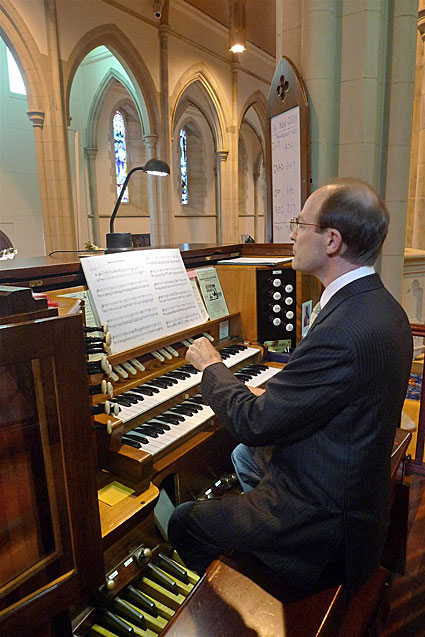
Phillip Gearing at the console
[Photograph by Trevor Bunning (November 2011)]
________________________________________________________________________
1 Queensland Heritage Council, Queensland Heritage Register, location 601878; Donald Watson & Judith McKay, Queensland Architects of the 19th Century: A Biographical Dictionary (Brisbane: Queensland Museum, 1994), pp. 25-26.
2 Norman & Beard Order Book, pp. 26 & 28 (Job No. 816), cited in Max Brightman (ed.), The Organ and Organists of St Luke's Anglican Church, Toowoomba: A Booklet to Commemorate the Restoration of the Norman & Beard Organ, 1995 (Toowoomba: St Luke's, 1995), p. 12.
3 The Brisbane Courier (12 September 1907), p. 2.
4 The Brisbane Courier (18 October 1907), p. 2.
5 Brightman, pp. 13-16.
6 Specification noted by G. Cox, 1974, and personal communication to G. Cox from Walter Emerson (organist 1953-77).
7 Phillip Gearing, 'The Organ of St Luke's Anglican Church, Toowoomba: An Historical Account, 1907-93,' OHTA News, vol. 17, no. 3 (July 1993), pp. 5, 17, 19-21 [ a slightly earlier version of this article appeared in The Organ Voice, vol. 19, no. 6 (June 1992), pp. 6-11].
8 The Organ Voice, vol. 21, no. 2 (Spring 1993), pp. 79-80; Brightman, p. 21.
9 OHTA News, vol. 18, no. 4 (October 1994), p. 8; W. J. Simon Pierce, 'The Restoration of the Organ at St Luke's Toowoomba: The Organ Builder's Account,' The Organ Voice, vol. 23, no. 2 (June 1997), pp. 5-10 [also included in Brightman, pp. 25-32]; personal communication to G. Cox from Phillip Gearing, May 2003.
10 The Organ Voice, vol. 23, no. 4 (December 1997), p. 28; OHTA News, vol. 22, no. 2 (April 1998), p. 12.
11 Brightman, p. 39; with additional details noted by G. Cox, 1974, and Phillip Gearing, 2003.