
St George's Uniting Church, East St Kilda
[Photograph by Simon Colvin (October 2009)]
St George's Uniting Church, East St Kilda
[Photograph by Simon Colvin (October 2009)]
Historical and Technical Documentation by John Maidment and Geoffrey Cox
© OHTA, 2011, 2015 (last updated June 2015)
St George’s Church was designed by architect Albert Purchas. The foundation stone of the first section, comprising the western section of the nave, was laid by Sir James McCulloch KCMG on 21 April 1877 and the first service held on 1 October 1877. Transepts and the apse were added and the completed building opened on 3 October 1880, this being due to the ‘enthusiasm and liberality’ of McCulloch, a former premier of Victoria. The Australasian Sketcher noted that the total length of the building was 118ft 6 in, by 40ft wide and that the striking octagonal tower to the north-west was 110ft 6 in high. The exterior was constructed from brick, on a bluestone plinth, and the dressings were executed in Waurn Ponds freestone. The stained glass windows were all by Ferguson & Urie.1
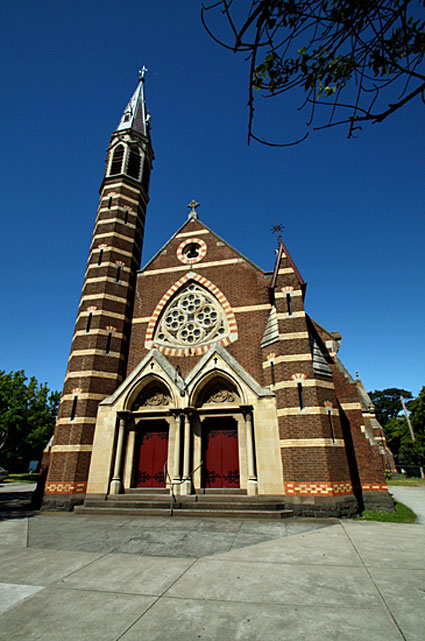
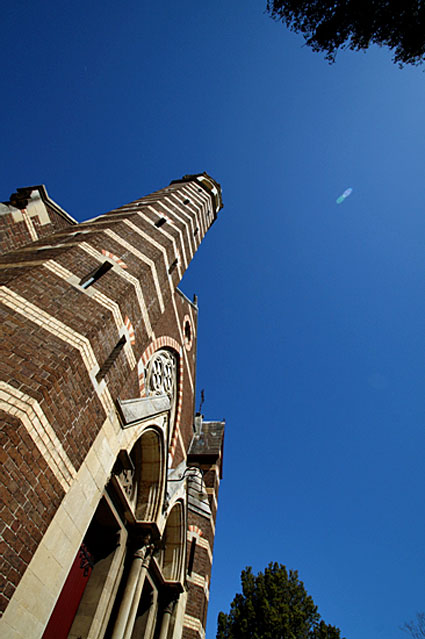
St George’s Uniting Church, East St Kilda: exterior
[Photographs by Simon Colvin (October 2009)]
Albert Purchas had previously designed parts of Christ Church, Brunswick, Christ Church, St Kilda, St George’s, Queenscliff (a pastiche of the medieval Skelton Church, Yorkshire) and St Luke’s, Yea, but St George’s was certainly his ecclesiastical tour-de-force. It was probably the first major church design in Melbourne, in which polychrome brickwork had been lavishly employed both externally and internally.
The building, which is listed on the Victorian Heritage Register, was leased by St Michael's Grammar School from 1990 and sold to the school in 2014. It now forms part of the school's performing-arts complex, in which the organ is not required.
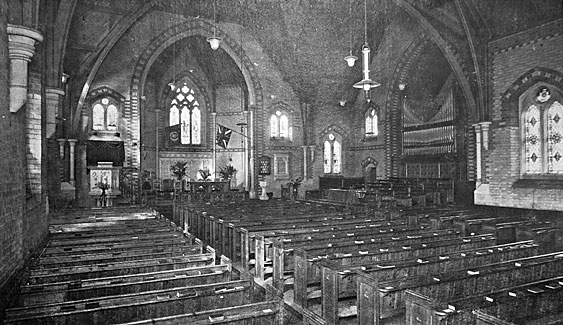
St George’s Uniting Church, East St Kilda:
interior showing the organ case with its original pierced panelling
[Photograph from Uniting Church Archives]
First Organ.
George Fincham of Melbourne agreed in May 1880 to build an organ of 2 manuals and 20 speaking stops for St George's Church at a cost of £600. Because he was already engaged in work on the Exhibition Organ, however, he was unable to promise delivery in time for the re-opening of the church.2 Fincham gave the church the option of cancelling the contract, and agreed to provide a small temporary organ to be installed in the church by 26 September.3
The temporary organ was offered for sale in February 1883. Writing to Mr C.H. Davies regarding an organ for All Saints' Anglican Church, Northcote, Fincham described the instrument as follows:
Dear Sir,
Yours of 9th inst. to hand containing information re Organ for All Saints Ch. Northcote.
I beg to inform you that I have a small organ of my own build, which I lent to St. George's Presbyterian Church St Kilda, while their organ was being built, as it has been in use long enough to prove its reliability.
The dimensions are:-
Width
Depth
Height
4 ft 1-1/2 ins
9 ft 6 ins
It contains the following:-
1. Open Diapason
2. Stop Diapason (Bass)
3. Claribel
4. Principal
5. Flute
6. Fifteenth
Pedal Bourdon
12 pipes
44 pipes
56 pipes
44 pipes
56 pipes
12 pipes
8ft
8ft
4ft
4ft
2ft
16ft
Coupler Manual to Pedal
German pedal clavier. Compass 29 notes
Compass of manual CC to G 56 notes
Case: Oak grained & varnished
with illuminated pipes in front.
The whole enclosed in a swell box.
Price in the factory £130 One hundred and thirty pounds.4
Mrs Matthews claimed, perhaps speculatively, that this organ went initially to the Presbyterian Church, Alma Road, St Kilda, and then to St Alban's Anglican Church, Armadale (now Coptic Orthodox).5 The supposed connection with the Alma Road and Armadale churches seems, however, to be incorrect. William Anderson built a two-manual organ for the Presbyterian Church, Alma Road, opened on 4 May 1880,6 and it was this instrument that went to St Alban's Church, Armadale, in 1892.
The subsequent history of the 1880 organ remains unknown.
Present Organ.
The present organ at St George's Church was built in 1881 by Thomas Christopher Lewis of London. It was a two-manual organ of 15 speaking stops and three couplers.

The present organ at St George's Uniting Church, East St Kilda:
interior showing the organ case with its altered front panelling
[Photograph by John Maidment (March 2014)]
The choice of builder was due to the organist at St George’s, Thomas Brentnall (1846-1937), who had played a Lewis organ at Wesley Church, Middlesbrough, UK, before his emigration. In his biography My Memories, Brentnall relates:
When I accepted the position [at St George’s], at the request of Sir James McCulloch, it was on the understanding that they would install a proper pipe organ instead of the American organ then in use. Shortly afterwards I was authorized to get into touch with English makers and to spend £1,000 on an instrument. I obtained from the makers the specifications of the organ in my Middlesbrough Church, and, with the money placed at my disposal in London, gave the order for a replica to be sent out here. In order to have better command of the choir, I arranged for the console to be detached from the body of the organ. This involved an immense number of trackers, but the English work was so excellent that it gave no trouble. I have thus been the medium of the introduction of an organ into two churches, one in Australia and the other in Scotland. I ought to mention that Mr. Fincham, of Richmond, did the actual erection and did it well – and he was generous in his praise of the splendid quality of the maker’s work.7
Tenders had also been sought from George Fincham, as noted above, and from Hill & Son.8 It was Fincham, however, who erected the Lewis organ in the church, having promised in June 1882 to do so immediately upon its arrival.9
The organ was built to one of Lewis's standard designs as outlined in his work Organ Building and Bell Founding. It appears to have been design number 10, with the 2ft separated from the Mixture, originally specified as three ranks 15.19.22.10
| GREAT Bourdon Open Diapason Lieblich Gedact Salicional Octave Flute Flautina Mixture 19.22 Swell to Great SWELL Geigen Principal Rohr Flöte Geigen Principal Horn Oboe PEDAL Open Bass Sub Bass Great to Pedals Swell to Pedals |
16 8 8 8 4 4 2 II 8 8 4 8 8 16 16 |
gvd.bass |
The Argus reported the opening of the organ in September 1882 as follows:
ST. GEORGE'S CHURCH, EAST ST. KILDA.
At St. George's Presbyterian Church, East St Kilda, a concert was given last night in celebration of the opening of the new organ. There was a very large attendance. Mr. T. Brentnall, the conductor, had under his baton his own choir of St. George's Church, assisted by members of the choirs from West St. Kilda, Williamstown, and Toorak, and musical volunteer friends of the congregation, numbering in all some 80 voices. The solo voices were those of Mrs. Palmer, soprano; Mr. Alfred Ford, tenor; and Mr. B.T. Moroney, basso. Mr. T.H. Guenett did duty at the organ. … The new instrument is by T.C. Lewis and Co., of London. The erection and fitting of the instrument has been carried out under the direction of Mr. George Fincham, the organ-builder, of Bridge-road, Richmond. The quality of it is remarkably bright and full, and the effect in such a well-sounding building as St George's Presbyterian Church most satisfactory.11
The detached console was located in front of the organ with a fully mechanical key and stop action and the case filled with spotted metal pipes, which appear to have been stencilled after their arrival. The case had pierced panels at a lower level, two of which survive in the access doors. It is interesting that The Argus reporter noted the outstanding sound of the instrument, which floods the building in an unrestrained manner.
The organ was maintained by George Fincham for some twenty-five years. Various problems with the action were reported between 1884 and 1889, including cyphering in the Great and Swell soundboards in January 1884, and weak springs and sluggish action in July 1885. Fincham proposed replacing the existing 'sticker' action with new tracker action.12
The problems persisted, and there were proposals between 1887 and 1889 to move the console about 6 feet forward, to 'put in action of a lighter character,' and to increase the power of the Pedal Sub Bass and Great Bourdon.13 Agreement was finally reached in January 1890, and the alterations commenced in March that year.14 Fincham went on to provide estimates in November 1903 for re-facing eight pedals, and in October 1904 for supplying independent generators and an hydraulic motor.15
More extensive additions and alterations, including the conversion of the entire action to tubular-pneumatic, were proposed in 1906, when Fincham provided an estimate to the organist of the church, Mr Charles Kerry, as follows:
Dulciana, 44 pipes, 8 feet. The bass to be grooved
To supply to the Swell Organ:-
Gamba, 44 pipes, 8 feet. The bass to be grooved
Celeste, 44 pipes, 8 feet.
Flute, 56 pipes, 4 feet.
Tremulant.
To supply Electric blower complete.
To convert the present action to Tubular Pneumatic,
supplying Sw. to Gt. Sub & Super octave Couplers,
Pistons, heavy pressure reservoir, &c. &c
£20
£20
£20
£15
£12
£58
£210
____
£355
Less than a year later, Fincham presented a reduced estimate of £190 for the same work St Kilda, presumably without converting the entire action to pneumatic:
We are prepared to carry out the suggested alterations to the Organ in the above Church for the sum of One hundred and ninety pounds, excepting only the one new composition pedal to the Great Organ, we are at present extremely doubtful if this pedal can be placed.
Should earthenware pipe be used instead of the Spiral Steel which is included in the above estimate, the price may be reduced by £20: 0: 0.
We are prepared to further reduce the price by £20: 0: 0 if the Composition action is left as at present, and a Viol d' Gamba is supplied instead of the Viol d' Orchestre as specified.
The compass of the new stops will be as follows:-
Dulciana Tenor C,
Viol d' Orchestre Tenor C,
Vox Celeste Tenor C,
Hohl Flote CC.17
Fincham's revised costing and proposals were obviously rejected, and The Prahran Telegraph reported in February 1908 that the additional stops had been added by Frederick Taylor of Hawthorn, who was a former employee of Fincham. Taylor also supplied a new pedal board, a balanced swell pedal, and an electric blower:
RE-OPENING AN ORGAN.
St. George's Presbyterian Church.
An event in the history of St. George's, Chapel-street, East St. Kilda, will take place on Wednesday evening, 4th March, the occasion being the re-opening of the organ. The instrument, whose excellence has a wide spread reputation, was built in 1884 [recte 1881], at a cost of £1000 by Lewis and Son [recte T.C. Lewis], of London. As time went on, and new discoveries and inventions were made in the science of organ-building, and new demands began to be made on organists and their instruments by the exigencies of modern music, this organ was found inadequate to meet the new conditions, the result being the adoption of the scheme of alteration and extension which has now been completed. The new stops comprise a Dulciana 8ft. on the great organ, and on the swell organ a Vox Celeste 8ft., Viol d' Orchestra 8ft., Rohr Flute 4ft. and Tremulant. The entire organ has been revoiced, and thoroughly overhauled and repaired; a new pedal-board of up-to-date pattern replacing the old one, the swell pedal "balanced," and a new blowing apparatus, operated by an electric motor, installed. The work has been carried out by Mr. Fred Taylor, of Hawthorn, under the supervision of Mr. Ch. W. Kerry, the organist of St. George's, who drew up the scheme of alterations. The re-opening will be celebrated on Wednesday evening by an organ recital by Mr. Kerry, assisted by Miss Louie Sims, Mr. H. Hadwen Chandler, and the choir of St. George's. The music has been selected with a view to displaying the beauties of the new stops, and will include, besides organ and vocal solos, a new anthem composed by Mr. Kerry, and Handel's "Hallelujah Chorus." There will be no charge for admission, but a collection will be made on behalf of the organ enlargement fund.18
The four stops added in 1908 were presumably placed on one or more separate pneumatic-action chests, and were playable on the Great and Swell respectively, as there is no evidence that either the Lewis chests or the swell box were altered.
In 1935, the organ was rebuilt by Frederick Taylor, who converted the entire action to tubular-pneumatic and provided a new three-manual detached drawstop console, with couplers controlled by stop keys.19 The additions of 1908 were made playable from the new Choir manual at this time, moved to what is presumed to be a new six-rank chest. The Lewis chests and wind system, all of the Lewis pipework and most of the casework were left intact.
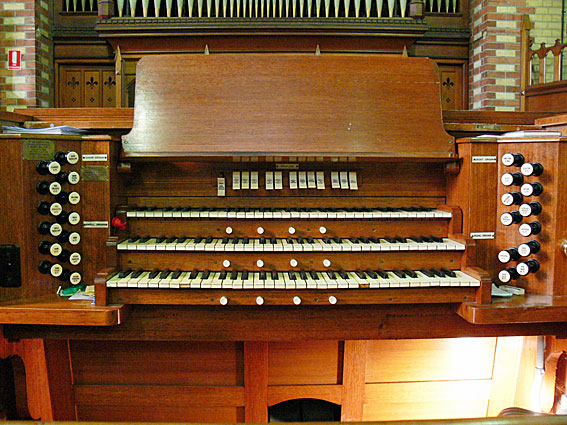

St George's Uniting Church, East St Kilda:
the 1935 console and the organ case
[Photographs by John Maidment (March 2014)]
In 1941, by which time the organ was maintained by Hill, Norman & Beard (Aust.) Pty Ltd., a Tremulant was added to Swell.20 The Tremulant added by Taylor in 1908 had presumably, by this stage, found its way to the Choir Organ. In 1947, Hill, Norman & Beard added a further three stops: a Clarinet 8ft on the Choir Organ, and two 8ft stops on the Pedal Organ, derived from the two original 16ft stops.21 Additions are also recorded by two plaques on the console:
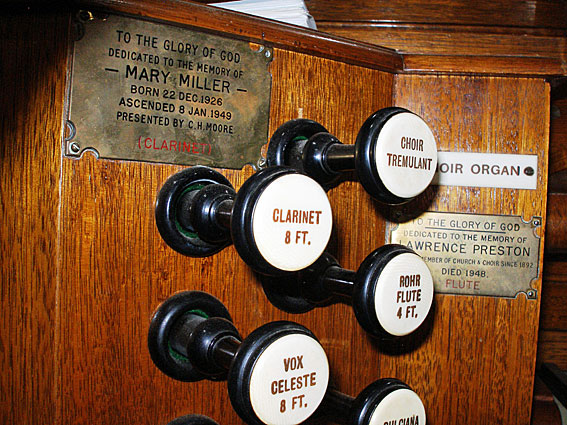
Donors' plaques on the console
[Photograph by Kelvin Hastie (May 2015)]
Presumably on the basis of one of the donors' plaques, Stiller assumed that the Rohr Flute 4ft was added to the Choir in 1950,22 but it had been one of the stops added by Taylor in 1908. Stiller also speculated that the Viola stop on the Choir Organ was 'originally a Fincham Keraulophon 8ft, possibly from the 1880 Exhibition organ.'23 As the pipes are stamped "GAM", and as the pipes of this rank are of spotted metal through the entire compass, it may have originated as the Gamba 8ft stop on the Swell of the Exhibition Organ.24 It was probably added to the St Kilda organ by Taylor in 1935.
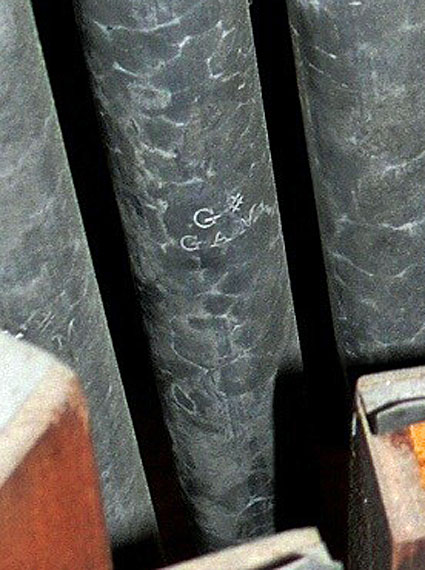
Pipes of the Viola 8ft on the Choir Organ,
marked "GAM" (= Gamba)
[Photograph by John Maidment (May 2015)]
The current specification is as follows:
| GREAT Bourdon Open Diapason Lieblich Gedact Salicional Octave Flute Flautina Mixture 19.22 Swell to Great Choir to Great SWELL Geigen Principal Rohr Flute Geigen Principal Horn Oboe Tremulant Sub Octave Unison Off Octave CHOIR Viola Dulciana Viol d’Orchestra Vox Celeste Rohr Flute Clarinet Tremulant Sub Octave Unison Off Octave Swell to Choir PEDAL Open Bass Sub Bass Principal Bass Flute Great to Pedal Swell to Pedal Choir to Pedal |
16 8 8 8 4 4 2 II 8 8 4 8 8 8 8 8 8 4 8 16 16 8 8 |
gvd bass stopped metal gvd bass [1941 Hill, Norman & Beard] (added 1935; enclosed) [possibly added 1935, originally from Exhibition Organ 1880] [1908; originally playable on Great Organ] [1908; originally playable on Swell Organ] [1908; originally playable on Swell Organ] [1908; originally playable on Swell Organ] [1947; Hill, Norman & Beard] [1908, originally on Swell] A B A [1947, Hill, Norman & Beard] B [1947, Hill, Norman & Beard] |
Compass: 61/30 (originally 56/30)
Tubular-pneumatic action
Balanced mechanical swell pedals to Swell and Choir organs
Vertical swell shutters (original).25
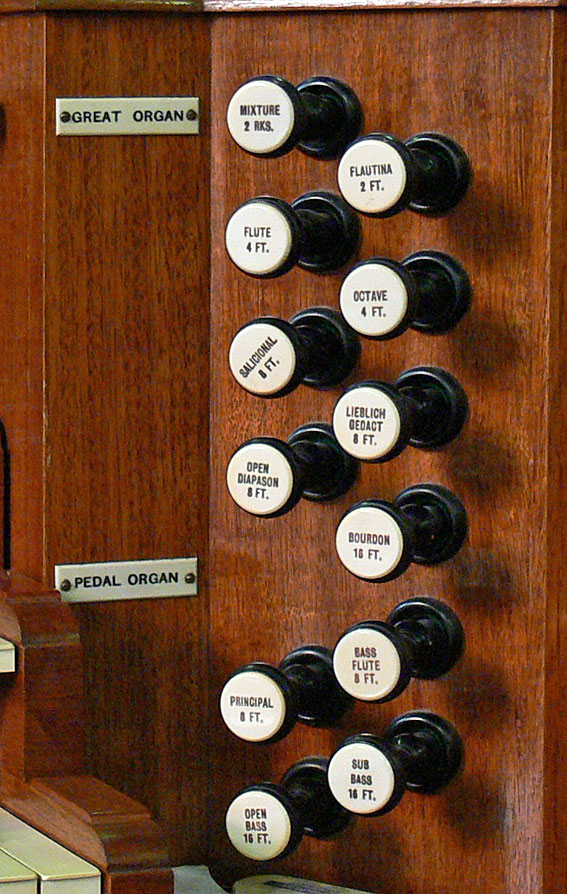
St George’s Uniting Church, East St Kilda:
right-hand stop jamb
[Photograph by John Maidment (March 2014)]
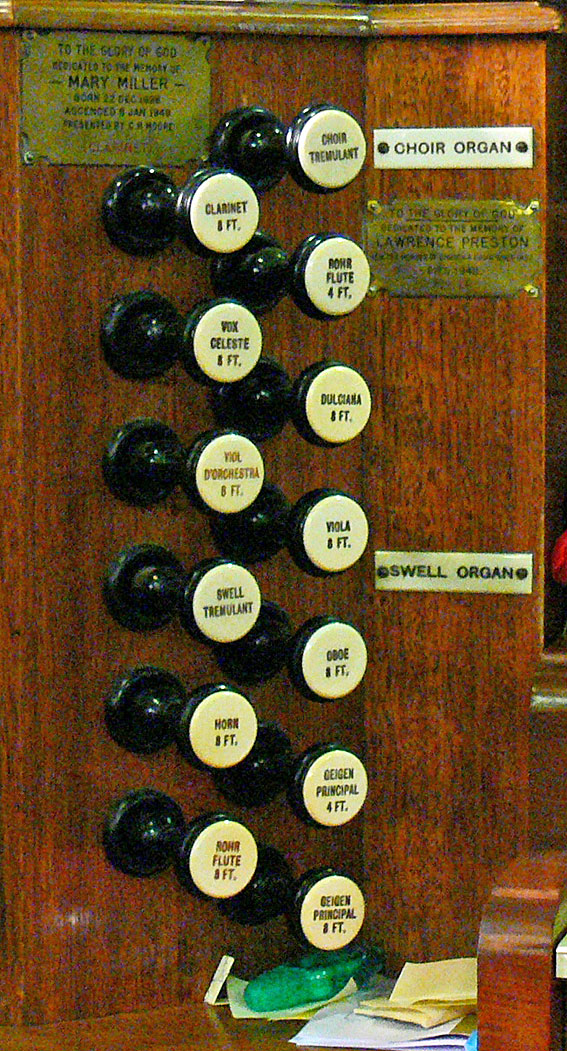
St George’s Uniting Church, East St Kilda:
left-hand stop jamb (John Maidment)
[Photograph by John Maidment (March 2014)]
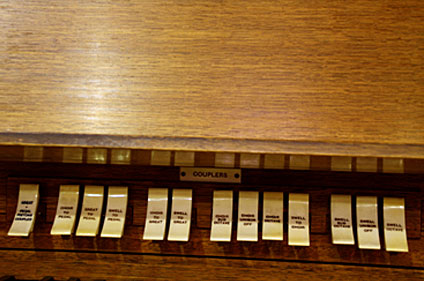
St George’s Uniting Church, East St Kilda:
coupler stopkeys
[Photograph by Simon Colvin (October 2009)]

The Great Organ windchest and pipework
[Photograph by John Maidment (May 2015)]
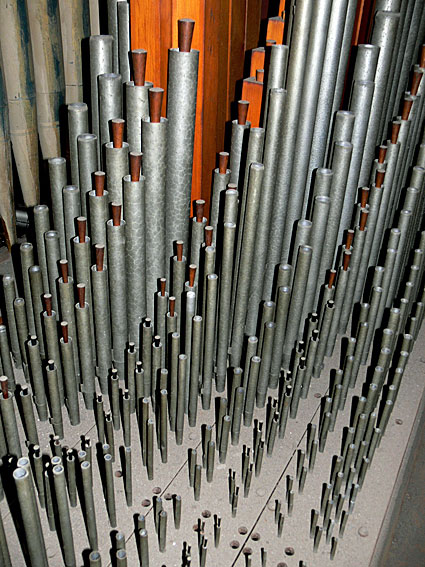
Cone-tuned pipework on the Great Organ,
including metal flutes at 16ft, 8ft and 4ft pitches
[Photograph by John Maidment (May 2015)]
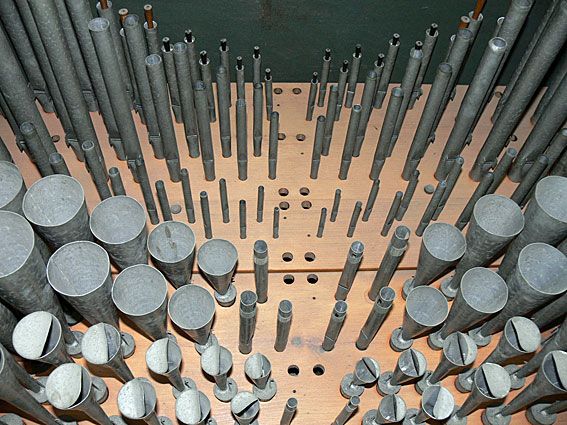
Swell pipework (from front: Oboe 8ft, Horn 8ft,
Geigen Principal 4ft, Geigen Principal 8ft and Rohr Flute 8ft)
[Photograph by John Maidment (May 2015)]
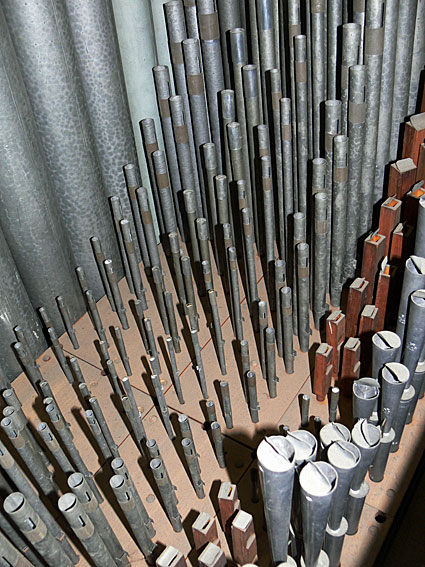
Choir pipework, showing (at front) the harmonic trebles on the Clarinet 8ft
[Photograph by John Maidment (May 2015)]

Choir pipework, showing the bass of the Clarinet 8ft
with cylindrical resonators
[Photograph by John Maidment (May 2015)]
The organ was renovated, cleaned and overhauled in 1973,26 and the tubular-pneumatic action was converted to electro-pneumatic in 1998 by Australian Pipe Organs Pty Ltd.27 The tubular-pneumatic action had become increasingly unreliable, exacerbated by the closeness of the action to the church floor and the effects of changing humidity. Most of the Taylor components were stored within the organ, and the console was carefully conserved, with no outward changes. The order of the manuals was changed at this time, resiting the Choir Organ to the bottom keyboard; in 1935 it had played from the top keyboard.
The bellows were re-leathered by Australian Pipe Organs Pty Ltd in 2002.28
The instrument retains the two Lewis slider chests, of generous dimensions, the Lewis wind system, all of the Lewis pipework, and most of the Lewis casework. The pipework (of spotted metal) has survived unaltered, retaining its original high pitch and cone tuning. This is the most unaltered of any of the five Lewis organs exported to Australia.29
Recording of the Lewis organ at East St Kilda
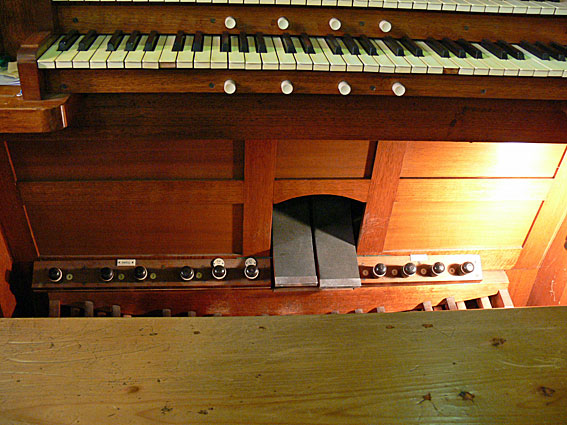

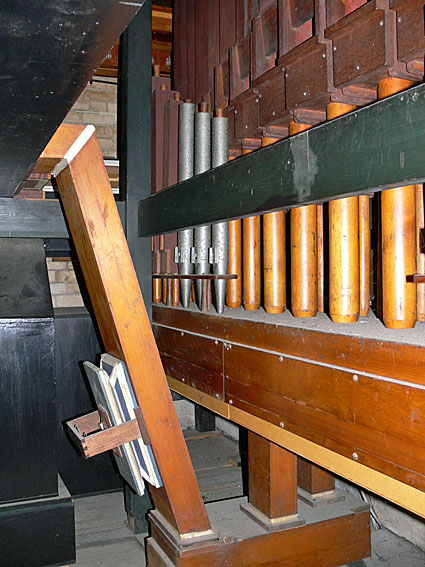
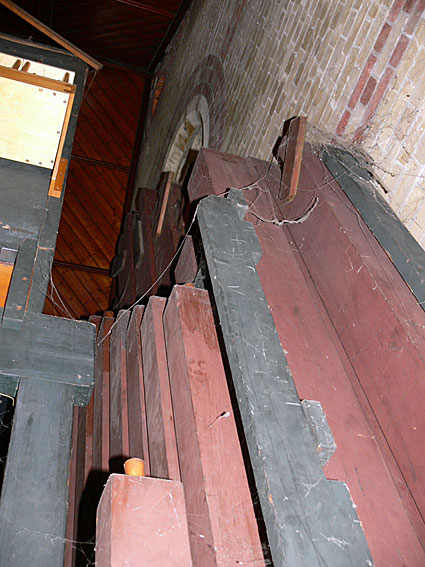
St George's Uniting Church, East St Kilda:
pistons, reservoir, pedal chest and pedal pipes
[Photographs by John Maidment (March 2014)]
1 The Australasian Sketcher (23 October1880), p. 278. See also: The Argus (8 May 1880), p. 5; The Argus (2 October 1880), p. 8.
2 George Fincham Letters, vol. 13 [= Specification Book], pp. 95-97 (7 May 1880); vol. 3, p. 229 (17 August 1880) - MS 13534, State Library of Victoria, Melbourne.
3 George Fincham Letters, vol. 3, p. 234 (30 August 1880) - cited in E.N. Matthews, Colonial Organs and Organbuilders (Carlton: Melbourne University Press, 1969), pp. 35-36.
4 George Fincham Letters 13 [=Specification Book], p. 152 (13 February 1883).
5 Loc. cit.; Matthews, op. cit., pp. 120, 150.
6 The Argus (7 May 1880), p. 6.
7 Thomas Brentnall, My Memories (Melbourne: Robertson & Mullens, 1938), p. 55.
8 Estimate 2037 (5 October 1880), in Hill and Son Estimate Book 2B, p. 157.
9 George Fincham Letters, vol. 3, p. 331 (19 June 1882).
10 T.C. Lewis, Organ Building and Bell Founding, 8th edn (1883), p. 36.
11 The Argus (8 September 1882), p. 5.
12 George Fincham Letters, vol. 3, p. 488 (29 January 1884); vol. 4, p. 263 (3 July 1885).
13 George Fincham Letters, vol. 5, pp. 303, 360 (6 June & 19 July 1887); vol. 6, pp. 32, 473 (23 Januuary 1888 & 27 November 1889)
14 George Fincham Letters, vol. 7, p. 18 (20 February 1890); vol. 14, p. 213 (16 January 1890).
15 George Fincham Letters, vol. 19, p. 645 (24 November 1903); vol. 20, p. 245 (27 October 1904).
16 George Fincham Letters, vol. 21, p. 289 (1 October 1906).
17 George Fincham Letters, vol. 21, p. 638 (3 August 1907).
18 The Prahran Telegraph (29 February 1908), p. 5.
19 The date 1935 apparently comes from St George's Church, East St Kilda 1877-1977: Thanksgiving Service for 100 Years of Presbyterian Witness, p. 5 - cited in John Stiller, St George's Uniting Church, St Kilda East, Vic: Standard Documentation of Pipe Organ built by T.C. Lewis 1881 (Camberwell: OHTA, 1980).
20 HNB Order V150, 'Hill Norman & Beard Australian & New Zealand Orders – checklist, www.ohta.org.au < documentation]
21 HNB Order V230, 'Hill Norman & Beard Australian & New Zealand Orders – checklist, www.ohta.org.au < documentation]
22 Stiller, op. cit., p. 2.
23 Stiller, op. cit., p. 4.
24 Specification given in Matthews, op. cit., pp. 221-23.
25 Specification noted by John Maidment, 1966 and 2014.
26 St George's Presbyterian Church: The First One Hundred Years, p. 11 – cited in Stiller, op. cit., p. 2.
27 OHTA News, vol. 22, no. 4 (October 1998), p. 13; John Bottomley, Gary Bowman, et al, Sorrow's gift: God's grace for pilgrim people: celebrating the 125th Anniversary of St. George's East St. Kilda Uniting Church and its journey from suburban congregation for urban church (St. Kilda: Centre for Creative Ministeries, 2002), p. 50.
28 Bottomley, p. 50.
29 The others were at St John's Anglican Pro-Cathedral, Brisbane, Qld (1873), the Wesleyan Church, Tyrrell Street, Newcastle, NSW (1886), the Congregational Church, Petersham, NSW (1886) and St Paul's Anglican Cathedral, Melbourne, Vic. (1891).