Musgrave Road, Red Hill
B.B. Whitehouse & Co., Brisbane, 1914
Restored 2001-02 W. J. Simon Pierce, Brisbane
2 manuals, 17 speaking stops, tubular-pneumatic action
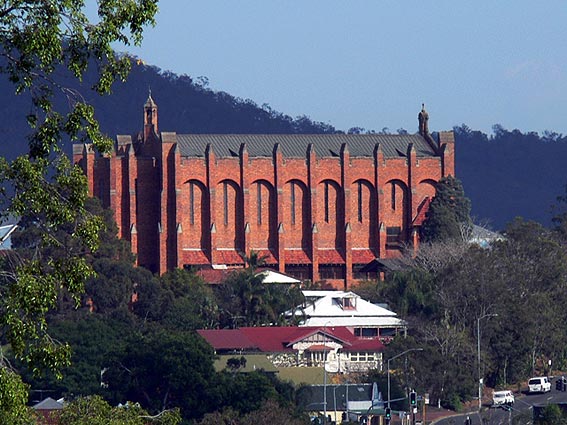
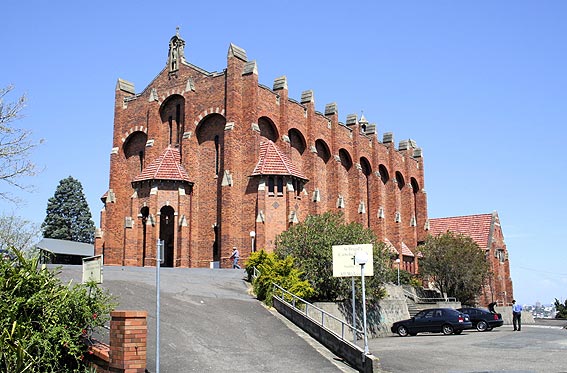
St Brigid's Catholic Church, Red Hill
[Photograph by John Maidment (October 2007)]
Historical and Technical Documentation by Geoffrey Cox
© OHTA 1989, 1998, 2007, 2012, 2013 (last updated May 2013)
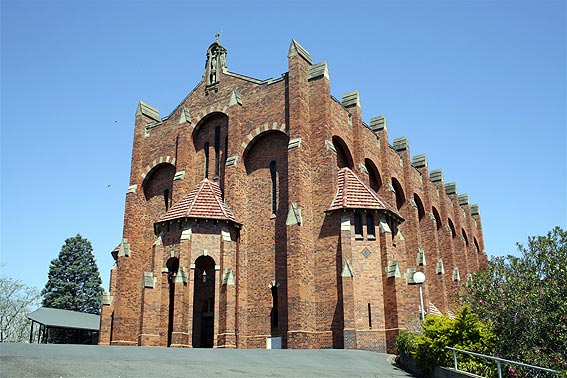
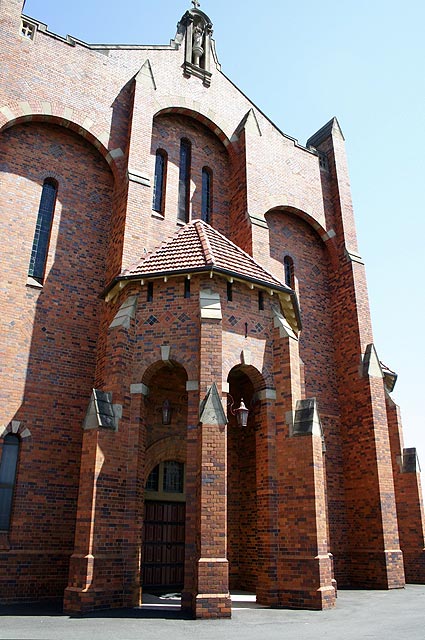
The present St Brigid's Church replaced an earlier stone structure built in 1877.1 It has been described as 'Brisbane's finest ecclesiastical building', the only other contenders for the title being St John's Cathedral and St Andrew's Uniting Church in the city.2 A massive red brick structure, the building enjoys a commanding position, overlooking the city. It was built between 1912 and 1914 to the design of the Australian architect, Robin Dods, a partner in the Brisbane firm, Hall & Dods.
Its appearance stems from the directive of the Church Committee who commissioned Dods to design a church like the Cathedral at Albi [in France]. . . .The essential fortress-like character of St Brigid's was unavoidable, therefore, as this was the major characteristic of "Albi". . . . While in the spirit of "Albi", Dods' creation is not a replica. Although inescapably cast in the Gothic idiom, ornamentation has been reduced to a minimum and the architect has succeeded in creating contemporary imagery in both choice of materials - red brick walls and grey tiled roof - and in its powerful form, the latter evidenced by tall supporting buttresses and infill brick panels penetrated by narrow windows and topped by projecting arched spandrels.3
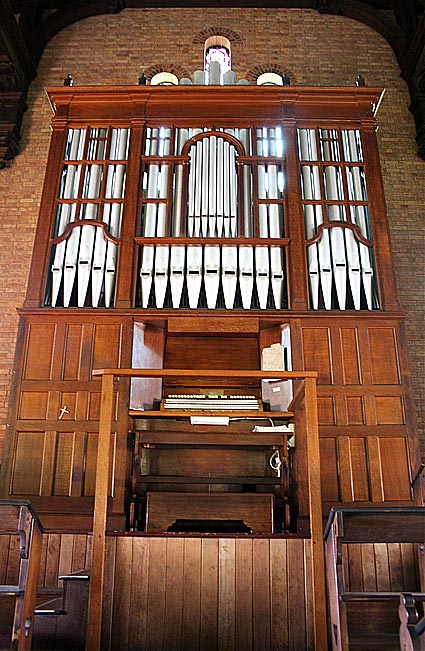
The case of the organ (of polished silky oak) was designed by the architect to conform with the church architecture.4

Organ casework designed by the architect, Robin Dods
[Photograph by Trevor Bunning (October 2007)]
The contract for building the organ had been awarded to B.B. Whitehouse & Co. of Brisbane by November 1913, when the following details were published, drawing special attention to the use of tubular-pneumatic action and the inclusion of a crescendo pedal:
NEW PIPE ORGAN.
Messrs B. B. Whitehouse and Co., of Brisbane, have been intrusted with the building of a new pipe organ for St. Brigid's Church, Red Hill. The specifications for this instrument are is follows: -
Great Organ. - CC to A: 1, open diapason, 8ft. metal, 58 pipes; 2, stop diapason, 8ft. wood, 58 pipes; 3, harmonic flute, 4ft. metal, 58 pipes; 4, dulciana (grooved bass), 8ft. metal, 46 pipes; 5, principal, 4ft. metal, 58 pipes; 6, fifteenth, 2ft. metal 58 pipes; 7, trumpet, 8ft. metal, 58 pipes.
Swell Organ. - CC to A: 8, double diapason, 16ft. wood and metal, 58 pipes; 9, open diapason, 8ft. wood and metal, 58 pipes; 10, lieblich gedact, 8ft. wood and metal, 58 pipes; 11, salicional (grooved bass), 8ft. metal, 46 pipes; 12, vox Angelica (grooved bass), 8ft. metal, 46 pipes; 13, gemshorn, 4ft. metal, 58 pipes; 14, piccolo, 2ft. metal, 58 pipes; 15, oboe, 8ft. metal, 58 pipes; 16, cornopeon, 8ft. metal, 58 pipes.
Pedal Organ. – 17, Bourdon, 16ft. wood, 30 pipes.
Couplers. – 18, swell sub-octave; 19, super octave; 20, swell to great; 21, great octave; 22, pedal to great; 23, pedal to swell; 24, pedal octave; 25, tremulant.
Three pistons to great organ. Three pistons to swell organ. Balanced swell pedal. Balanced pedal for crescendo and diminuendo. The wind will be supplied by an electric rotary blower. The key and pedal action, draw stop action, couplers, and all accessories will be worked by the latest improved system of tubular pneumatics. The crescendo and diminuendo balance pedal is quite a new invention and it will be the first introduced into this State.5
The instrument was opened, along with the church itself, on Sunday 9 August 1914.6 For many years, until the firm ceased operation in 1982, this organ enjoyed the advantage of close proximity to the builder's workshop, which was situated on the opposite side of Musgrave Road from 1921, when the name Whitehouse Bros was adopted. Placed in the west gallery of this reverberant church, the instrument is heard to maximum advantage, and it is regarded as one of the firm's most notable instruments of the period.
This was one of the earliest organs by the Whitehouse firm to use pneumatic action. The chests are of the cone-pallet variety, fed by single-rise bellows. The firm had used cone-pallet chests as early as 1910 in the small instrument at the Methodist Church, Nundah, but this was one of the earliest of their major instruments to use them. It was followed by the slightly larger pneumatic-action instrument at the Baptist City Tabernacle, Brisbane, in January 1915 (3 manuals, 20 stops), and others of comparable size at St Mary's Catholic Church, Ipswich, in October 1915 (2 manuals, 19 stops), West End Methodist Church in 1924 (2 manuals, 19 stops) and the Masonic Temple, Brisbane, in 1930 (2 manuals, 20 stops).
As is true of other Whitehouse organs of the period and earlier, the pipework appears to derive from A. Palmer & Son of London, and the console fittings from Thomas Harrison of London. The console at Red Hill is unusual in that it has stopkeys (of the triangular-block type) although the angled jambs are apparently designed as if for drawstops.
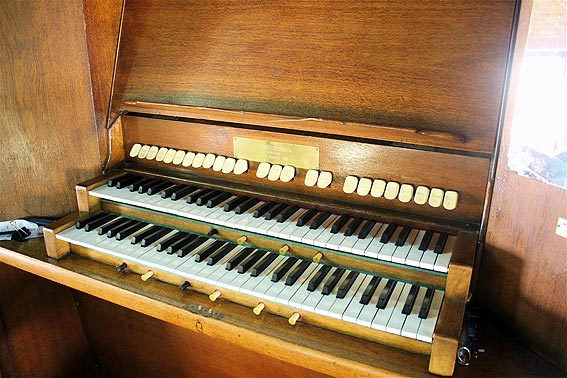
[Photograph by Trevor Bunning (October 2007)]
Substantial refurbishment of the organ was undertaken in 1994-95 by H.W. Jarrott of Brisbane,7 and a complete restoration was carried out in 2001-02 by W.J. Simon Pierce.8 The latter included replacement of all the puffers and cones of the cone-pallet soundboards, and extensive remedial work on the soundboards. Cone tuning was retained where possible, although it was found necessary to fit slides to the Fifteenth 2ft, the Piccolo 2ft, and the top octave of the Gemshorn 4ft and Principal 4ft. The wind pressure was raised slightly to achieve optimum speech of both flues and reeds.9
| GREAT Open Diapason Stopt Diapason Dulciana Harmonic Flute Principal Fifteenth Trumpet SWELL Double Diapason Open Diapason Lieblich Gedact Salicional Vox Angelica Gemshorn Piccolo Cornopean Oboe PEDAL Bourdon |
8 8 8 4 4 2 8 16 8 8 8 8 4 2 8 8 16 |
[wood] [gvd bass] [metal] [wood & metal] [wood & metal] [gvd bass] [gvd bass] |
COUPLERS
Swell to Pedal
Great to Pedal
Swell to Great
Great Octave
Pedal Octave
Swell Sub Octave
[Swell] Super Octave
Stop-key console (attached)
3 combination pistons to Great Organ
3 combination pistons to Swell Organ
Radiating concave pedalboard
Balanced swell pedal (brass shoe)
Crescendo pedal, with indicator above keyboards [added in the 1920s, but later disconnected]
Swell tremulant
Compass: 58/30
Pneumatic action.10
1 Queensland Heritage Council, Queensland Heritage Register, location 600284.
2 Nancy Underhill, 'St Brigid's Church, Red Hill', Art and Australia, vol. 15 (June 1978), pp. 397-402.
3 The Heritage of Australia: The Illustrated Register of the National Estate (South Melbourne: Macmillan, 1981), vol. 4, p. 20.
4 Robert Riddel, 'St Brigid's Church, Red Hill - The Origins of its Architectural Style', Organ Society of Queensland Newsletter, vol. 18, no. 3 (December 1990), pp. 17-24;
5 The Brisbane Courier (10 November 1913), p. 5.
6 The Brisbane Courier (10 August 1914), p. 4.
7 Personal communication to G. Cox from H. W. Jarrott, c.1996.
8 The Organ Voice, vol. 27, no. 1 (March 2001), pp. 28-29; The Organ Voice, vol. 27, no. 2 (June 2001), p. 31; The Organ Voice, vol. 27, no. 3 (September 2001), p. 27; The Organ Voice, vol. 28, no. 1 (March 2002), p. 30; The Sydney Organ Journal, vol. 33, no. 3 (Winter 2002), p. 23; OHTA News, vol. 25, no. 4 (October 2001), p. 14.
9 Simon Pierce, 'The Restoration of the 1913 [recte 1914] Whitehouse & Co organ, St Brigid's Catholic Church, Red Hill, Brisbane, Queensland', OHTA News, vol. 26, no. 2 (April 2002), pp. 7-9.
10 Specification noted by G. Cox, 1974 and 1989; additional details from The Brisbane Courier (10 November 1913), p. 5.

[Photographs by Trevor Bunning (October 2007)]
[Photograph by John Maidment (October 2007)]

[Photograph by Trevor Bunning (October. 2007)]