St Joseph's Catholic Cathedral
cnr William and West Streets, Rockhampton
Whitehouse Bros, Brisbane, 1926
2 manuals, 12 speaking stops, tubular-pneumatic action
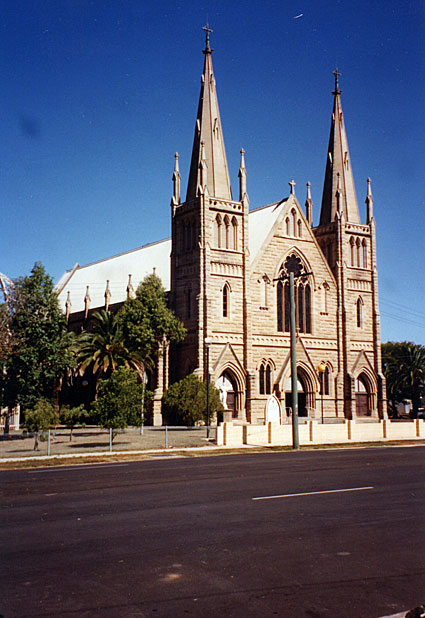
St Joseph's Catholic Cathedral, Rockhampton
[Photograph by Howard Baker (1990s)]
Historical and Technical Documentation by Geoffrey Cox
© OHTA 2010, 2013, 2016 (last updated November 2016)
The Catholic Church in Rockhampton dates from the days of early settlement, although the Diocese of Rockhampton was not created until 1882. The first Mass was celebrated in 1862 in the Court House, and the first St Joseph's Church was opened on 4 January 1863 on the corner of Derby and Alma Streets. The site for the Cathedral was acquired in 1877, and by 1892 plans for the building had been completed by the Brisbane colonial architect, F.D.G. Stanley. Construction commenced in the mid 1890s, but it was not until 15 October 1899 that this fine neo-gothic sandstone building with twin towers and spires was opened. A 'temporary' wall closed off the East end until the building was completed in simple Gothic style and dedicated on 22 May 1982.1

The completed East end of St Joseph's Cathedral, Rockhampton
[Photograph by Trevor Bunning (November 2010)]
The organ was built in 1925-26 by Whitehouse Bros of Brisbane at a cost of £1320.2 Installation in Rockhampton was in progress by late April 1926, when the instrument was described as follows in the local press:
New Pipe Organ.
An exceptionally fine pipe organ has been built by Messrs. Whitehouse Brothers, Brisbane, for the St Joseph's Cathedral parish, and its erection in the choir gallery of the cathedral is now being supervised by Mr. J. H Whitehouse, a member of the firm.
The great organ has 58 notes, the swell organ 58 notes, and the pedal organ 30 notes. According to the specifications the following are features:-
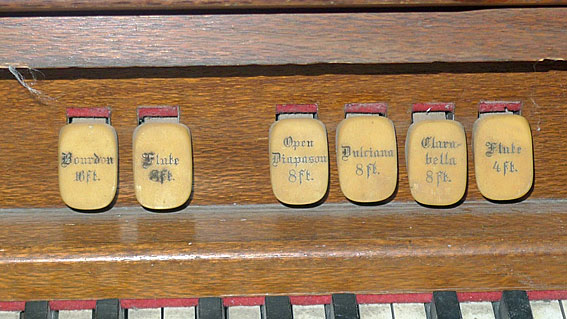
Great organ: Open diapason, 8 ft. pipe; dulciana (grooved bass), 8 ft pipe; clarabella, 8 ft; harmonic flute, 4ft. Swell organ: Violin diapason, 8 ft.; Lieblich gedact, 8 ft.; echo gamba (grooved), 8 ft., voix celestes, 8 ft.; gemshorn, 4ft.; and oboe, 8 ft. Pedal organ: Bourdon, 16 ft.; bass flute, 8 ft.
The couplers comprise swell to great, swell to pedal (two pistons to swell), swell sub octave (two pistons to great), swell super octave, great to pedal, tremulant, swell sub to great, and swell super to great.
The action is Whitehouse Brothers' special form of tubular pneumatic throughout, with a separate pallet to every pipe. This prevents robbing, ensuring perfect speech and repetition, whether the manuals are used singly or coupled. The keys are of the finest quality ivory, with ebony sharps. The pedal board is of the revised Royal College of Organists' pattern (radiating and concave) and is of well seasoned hardwood. The sound boards are slideless, of ample size, and made of thoroughly seasoned timber, and painted to resist the climatic changes. The bellows are of ample size to ensure copious and steady supply of wind to the pipes, double leathered throughout, and fitted with panels, which, when removed, render every portion of the interior easy of access. The swell box is as lofty as possible, of suitable thickness, and made perfectly tight. The shutters are padded and every precaution is taken to ensure an effectual and silent closing.
The case is of silky oak, of plain design and best workmanship.
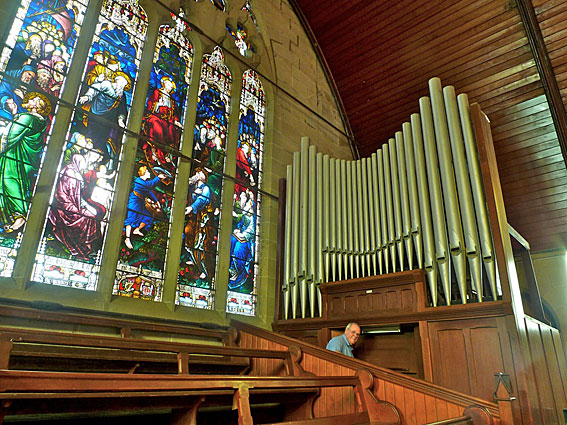
The front pipes are of stout V.M. zinc, silvered with aluminium, the interior pipes of the best plain metal, with bases of zinc of suitable thickness, and the wood pipes made of thoroughly seasoned pine and constructed on the most improved principal. The voicing of the pipes is such as to secure power and accurate balance of tone in full combination, together with purity and delicacy in the soft and solo register. The scaling of the pipes are specially adapted to the size and requirements of the building.
The blowing is supplied by a rotary blower, driven by an electric motor. The type of blower is manufactured by Messrs. Whitehouse Brothers.
The reputation of Messrs. Whitehouse Brothers is widely known as builders of organs, and many have been installed in churches of all denominations throughout Queensland, as well as outside the State. Among their future contracts is the building [sic] and installation of the organ in the new Town Hall in Brisbane. The installation of this organ will be undertaken about 12 months hence. The cost will be approximately £l5,000.3
The opening of the organ took place on Sunday 16 May, with a recital by Mr N.G. Wiley, organist of the Campbell-street Methodist Church, Rockhampton, and associated artists:
ST. JOSEPH'S CATHEDRAL PIPE ORGAN
The opening of the new pipe organ recently installed in St. Joseph's Cathedral will take place on Sunday evening next when a grand recital of sacred music will he given including organ solos by Mr. N. G. Wiley, vocal solos by Miss A. Moore (contralto, Mt. Morgan), Messrs. G. Hempenstall (baritone, Mt Morgan), H. Baildon (bass), E. Benjamin (tenor), and H. Hamilton (baritone), a cornet solo by Mr. P. Partington, and choral items by the full choir. The new organ, which is considered one of the finest instruments of its class in Queensland, should be heard at its best on this occasion under an artist of Mr. Wiley's ability. The recital will commence at 8.15 sharp and a collection will be taken up in aid of tho organ fund.4
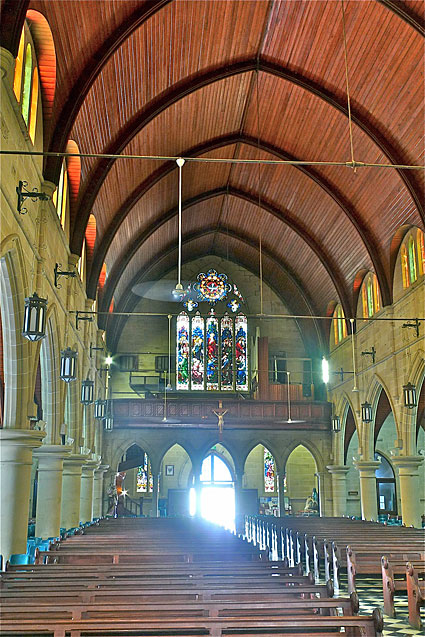
The organ was maintained regularly by Whitehouse Bros, and received major overhauls in May 1938 and July 1942.5 Located in the West gallery, it is a good example of its type, though possibly inadequate for the size of the building. The Echo Gamba 8ft is of notably keen quality, and the Flute 4ft on the Great is remarkably bright.
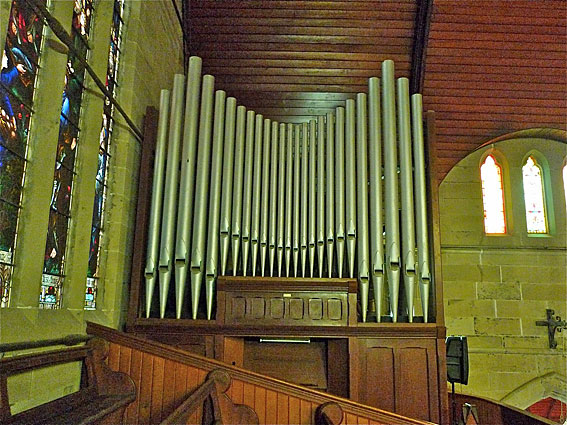
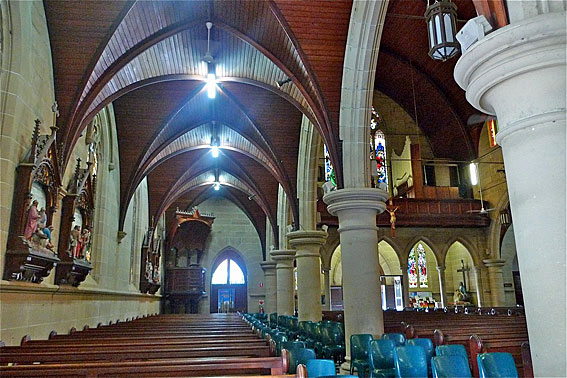
[Photographs by Trevor Bunning (November 2010)]
The organ was disassembled in the late 1970s by Whitehouse Bros before the firm ceased operation, and it has not been used since around 1980. It has been subjected to vandalism, but remains intact. There have been proposals since around 2010 for restoration of the pipe organ by Max Thompson, a senior airline pilot from Bowral, NSW,6 and there appears to be an intention eventually to link the pipe organ to a new Roland digital organ placed at floor level near the sanctuary.7
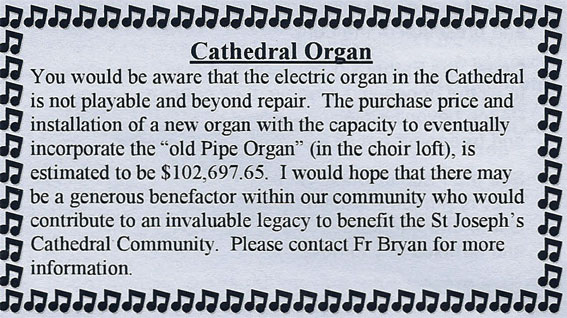
[Parish Notice in Newsletter of the
Catholic Parish of Rockhampton South (November 2016)]
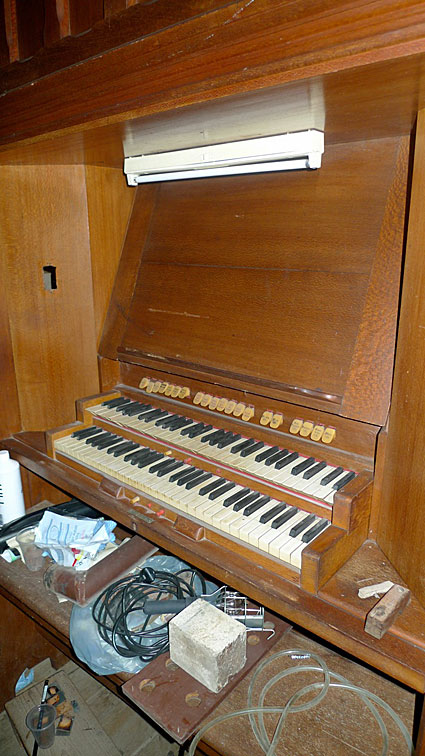
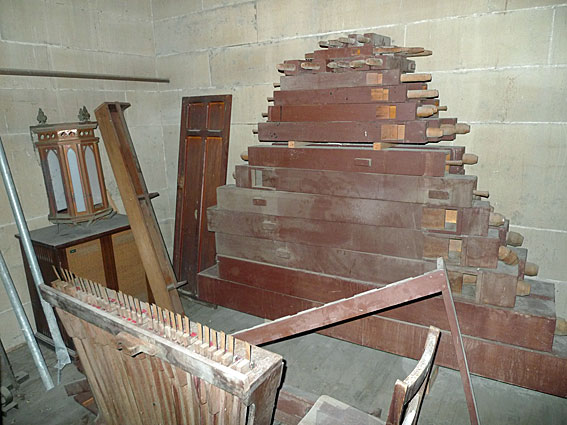

[Photographs by Trevor Bunning (November 2010)]
GREAT
Open Diapason
Dulciana
Clarabella
Flute
SWELL
Violin Diapason
Lieblich Gedact
Echo Gamba
Voix Celeste
Gemshorn
Oboe
PEDAL
Bourdon
Flute
COUPLERS
Great to Pedal
Swell to Pedal
Swell to Great
Swell Sub Octave
Swell Octave
Swell Sub to Great
Swell Octave to Great
|
8
8
8
4
8
8
8
8
4
8
16
8
|
[gvd bass]
[stpd]
[gvd bass]
[Ten.C]
A
A
|
Swell tremulant
Attached stopkey console
Pneumatic action
Compass: 58/30
Trigger swell pedal
Pedalboard: radiating & concave
2 combinations pistons (& cancel) to Great
2 combinations pistons (& cancel) to Swell.8
______________________________________________________________________
1 Queensland Heritage Register, location 600822; 'St Joseph's Catholic Cathedral,
Rockhampton' (Church Pamphlet, October 1990).
2 Whitehouse Bros Ledger (1922-1940), p. 112.
3 Morning Bulletin (Rockhampton, 27 April 1926), p. 9.
4 Morning Bulletin (Rockhampton, 13 May 1926), p. 8.
5 Whitehouse Bros Ledger (1922-1940), pp. 319-20; Whitehouse Bros Ledger (1940-1954), p. 268.
6 Personal communications to G. Cox from Roger Marks, September 2002 and December 2010.
7 Personal communications to G. Cox from Roger Marks, November 2016.
8 Specification noted by G. Cox, July 1974, and Trevor Bunning, November 2010.

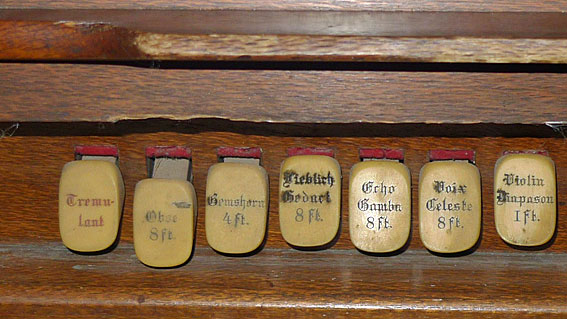
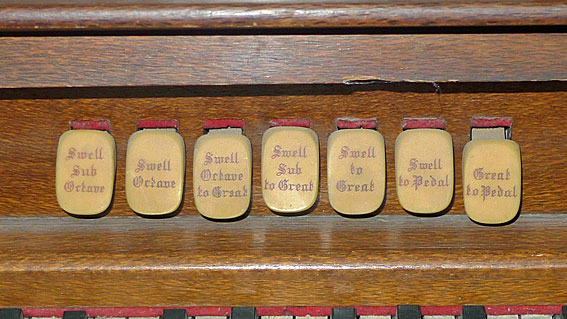

[Photographs by Trevor Bunning (November 2010)]