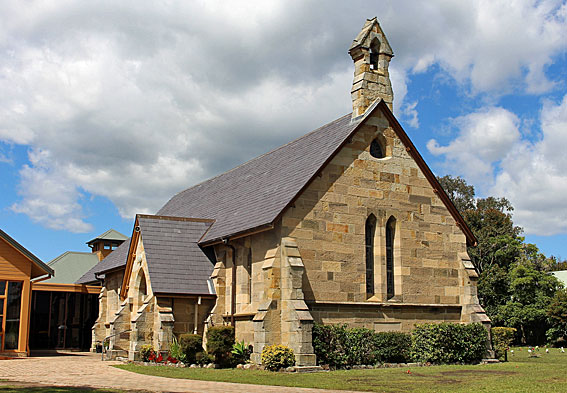
St John's Anglican Church, Raymond Terrace:
exterior from the west
[photograph by Trevor Bunning (29 September 2015)]
St John's Anglican Church, Raymond Terrace:
exterior from the west
[photograph by Trevor Bunning (29 September 2015)]
Historical and Technical Documentation by Kelvin Hastie
© OHTA, 2015 (last updated September 2015)
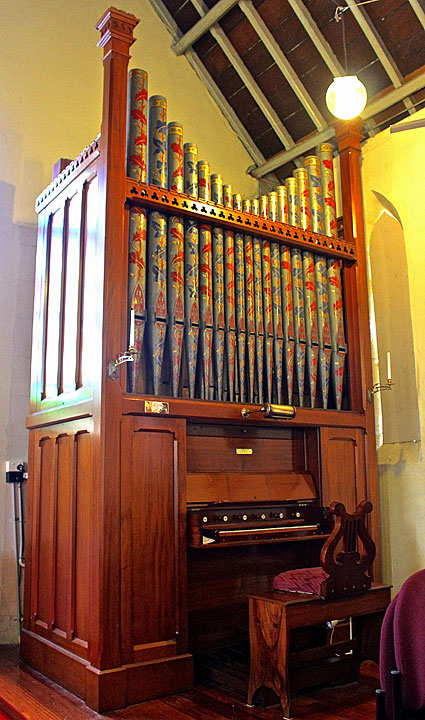
St John's Anglican Church, Raymond Terrace: organ
[photograph by Trevor Bunning (29 September 2015)]
Although Anglican services were held in Raymond Terrace as early as 1839, the current site for St John's was not purchased until 1861, with plans drawn up by architect, Edmund Blacket, in Gothic style: the stone chosen for stonemason Robert Carnell to lay was "Muree" blue sandstone, from a local quarry. Bishop Tyrrell contributed five hundred pounds towards the construction of the church, while the local parishioners provided one thousand pounds. The bishop conducted the consecration on 25 November 1862.1
The church is home to a small single-manual J.W. Walker organ (job number 692) which has served the church faithfully for 153 years. Although altered during renovation work carried out in the 1970s, a majority of components survive, including the case (including candle sconce bases), delicately stencilled façade pipes, action, soundboard, key cheeks, short-compass flat pedal board, composition pedals, bench, nameplate and all internal pipework. The hand-blowing mechanism and barrel playing mechanism were removed at some stage.
In 2009 Peter D.G. Jewkes Pty Ltd restored the organ and this used traditional methods to restore the manual soundboard, the key and pedal action and the pipework. Work also included the releathering of the bellows and the replacement of the plastic stopknobs, which date from a renovation carried out by Fr John Hamer-Howarth, of Caloundra, Queensland, in 1974. The new stopknobs were appropriately based on existing Walker models and made in turned mahogany with recycled ivory inserts.
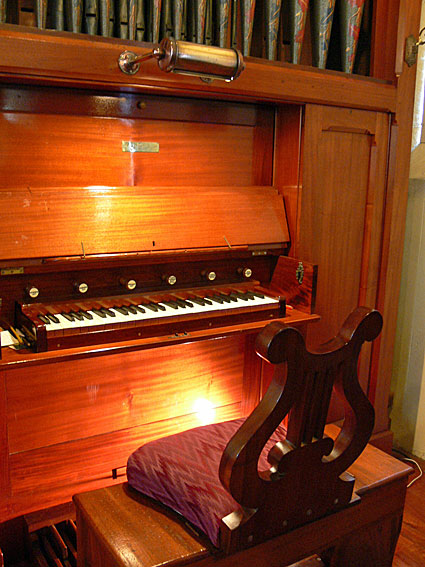
St John's Anglican Church, Raymond Terrace: restored console
[photograph by John Maidment (29 September 2015)]
It is important to note that in restoring the pipework no hot water or chemical solvents were used: cleaning was carried out using a vacuum process with fine soft brushes and dust mops, in accordance with best international practice. The original pitch of the organ was restored and new tuning slides replaced a deteriorated set dating from the 1960s. New keys (with mahogany frames and polished bone coverings) replaced the supply-house keys installed in 1974 by John Hamer-Howarth. These are facsimiles of those belonging to the 1864 Walker organ at Tyburn Priory, Riverstone. Upon return to Raymond Terrace from the Jewkes workshop in Ermington, the instrument was moved forward to allow improved access for maintenance.
Regrettably, available funds did not allow for the reconstruction of the original barrel playing mechanism, removed by Fr John Hamer-Howarth in 1974. The only other J.W. Walker organ in New South Wales with such a mechanism is the 1856 instrument at St Thomas' Anglican Church, Port Macquarie. When John Stiller documented the Raymond Terrace organ on 25 February 1985 he noted that among the last remaining evidence of the barrel operation was a heavily deteriorated paper notice glued to a back panel of the case. This lists some of the hymn tunes available on the three barrels, each pinned for 11 tunes. Some of the tunes available on No. 3 barrel, and whose names can still be discerned, were Evening Hymn, Rockingham, London New, Mount Ephraim, Darwall's and Hanover. A double chant is also listed.2
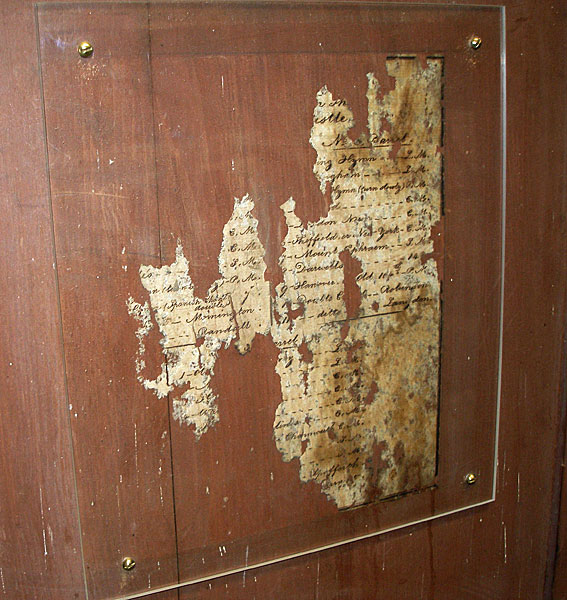
St John's Anglican Church, Raymond Terrace:
Label at rear of organ showing tunes used on the barrels
[photograph by Kelvin Hastie (3 May 2009)]
The Organ Historical Trust of Australia granted the restoration tax-deductible status and this facilitated a number of generous donations. The church appointed Kelvin Hastie as its consultant for the work. The appeal to raise funds for the restoration was launched by the late Hon. John Price, MP, on 4 February 2007. This took place in the grounds of the historic St John's Rectory (a building that dates from 1841) and featured speeches by The Revd Beatrice Pate and the organ restoration project co-ordinator, Don Denham.
The specification, noted by Kelvin Hastie in 2007, is as follows:
| MANUAL (unenclosed) Open Diapason Stopd Diapason Bass Stopd Diapason Treble Dulciana Principal Fifteenth |
8 8 8 8 4 2 |
CC-BB TC TC |
Pipes 56 12 44 44 56 56 |
Pedal pulldowns permanently coupled to Manual, 20 notes C - g0
2 composition pedals
Mechanical action
Compass: 56/20
268 pipes
1 http://www.stjohnsraymondterrace.org/2010/pages/parishc.html (accessed 3 July 2015)
2 John Stiller, St John's Anglican Church, Raymond Terrace, NSW - Documentation of Pipe Organ Built by J.W. Walker 1862. Organ Historical Trust of Australia, 25 February 1985.
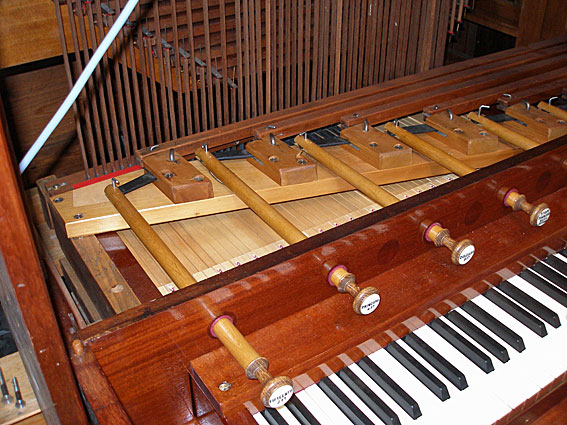
St John's Anglican Church, Raymond Terrace:
Detail of restored drawstops and keyboard
[photograph by Kelvin Hastie (3 May 2009)]
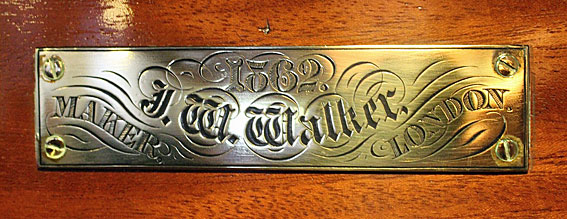
St John's Anglican Church, Raymond Terrace:
Walker nameplate
[photograph by Trevor Bunning (29 September 2015)]
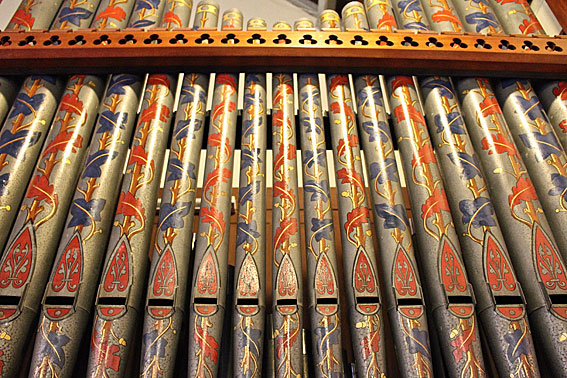
St John's Anglican Church, Raymond Terrace:
Detail of façade pipe decoration
[photograph by Trevor Bunning (29 September 2015)]