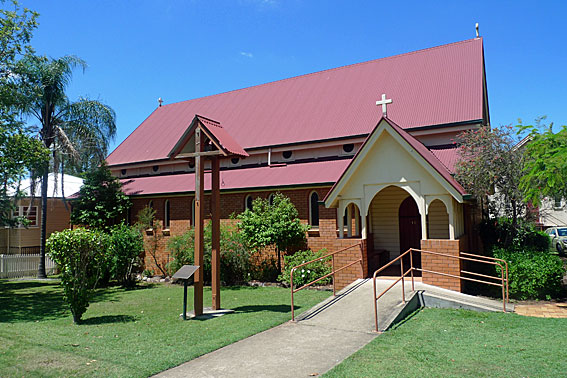
St Thomas' Anglican Church, North Ipswich
[Photograph by Trevor Bunning (November 2011)]
St Thomas' Anglican Church, North Ipswich
[Photograph by Trevor Bunning (November 2011)]
Historical and Technical Documentation by Geoffrey Cox1
© OHTA 1989, 2003, 2011, 2018 (last updated November 2018)
St Thomas' Church was built in 1887-89 and opened and consecrated by Dr Webber, the Bishop of Brisbane, on 11 March 1889. The building was designed by the Brisbane Diocesan architect, J.H. Buckeridge,2 whose other timber buildings in similar style included St John the Baptist Anglican Church, Bulimba (1888) and Christ Church Anglican Church, Milton (1891). The interior, including the distinctive carved wooden rood screen and wooden paneling, remains essentially intact, although the wooden exterior of the building was clad in brick in 1969 and 1980.
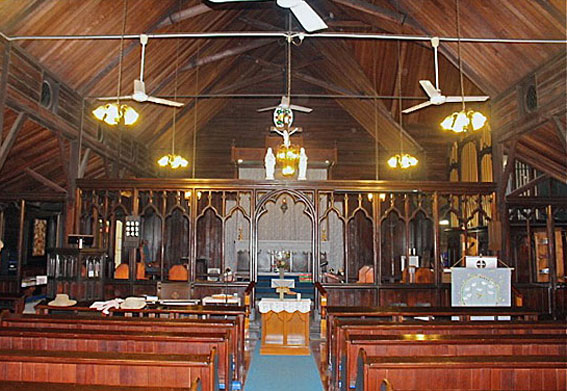
Interior of St Thomas' Church, showing the rood screen
[Photograph by Trevor Bunning (September 2014)]
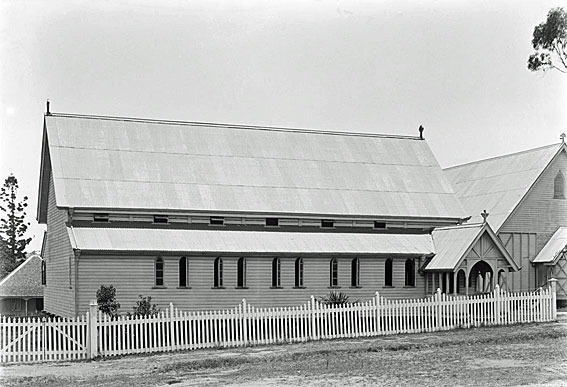
St Thomas' Anglican Church, North Ipswich, 1910
[Photograph from Whitehead Collection,
courtesy of Picture Ipswich, Ipswich City Council]
The nameplate on the organ records that it was built by 'James Cole, Manchester, England.' It was installed originally in the second Albert Street Wesleyan Church, Brisbane, which had been opened in 1856 on the site between Burnett Lane and Adelaide Street.3 The organ arrived in time for the re-opening of that church after repairs to the church in November 1878.4
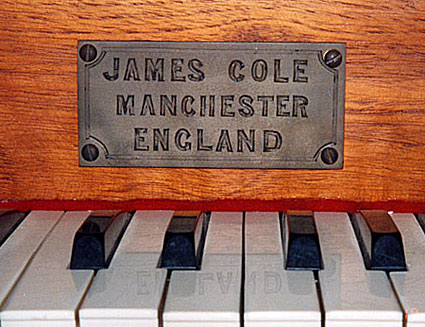
The builder's nameplate on the organ
[Photograph by Geoffrey Cox (January 2004)]
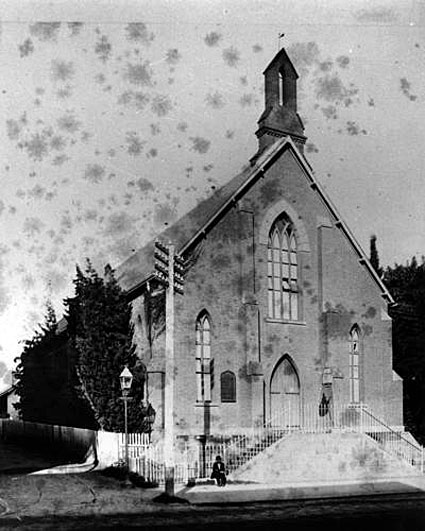
The second Wesleyan Church, Albert Street, Brisbane, c.1883
[Photograph: John Oxley Library, State Library of Queensland]
A full account of the organ and the re-opening of the church appeared at the time in The Weekly Advocate in Sydney:
Brisbane. - Albert -street - The Wesleyan church in Albert-street is one of the old landmarks of Brisbane, having been built about twenty years ago; but though commodious in size, and serving a very good turn, it has never, to this date, been completed according to the original intentions of the builders. Some months ago, however, it was determined by the trustees and the congregation to make a bold step in that direction, and a sum of £1200 was devoted to the work, with what result will ere long be seen. As regards the building itself, the most important change is the substitution of slates for the old shingles on the roof, and the erection of a gallery across the end of the building nearest to Albert-street. Besides this, the appearance of the interior of the roof has been greatly improved by the addition of small pillars as corbels to the arches supporting the roof.
The most pleasing change, however, is the substitution of a fine church organ for the old harmonium which did such good service in days gone by. The new instrument, which is of rich, beautiful tone, and considerable volume, was built for the trustees by James Cole, of Manchester, according to specifications furnished by Mr. James Lord, who has himself, at considerable personal inconvenience, erected it in its place in the church, thus saving the trustees much expense, and proving himself to be thoroughly acquainted with the mechanical part of his profession. The organ has in all seventeen stops, and is in every way suitable for the purpose for which it is designed. The following synopsis of it will doubtless prove interesting to those of our readers acquainted with the details of such instruments:-
GREAT ORGAN.
Stopped diapason, bass
Stopped diapason, treble
Dulciana, treble
Open diapason
Principal
Flute
Fifteenth
SWELL ORGAN.
Bourdon
Gedact
Viol di Gamba
Gemshorn
Piccolo
Cornopean
PEDAL ORGAN.
Bourdon
8 ft.
8 ft.
8 ft.
8 ft.
4 ft.
4 ft.
2 ft.
16 ft.
8 ft.
8 ft.
4 ft.
2 ft.
8 ft.
16 ft.
12 pipes
44 pipes
44 pipes
56 pipes
56 pipes
44 pipes
56 pipes
56 pipes
12 pipes
44 pipes
56 pipes
56 pipes
56 pipes
30 pipes
Total number of pipes ... 622Swell to great.
Swell to pedals.
Great to pedals.
Three combination pedals to great organ.It is erected on a platform at the end of the church opposite to the gallery, and a space for the choir is to be railed-off with cast-iron balustrading similar to that used in front of the gallery, . . .
The church was re-opened on Sunday, November 10th, the Rev. F. T. Brentnall preaching in the morning, and the Rev. W. Wilson in the evening. On Tuesday, the 12th, the anniversary tea-meeting was held in the schoolroom, and after tea a public meeting in the church, the chair being occupied by the Hon. J. S. Turner.
In connection with the opening of the organ, a selection of sacred music was given in the church, on Friday, the 15th, when a well-chosen programme was excellently performed, under the direction of Mr. Lord. The building is peculiarly well adapted for sound, all the voices in solo having an unusually resonant effect. The usual choir of the church was supplemented with two or three well-known amateurs, and the choruses were rendered with great precision and spirit. The lady who sang "The Reaper and the Flowers," and the gentleman who followed with "He Wipes the Tear," were accorded a thoroughly well-deserved ovation. "Saviour of Sinners" was excellently sung by another lady, and Spohr's magnificent anthem "As Pants the Hart" was rendered in a manner that reflected the highest credit on the ladies and gentlemen forming the choir.5
A parallel account appeared in the Queensland Evangelical Standard, where it is more clearly stated that the organ was erected at the back of the minister's platform.6 Pugh's Queensland Almanac mentions that, at the concert on 15th November, "a gold watch was presented to Mr. J. Lord, the organist."7
This is the only organ by James Cole of Manchester known to have been exported to Australia, although there was one by "Cole and Duckworth" in the 1880s for St James' Anglican Church, Toowoomba. Other English north-country builders who supplied organs for Queensland, but not elsewhere in Australia, were Joshua Porritt of Leicester (c.1883); Wadsworth of Manchester (1883); James Duckworth of Manchester (1884) and George Benson of Manchester (1888 & 1889).8 In the case of three of these instruments (this one by James Cole and the two by George Benson), there is a direct association with the Lancashire-born organist, James Lord, who had arrived in Brisbane in 1875.9
The organ from the old Albert Street church was subsequently moved to St Thomas' Church, North Ipswich.10 There had been correspondence in December 1891 between George Fincham of Melbourne and Mr Burton, Organist of St Thomas' Church, concerning the specification and estimate for a new three-manual organ for St Thomas' Church,11 but it was the Cole organ from Albert Street that was installed there in April 1892 by W.H. Paling & Co. of Brisbane, for whom B.B. Whitehouse worked at the time:
THE NEW ORGAN AT ST. THOMAS'S CHURCH, NORTH IPSWICH.
The congregation of the above-mentioned Church have, indeed, much to be proud of in the success of their latest undertaking - namely, the provision of a suitable instrument for use in the services of the Church. It has lately been erected by Messrs. Paling and Co., Brisbane, and their workmanship, judging from the easy and noiseless manner in which the instrument works, reflects great credit on that firm. The instrument was purchased for the Church, on the advice of their popular organist and choir-master, Professor Burton, whose judgment in selection has, doubtless, led to the Church reaping a tremendous bargain.
The organ is built by Messrs. Cole and Co., Manchester, England. The woodwork is a mixture of baltic pine and other timber. The wooden pipes especially are of the finest workmanship, and, in many cases, it is impossible to tell where the splicing commences or where it ends. The following is the specification of this magnificent instrument: 1, manual. Great Organ. Seven stops as follows: 1, Stopped Diapason (treble), 8ft.; 2, stopped diapason (bass), 8ft.; 3, open diapason, 8ft.; 4, dulciana, 8ft.; 5, principal, 4ft.; 6, flute, 4ft.; 7, fifteenth 2ft.; Total number of pipes, 330. 2, manual. Swell organ. Eight stops: 1, bourdon, 16ft.; 2, viol de Gamba, 8ft.; 3, leiblich gedact, 8ft.; 4, Gemshorn, 4ft.; 5, piccolo, 2ft.; 6, tremulant, 2ft. [sic]; 7, mixture (2 ranks), 2ft.; 8, cornopean, 8ft. Total number of pipes, 396. Pedal organ - bourdon, 16ft. of thirty pipes, makes up a total of 756 pipes. Accessories - Great to pedal, swell to pedal, swell to great, three composition pedals on the great organ. The tonality of this instrument is one of extraordinary mellow quality, and should be more pleasing to the ear each time one hears it. Professor Burton kindly states that the piccolo, dulciana, and the flute are amongst the finest of their kind throughout the colonies. The opening of this king of musical instruments is fixed for Sunday week (Easter Day), April 17, at 3 p.m. Professor Burton will officiate at the organ, when the following progamme will be gone through: - 1. March Imperiale, Dorn. 2. O Sanctissima, Hepworth. 3. Morning Prayer, Taylor. 4. Larghetto and Allegro, Roberts. 5. Pilgrim's song of hope, Batiste. 6 (a). "If with all your hearts"; and (b) "Woe unto them" Mendelssohn. 7. Carol – "Xmastide," especially composed for the choir of St. Thomas's Church by Professor Burton, will be given for the first time.12
The number of pipes given for each manual in the above account is curious, but it appears that a 2-rank Mixture had been added to the Swell by the time the organ was installed in St Thomas' Church. The existence of a clamp at the front of the swell box confirms that this addition took place. The pipes would originally have sat behind the tuning flap (since removed) beneath the horizontal (now vertical) swell shutters.
There were periodic repairs and renovations over succeeding decades. When an organ recital was given at St Thomas' on 31 January 1900 by Mr R.H. Johnston, organist of St Paul's Church, it was described as having been 'recently overhauled' by Whitehouse and Marlor of Brisbane.13 Johnston opened the organ again after 'several extensive repairs' on 22 December 1909, when it was described as having 'recently undergone renovations and improvements'.14
The Cole organ received quarterly attention by Whitehouse Bros between 1922 and 1954,15 and was described in May 1937 as having been 'restored' when it was opened and blessed by Archbishop Wand:
The organ has been restored and an electric rotary blower substituted for the hydraulic apparatus. The restored organ will be blessed by the Archbishop on May 2. Mr. R. Macfarlane is the official organist and I would like to thank Mrs. Corr for helping us out of a difficulty when Mr. Mayes left.16
The following ledger entry was made at the time:17
St Thomas' Ch of Eng. Ipswich
| 1937 Feb 11 |
Cleaning overhauling repairs to organ also installing new blower. |
£ 115 - - £ 55 - - _______ £ 170 - - |
The nature of the work undertaken on the organ at this time is described as "restoration" on a memorial plaque installed at the back of the church:
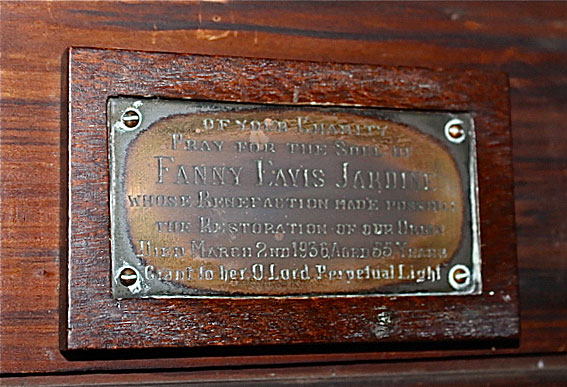
Memorial Plaque for Fanny Eavis Jardine
[Photograph by Trevor Bunning (September 2014)]
| Of your Charity Pray for the Soul of Fanny Eavis Jardine whose benefaction made possible the restoration of our Organ Died March 2nd 1936 Aged 55 Years Grant to her, O Lord, Perpetual Light.18 |
By the 1950s, two sources record the specification with a high degree of consistency as given below. The stop nomenclature had obviously been changed by this time, and the inclusion of a Horn Diapason 8ft on the Swell in one of the two sources may be an error. It appears that the 2-rank Swell Mixture, added in 1892, had been removed by the time.
| GREAT Open Diapason Stop Diapason & Hohl Flute Stopd Diapason, Treble Dulciana Principal Flute Fifteenth SWELL Bourdon [Horn Diapason] Lieblich Gedact Celeste Principal Piccolo Trumpet PEDAL Bourdon COUPLERS Swell to Great Swell to Pedal Great to Pedal |
8 8 8 8 4 4 2 16 [8] 8 8 4 2 8 16 |
[? bottom octave only] [described as 'not working' by Salisbury] [noted by Brohan, but not by Salisbury] [described as 'not working' by Salisbury] |
Swell tremulant [described as 'not working' by Salisbury]
Attached drawstop console
Pedalboard: straight & parallel
Hitchdown swell lever
Mechanical action.19
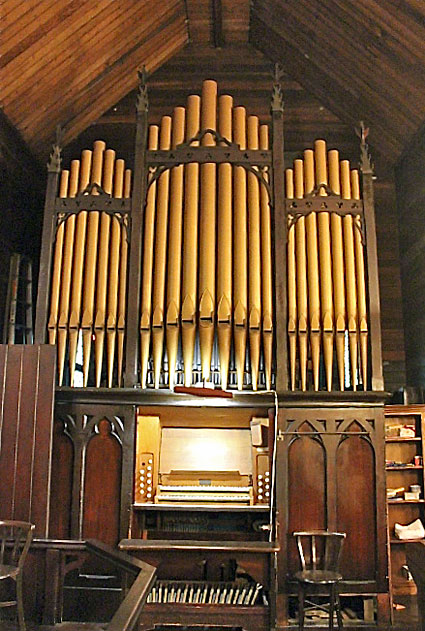
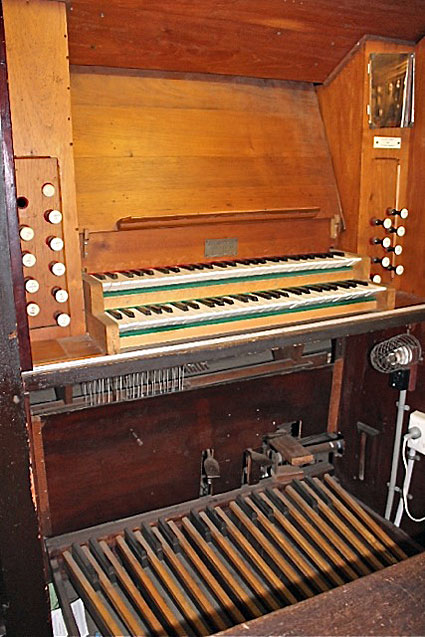
The James Cole organ, partially altered by John Hamer-Howorth in 1968
[Photographs by Trevor Bunning (September 2014)]
A partial rebuilding of the organ was commenced in 1968 by Fr John Hamer-Howorth (d.1988), who reported at the time that two sets of pipes in the Swell Organ were missing. His proposals included new Great and Pedal pneumatic soundboards, extension of the Pedal Bourdon to 8ft pitch, addition of a Swell Super Octave coupler, a 'new' radiating and concave pedalboard, provision of a balanced swell pedal and consequent modification of the swell shutters, new console fittings, and a revised specification in which the two manuals would be reduced to one.20

Hamer-Howarth's nameplate
[Photograph by Trevor Bunning (September 2014)]
Hamer-Howorth's work in Queensland included several organs, all using second-hand English pipework: at St Andrew's Anglican Church, Caloundra (1967-73), St Alban's Anglican Church, Auchenflower (1971-72), and St David's Presbyterian Church, Toowoomba (1977). Inspection of the Ipswich organ in 1973, 1989 and 2004 suggests, fortunately, that few of Hamer-Howorth's proposals were carried out. New stop knobs and keyboards (covered in plastic) were fitted, but the original keyboards have remained in storage at the church.21 The swell shutters were changed from horizontal to vertical; the original hitchdown swell lever was replaced crudely with a balanced swell pedal; and the original parallel and flat pedalboard was crudely modified to become radiating.
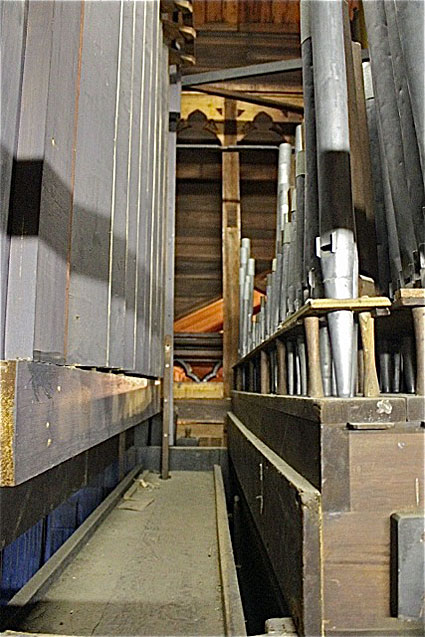
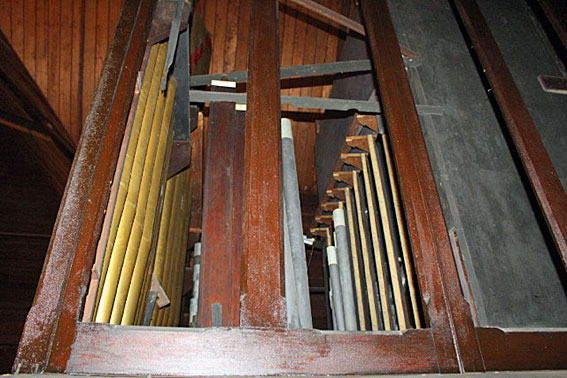
Swell shutters modified from horizontal to vertical
[Photographs by Trevor Bunning (September 2014)]
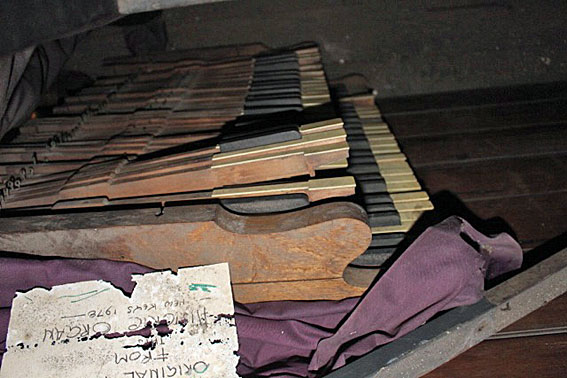
Original keyboards of the James Cole organ, stored behind the organ
[Photograph by Trevor Bunning (September 2014)]

Pedalboard, modified from parallel to radiating
[Photograph by Kelvin Hastie (September 2014)]
Following Hamer-Howorth's work in 1968, the stop nomenclature at the console has been as follows:
| GREAT Open Diapason Stopd Bass Stopd Diapason Dulciana Principal Flute Fifteenth SWELL Stopd Diapason Wood Bass Bell Gamba Principal Piccolo Cornopean [2 spare stop knobs] PEDAL Bourdon COUPLERS Swell to Great Swell to Pedal Great to Pedal |
8 8 8 8 4 4 2 8 8 8 4 2 8 16 |
[bottom octave] [Tenor C] [Tenor C] [wood, Tenor C] [wood, Tenor C] [bottom octave] [Tenor C] [wood] |
Compass: 56/30
Balanced swell pedal [not original]
Pedalboard: radiating and flat [altered; originally parallel and flat]
3 composition pedals to Great Organ
Mechanical action.22
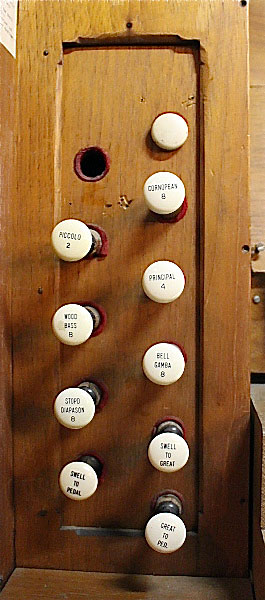
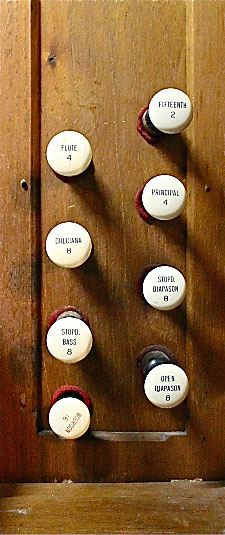
The stop jambs since 1968
[Photographs by Trevor Bunning (September 2014)]
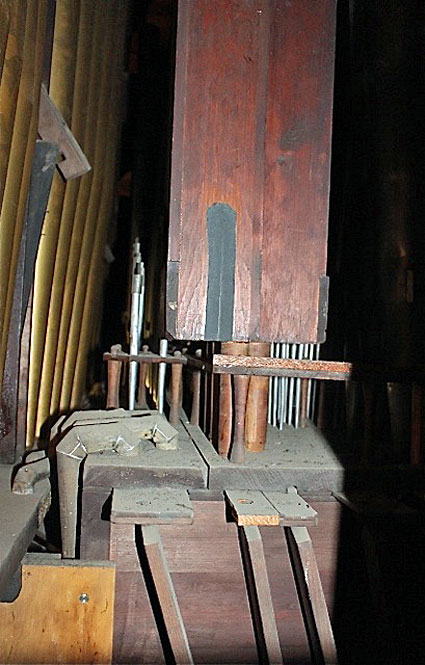
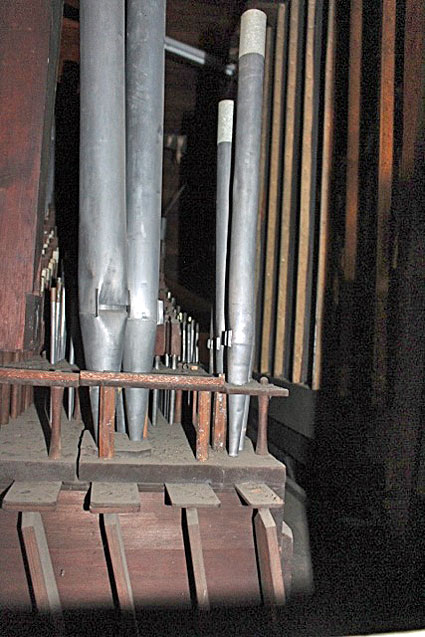
Original Great soundboards and sliders
[Photographs by Trevor Bunning (September 2014)]
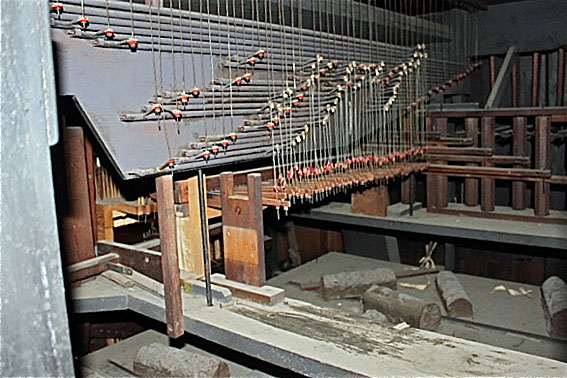
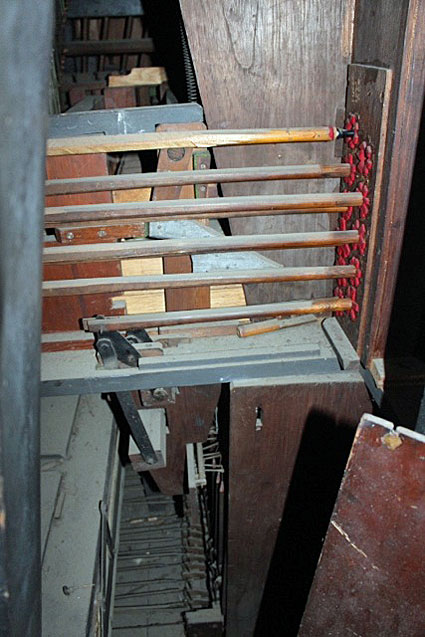
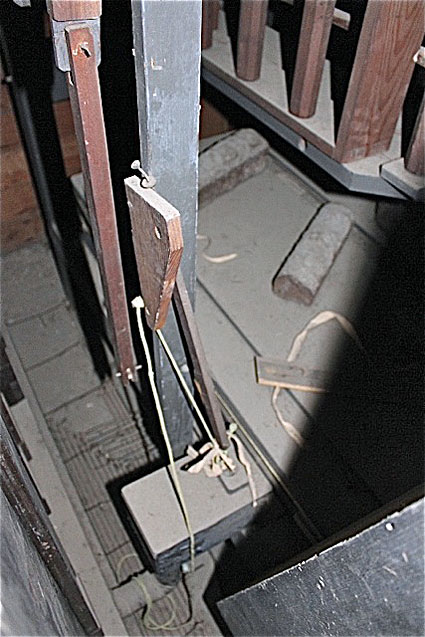
Original playing action, stop action and bellows
[Photographs by Trevor Bunning (September 2014)]
Despite at least two changes of stop nomenclature over a period of more than a century, it appears that most of James Cole's 1878 organ has survived intact. The soundboards and most of the original playing and stop action remain in place, and the double-rise bellows have been retained. The pipework is now in appalling condition, with slides fitted, but most of it appears to be original. The original Great pipework and specification appear to be intact, although the top pipes of the Fifteenth 2ft are missing.
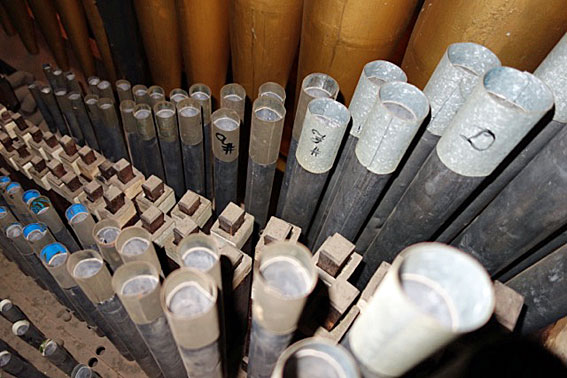
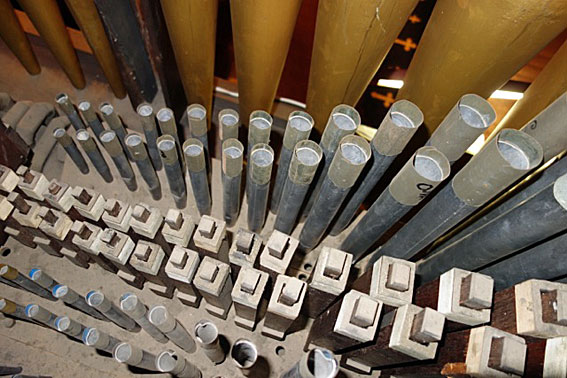
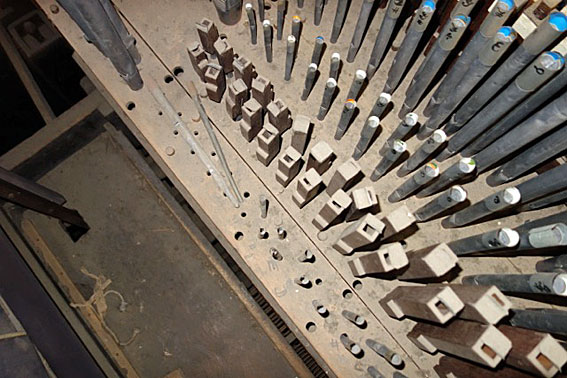
Great Pipework (from front to back of the organ):
Open Diapason, Stopped Diapason, Dulciana, Principal, Flute (wood), Fifteenth
[Photographs by Simon Pierce (September 2014)]
There has been more alteration to the Swell than to the Great. The original six-slider soundboard remains intact, together with a seventh (now empty) slider clamped to the front of the chest in 1892 for the 2-rank Mixture.


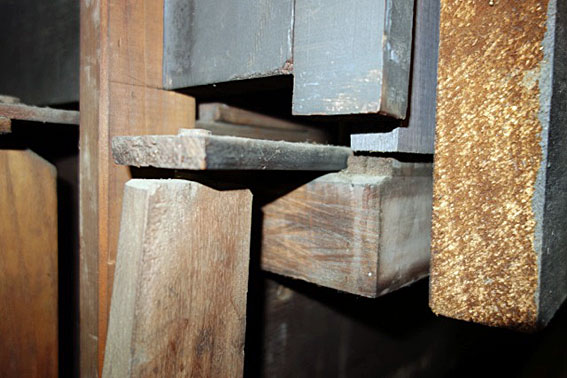
The Swell sliders (top), showing the original six (middle)
and a seventh slider (bottom) 'clamped on' at the front of the chest
[Photographs by Simon Pierce (September 2014)]
Inside the Swell box at the rear, the original Bourdon 16ft (full compass) has been replaced by a Stopped Diapason (Ten. C), with stoppers reminiscent of those used by the Whitehouse firm.23 The space originally occupied by the bottom octave of the Bourdon 16ft at the rear of the box gives the impression of a second spare slider (as described by Hamer-Howarth), but the holes for wind conveyencing to the bottom twelve notes of the Bourdon are still visible on the outside of the swell box.
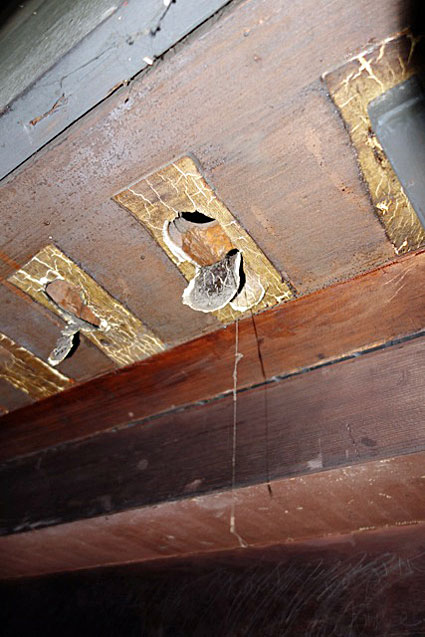
Wind-conveyancing holes for the bottom octave
of the Bourdon 16ft at the rear of the Swell Box
[Photograph by Simon Pierce (September 2014)]
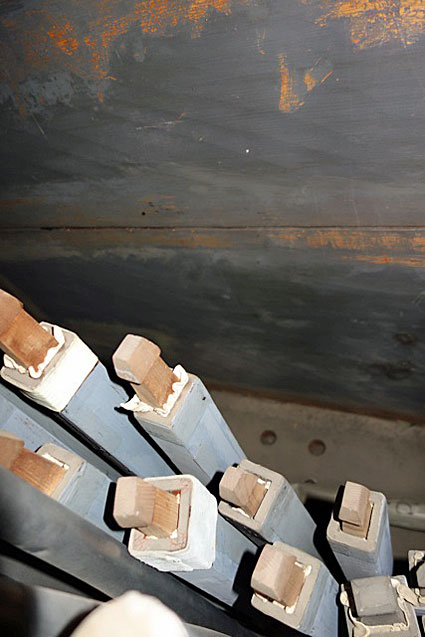
Stopped Diapason 8ft (Ten. C), apparently replacing the original Bourdon 16ft,
the bottom octave of which occupied the space at the rear of the swell box
[Photograph by Simon Pierce (September 2014)]
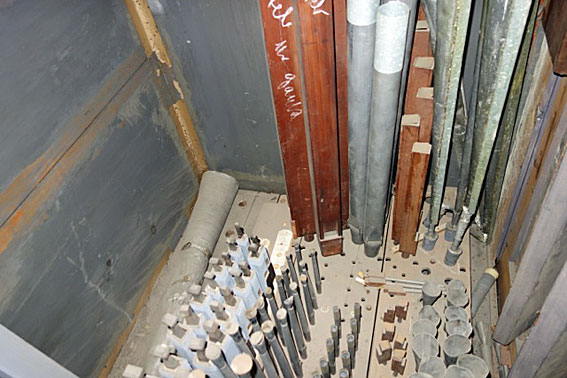
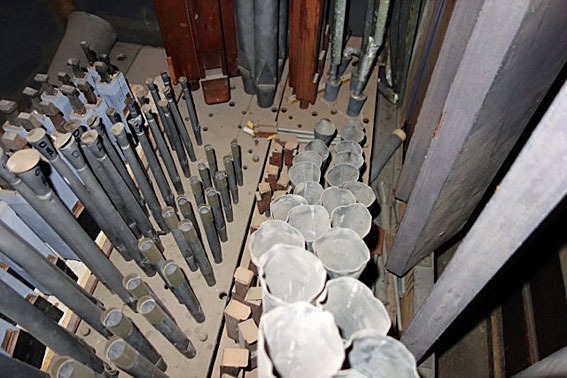
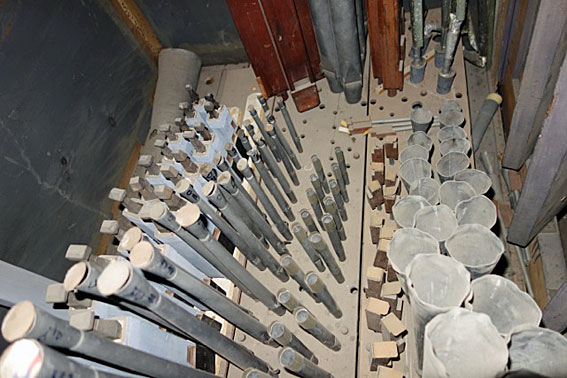
Swell pipework (from back to front of the box):
[spare slide], Stopped Diapason, Viol di Gamba, Gemshorn, Piccolo, Cornopean, [spare slide for 2-rank mixture]
[Photographs by Simon Pierce (September 2014)]
There is no record of when the Swell Bourdon was replaced or when the 2-rank Mixture was removed. Hamer-Howorth's observation in 1968 that there were two spare slides suggests that these changes were made earlier than this, while the specifications recorded by Salisbury (undated) and Brohan (c.1952) show that the Swell Bourdon remained in place at least until the 1950s.
Despite its chequered history, this instrument is a prime candidate for restoration along strictly historical lines. Its significance lies not only in its association with the Albert Street Wesleyan Church, but also with the rarity of Cole's work in Australia, and the fact that it is one of very few mechanical-action organs to have survived in Queensland from this period without the destruction of its original mechanism.
A fund-raising appeal, under the auspices of OHTA, was launched formally in the latter half of 2018.24 The work of restoration will be undertaken by Hargraves Pipe Organs of Mt Evelyn, Vic.
____________________________________________________________________
1 An earlier version of this article appeared as 'The Historic Organ at St Thomas' Anglican Church, North Ipswich,' OHTA News, vol. 27, no. 3 (July 2003), pp. 16-18; subsequent letter in OHTA News, vol. 28, no. 2 (April 2004), pp. 2-3.
2 The Centenary of St Thomas' Anglican Church, North Ipswich, 1889-1989 [privately printed, 1989].
3 E.J.T. Barton, ed. Jubilee History of Queensland: a Record of Political, Industrial, and Social Development, from the Landing of the First Explorers to the Close of 1909 (Brisbane: H.J. Diddams, [c.1910]), p. 141.
4 'Diary of Events' for 10 Nov. 1878 in Pugh's Queensland Almanac ... for 1880.
5 The Weekly Advocate (Sydney, 22 November 1878), p. 280.
6 The Queensland Evangelical Standard (16 November 1878).
7 'Diary of Events' for 10 Nov. 1878 in Pugh's Queensland Almanac ... for 1880.
8 These were for St James' Anglican Church, Toowoomba; St Paul's Anglican Cathedral, Rockhampton; St Paul's Anglican Church, Maryborough; Wesley Church, Maryborough (now at Ss Peter & Paul's Catholic Church, Bulimba; Surface Hill Methodist Church, Gympie & the Wesleyan Church, Albert Street, Brisbane.
9 W. Frederic Morrison, The Aldine History of Queensland (Sydney: Aldine, 1888), II, Appendix, p. 220.
10 Personal communication to Mr Edward Salisbury from Mr Joseph Whitehouse, Snr (undated), and thence to G. Cox, c.1973.
11 George Fincham Letter Book 14, pp. 312-21 (State Library of Victoria).
12 The Queensland Times (9 April 1892), p. 6.
13 The Queensland Times (1 February 1900), p. 4.
14 The Queensland Times (11 December 1909), p. 4; The Queensland Times (23 December 1909), p. 5.
15 Whitehouse Bros Ledger (1922-1940), pp. 71-72, 204, 438; Whitehouse Bros Ledger (1940-1954), pp. 172-74.
16 'Year of Progress: St Thomas's Church. Annual Easter Meeting,' The Queensland Times (23 April 1937), p. 8; see also: The Courier-Mail (3 May 1937), p. 11.
17 Whitehouse Bros Ledger (1922-1940), p. 558.
18 Plaque noted by G. Cox, January 2004, and reported in OHTA News, vol. 28, no. 2 (April 2004), pp. 2-3.
19 Collected Organ Specifications of Bernie Brohan (c.1952) & Notebooks of Mr E.R. Salisbury (n.d.). This specification is also given in Organ Society of Queensland Newsletter, vol. 15, no. 2 (October 1987), p. 4, and is incorrectly described as "original" in The Organ Voice, vol. 25, no. 2 (June 1999), p. 6.
20 John Hamer-Howorth, 'Survey of the Pipe Organ in St Thomas's Nth Ipswich (1967-68)' - presented to St Thomas' Parish, 1 April 1968; Personal communication to G. Cox from John Hamer-Howorth, January 1973.
21 The keyboards were still stored behind the organ in 2014.
22 Specification noted by G. Cox, 1973, 1989, 2004 and 2014.
23 Observations by Simon Pierce, September 2014.
24 Ian Eckersley, 'Organ Restoration An Historic Venture,' Anglican Focus (27 September 2018), cited at https://anglicanfocus.org.au/2018/09/27/organ-restoration-an-historic-venture/