Holy Trinity Anglican Church
cnr Cameron & George Streets, Launceston
First organ, B. 1854 James Eagles, London.
Present organ, B. 1887 George Fincham, incorporating pipework from first organ.
Inst. present church 1902. Res. 1959 Davis & Laurie; new pedal action 1991 Hans Meijer.
2m., 14 sp.st., 3c., tr. Gt: 8.8.8.4.4.2. Sw: 16 divided.8.8.8.4.8. Ped: 16.16.
Historical and Technical Documentation by John Maidment
© OHTA (last updated May 2011)
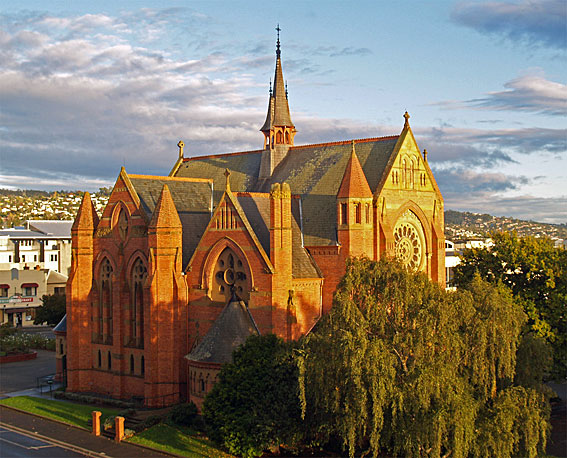
Holy Trinity Anglican Church, Launceston : exterior from south
[photograph by Brian Andrews (April 2010)]
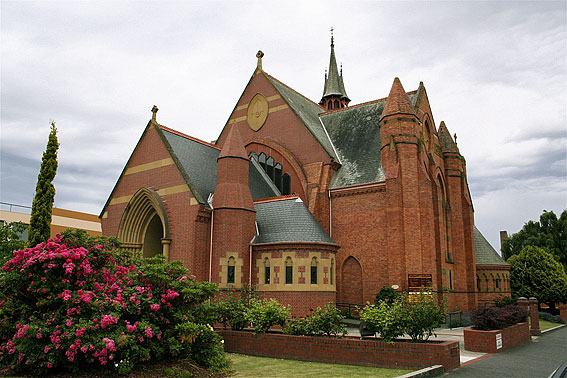
Holy Trinity Anglican Church, Launceston : exterior from west showing the 1980s additions
[photograph by Trevor Bunning (29 April 2011)]
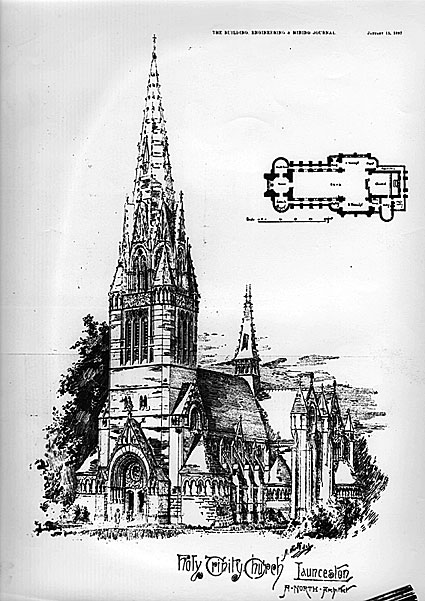
Holy Trinity Anglican Church, Launceston – Alexander North's initial design
[The Building, Engineering & Mining Journal, 15 January 1897]
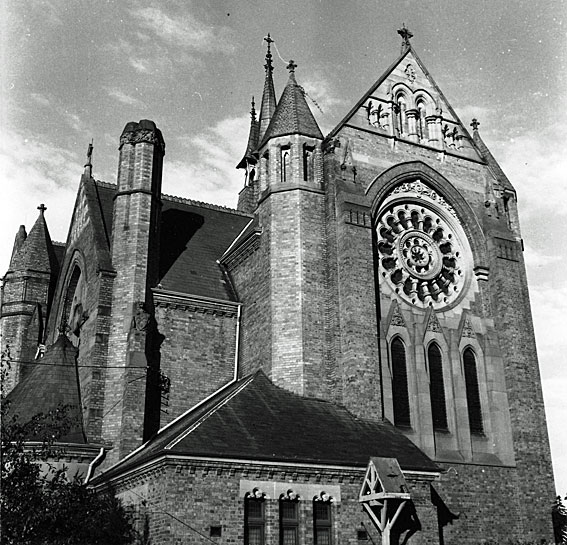
Holy Trinity Anglican Church, Launceston – east front
[photograph by John Maidment (January 1979)]
The present church, designed by Alexander North, was opened in 19021 and replaced an earlier building which had become unsafe. North's plan incorporated a spacious five-bay aisled clerestoried nave, with immense western tower, spire and flanking apses, but only the transepts, chancel, chapel and vestries were initially built.2 The completed building would have been well over 170 feet long. An alternative plan was produced by North in the 1920s that envisaged twin western towers linked by an arch that incorporated a projecting baptistery and window with perpendicular tracery; this was also unaffordable at the time. The present narthex was built in the 1980s on the site of the intended nave.
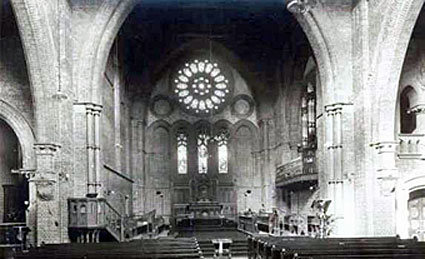
Holy Trinity Anglican Church, Launceston – interior looking east – an early view c.1909-1940
[State Library of Victoria]
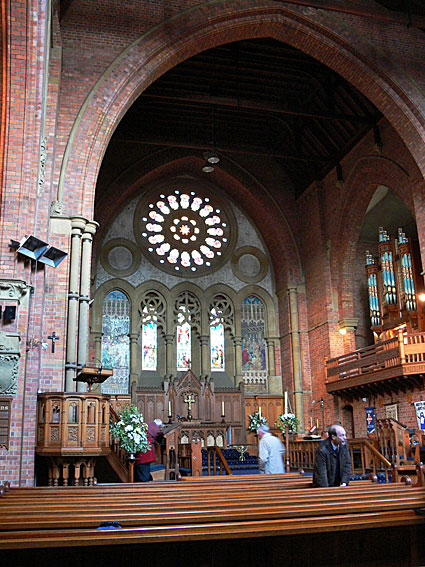
Holy Trinity Anglican Church, Launceston – interior looking east showing organ
[photograph by John Maidment (29 April 2011)]
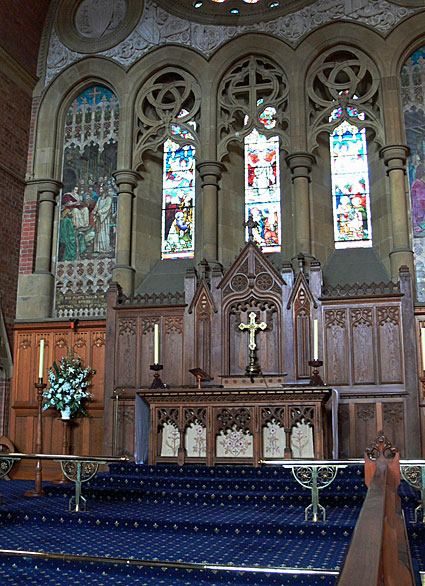
Holy Trinity Anglican Church, Launceston – interior showing high altar, reredos and opus sectile panels
[photograph by John Maidment (29 April 2011)]
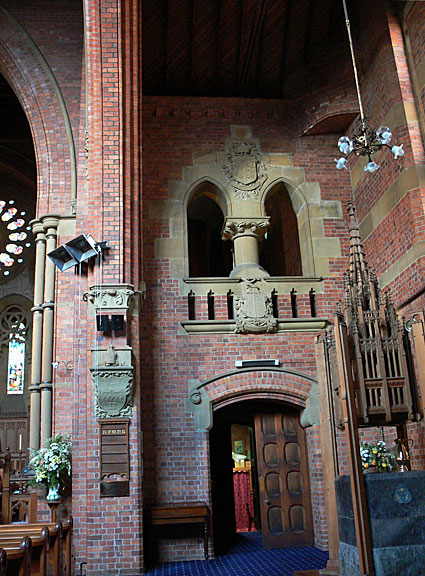
Holy Trinity Anglican Church, Launceston – interior showing organ loft opening and font cover
[photograph by John Maidment (29 April 2011)]
The building is of note for its impressive scale and conscious asymmetry. The eastern façade includes a large rose window with flanking turrets and an arcaded gable, and the roof ridge is crowned by a fleche of original design. Within, the detailing and fittings are of a high order including a splendid font and cover supported on a large wooden canopy carved by Gordon Cumming. Some of the stained glass is by the accomplished Melbourne artist William Montgomery. This was the most avant-garde Anglican church building in Australia at the time of its construction and has a huge chancel and choir built on a cathedral scale.
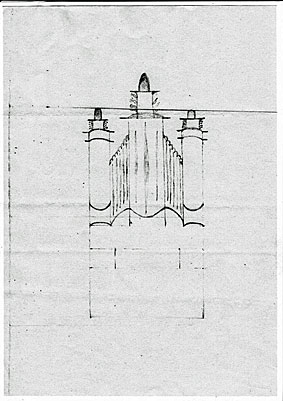
Holy Trinity Anglican Church, Launceston –
sketch of the organ offered to Holy Trinity Church by William Hobart
[Holy Trinity Archives, courtesy of Jenny Gill]
The earliest instrument in use at Holy Trinity Church was a seraphine. In 1842, William Hobart, of Charles Street, Launceston, offered a small organ to the church that he had built for his own use, a single-manual instrument with a chorus up to Sesquialtera, and contained within an elegant case; it is unclear whether this was purchased. In 1854, a new single-manual organ arrived from the London organbuilder James Eagles. Sadly, this instrument did not receive any comment in the local newspapers at the time. It was in use for more than 30 years.3
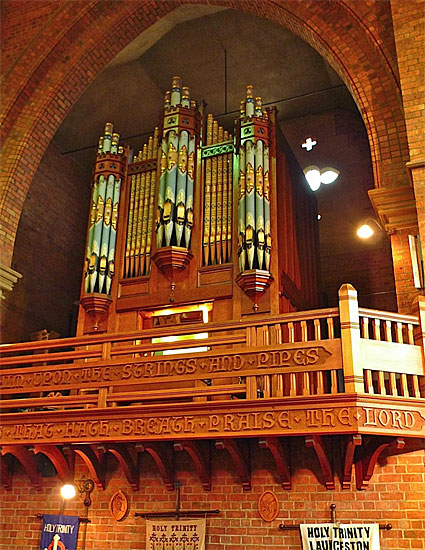
Holy Trinity Anglican Church, Launceston – the Fincham organ
[photograph by Trevor Bunning (29 April 2011)]
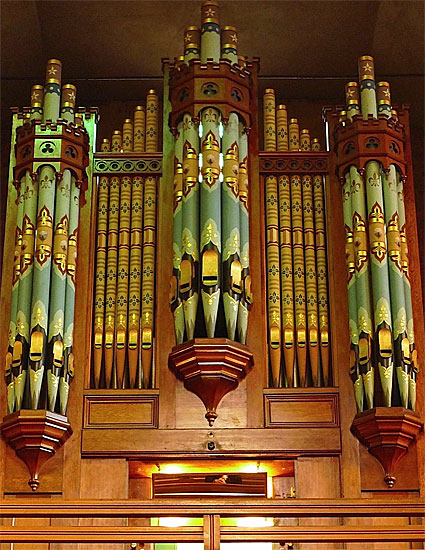
Holy Trinity Anglican Church, Launceston – the Fincham organ
[photograph by Trevor Bunning (29 April 2011)]
The present organ, placed in a spacious vaulted gallery to the south of the chancel (for which North sought advice on its design from Geo. Fincham & Son) was built in 1887 for the former church by George Fincham, of Richmond, Victoria, at a cost of £445 and incorporates some pipework from the previous Eagles instrument.4 The divided swell 16ft is unique in Fincham's oeuvre, and may have been inspired by the two Bevington two-manual organs in Tasmania in Hobart and Launceston; William Anderson also used such an arrangement.
A contemporary report stated:
We learn that a new organ manufactured by Mr. Geo. Fincham, of Richmond, Victoria, has been secured, and this will be placed to the right of the chancel. The instrument will have six stops on the great organ, six stops on the swell, two on the pedal, and three couplers, as well as three compound [sic] to the great and swell. The case will be of stained pine varnished, with speaking tubes illuminated in gold and colours. All the pipes in the old organ will be utilised in connection with the construction of the new one, the cost of which will be about £400 in the factory, which really represents an organ of £500 value when erected in the church. We understand there is some little difficulty experienced in obtaining a competent man to erect the organ, as the men from the firm of whom the organ has been bought object to come to Launceston in consequence of the quarantine regulations in force in Victoria.5
In 1895 a Dulciana was inserted in place of the former Gamba and in 1902 a pedal Bourdon and hydraulic engine were added by George Fincham & Son when the organ was moved into the present building.6 Davis & Laurie Pty Ltd carried out restoration work in 1959 and in 1991 Hans Meijer, of Launceston, refurbished part of the pedal action.7
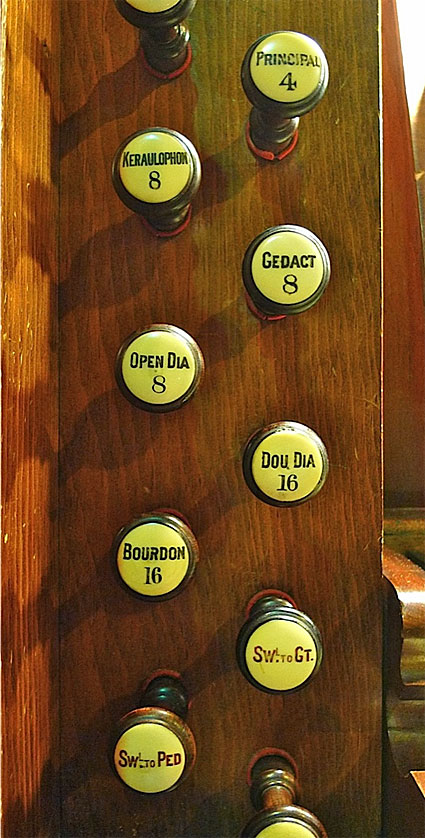
Holy Trinity Anglican Church, Launceston – the Fincham organ – left hand stop jamb
[photograph by Trevor Bunning (29 April 2011)]
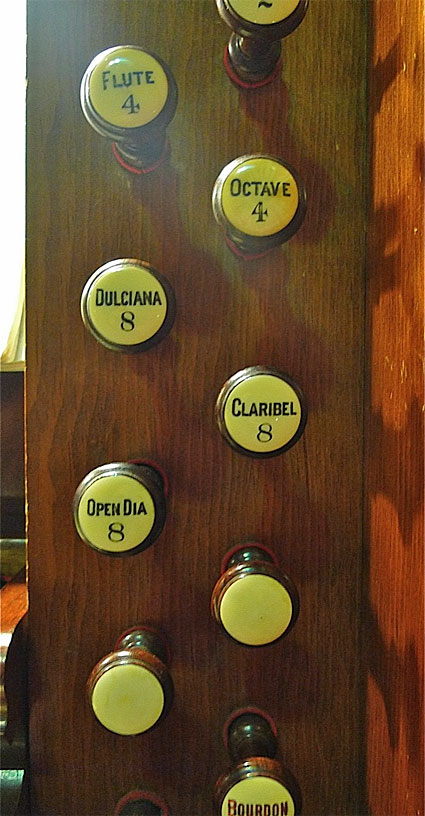
Holy Trinity Anglican Church, Launceston – the Fincham organ – right hand stop jamb
[photograph by Trevor Bunning (29 April 2011)]
GREAT
Open Diapason
Claribel
Dulciana
Octave
Flute
Fifteenth
Swell to Great
SWELL
Bourdon
Double Diapason
Open Diapason
Gedact
Keraulophon
Principal
Oboe
PEDAL
Open Diapason
Bourdon
Great to Pedal
Swell to Pedal
|
8
8
8
4
4
2
16
16
8
8
8
4
8
16
16
|
CCC-BBB
CC
gvd. bass
|
6 composition pedals
trigger swell lever
mechanical key & stop action
compass: 56/308
1 Dorothea I. Henslowe. Our Heritage of Anglican Churches in Tasmania (Moonah, Tas.: Mercury-Walch, c.1979), p.40
2 A perspective drawing and plan for the church were published in the Building Engineering and Mining Journal for 15 January 1897 and subsequently issued as an offprint by the church.
3 Information kindly supplied by Jenny Gill June 2009
4 Graeme Rushworth, 'Notes on some Early Tasmanian Organs and also on the Commencement of the Hobart Town Choral Society', OHTA News, vol. 23, no. 2 (April 1999), p.34
5 Launceston Examiner, 24 October 1887, p.2:
6 E.N. Matthews, Colonial Organs and Organbuilders (Carlton, Vic.: Melbourne University Press, 1969),p. 200
7 Notes, John Maidment
8 Spec. noted John Maidment 1974, 2011