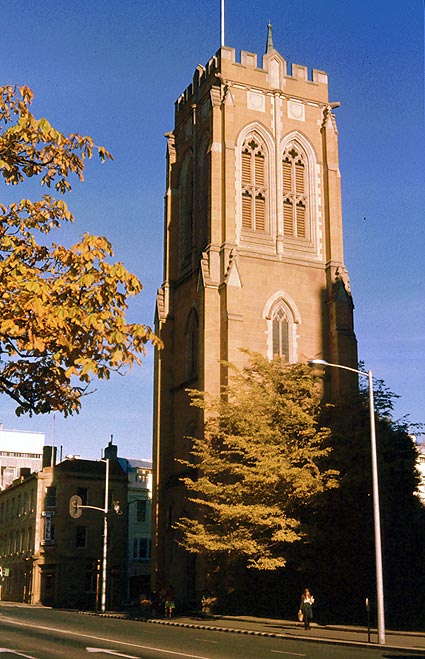
St David's Anglican Cathedral
cnr Macquarie & Murray Streets, Hobart
B. 1858 Bishop & Starr, London;
Reb. & enl. 1917 Geo. Fincham & Son (addition of choir organ).
Reb. & enl. 1958 J.W. Walker & Sons, Ruislip, Middlesex.
3 manuals., 54 speaking stops, 12 couplers, electro-pneumatic
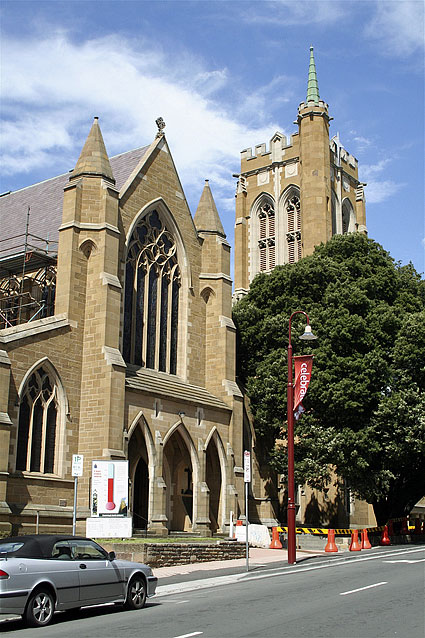
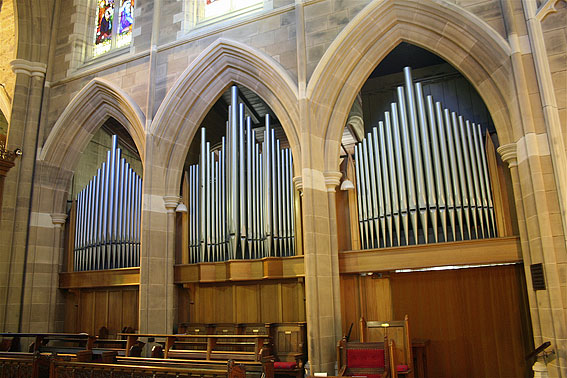
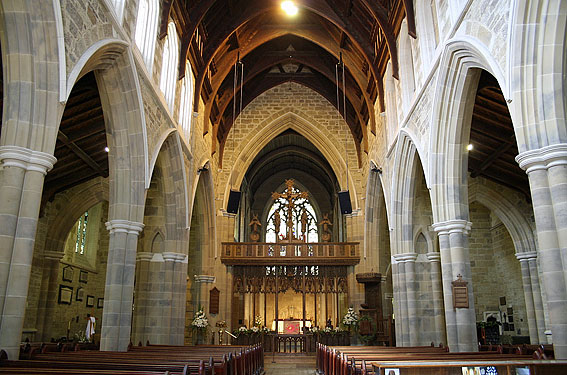
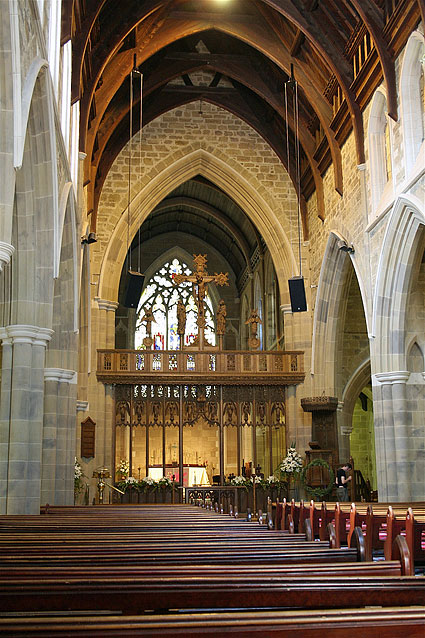
St David’s is a stone Gothic Revival Cathedral begun in 1868 and completed in 1936 to the original design of the English architect G.F. Bodley. It is the second church on the site. The arcaded entry features a large west window with fine tracery in the gable-end balanced by buttressed turrets. Other features include a simple square tower in Oatlands stone, with castellated parapet and quatrefoil tracery to the openings. There is a fine close on the southern side including old trees. With associated ecclesiastical buildings, it forms an historic precinct in a central location with the tower as a landmark. [1]
From the Cathedral website:
The first organ of St David's Cathedral was a small instrument of one manual built by John Gray of London in 1823. Although the original Georgian cathedral building was not large, the organ was probably soon felt to be inadequate to accompany the hymn-singing of its congregation.
| Manual Open Diapason Stopped Diapason Principal Twelfth Fifteenth Cornet Sexquialtera Mixture |
8 8 4 2-2/3 2 III III II |
Treble Bass |
Action: tracker; compass: GGG-f3 (no GGG#)
In 1858 it was moved to St Matthew's Anglican church Rokeby (now an eastern-shore suburb of Hobart). This fine instrument, the oldest in the country, retains its original free-standing case and is still playing, modernized only with an electric blower.
Its successor at St David's was an instrument of two manuals and pedals built by another famous London firm, Bishop and Starr. A small amount of its pipework (notably the Clarabella, Flute and Dulciana) has been retained in the present instrument.
The 1858 specification was:
| Great Open Diapason Stopped Diapason Clarabella Dulciana Principal Flute Twelfth Fifteenth Clarionet Swell Open Diapason Stopped Diapason Principal Fifteenth Mixture Cornopean Oboe Pedal Bourdon |
8 8 8 8 4 4 2-2/3 2 8 8 8 4 2 III 8 8 16 |
Mid C |
Action: tracker
Moved into the new and larger cathedral church in 1874, it remained unaltered until 1909. In that year, and again in 1916, it was enlarged by the Melbourne firm of George Fincham & Sons. A third manual was added, the action converted to tubular pneumatic, and most of the earlier pipework replaced. Still, however, written records from the next few decades indicate that dissatisfaction was felt with the organ's ability to lead a large congregation.
The 1916 specification was:
| Great Open Diapason I Open Diapason II Stopped Diapason Claribel Salicional Principal Flute Twelfth Fifteenth Trumpet Swell Double Diapason Open Diapason Stopped Diapason Gamba Celeste Principal Fifteenth Mixture Cornopean Oboe Clarion Choir Gedacht Wald Flute Dulciana Flute Traverso Clarionet Pedal Open Diapason Bourdon Principal |
8 8 8 8 8 4 4 2-2/3 2 8 16 8 8 8 8 4 2 III 8 8 4 8 8 8 4 8 16 16 8 |
Claribella MidC 1909 replaced Dluciana 1916 new 1916, replaced Clarionet prep. for 1909, inst. 1916 new division added 1916 new 1916 new 1916 from Great 1916? new 1916 from Great 1916? new 1916 |
9 couplers
Action: Tubular pneumatic
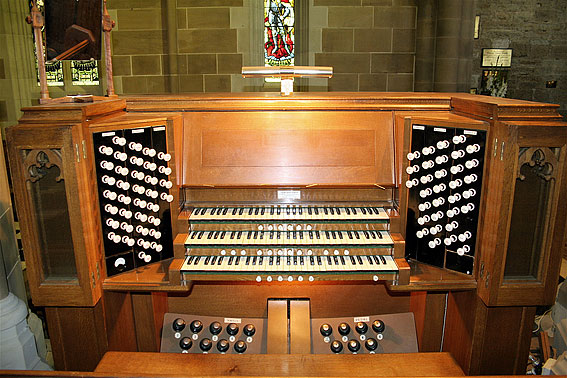
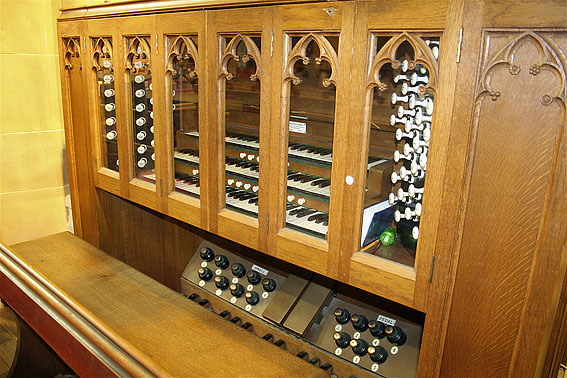
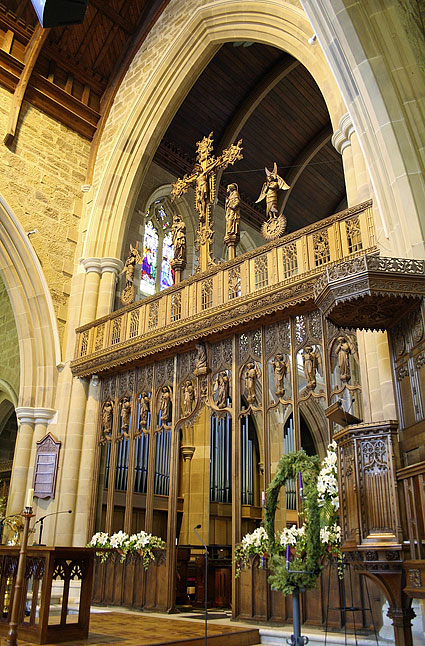
In 1958 a major rebuilding was undertaken by J. W. Walker & Sons. The action was converted to electro-pneumatic, a new blower provided, and the console moved from the organ case to the south side of the choir.
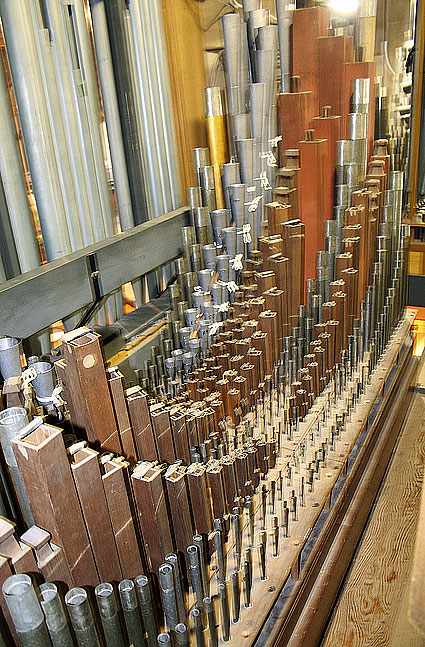
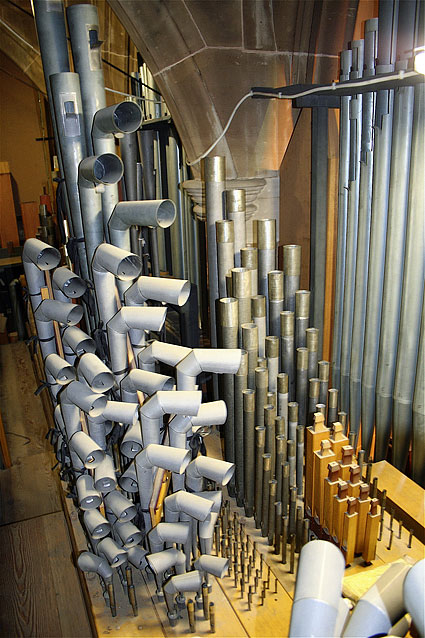
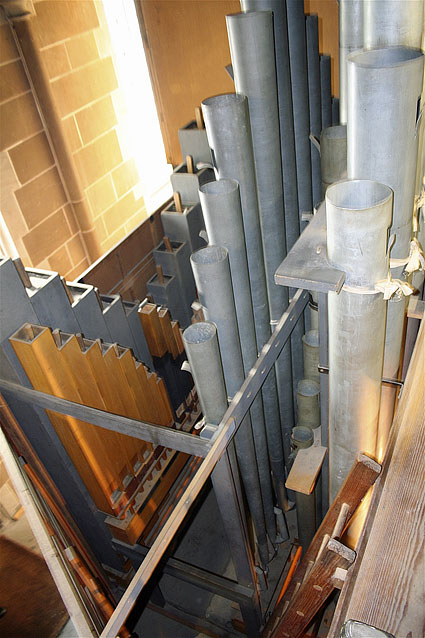
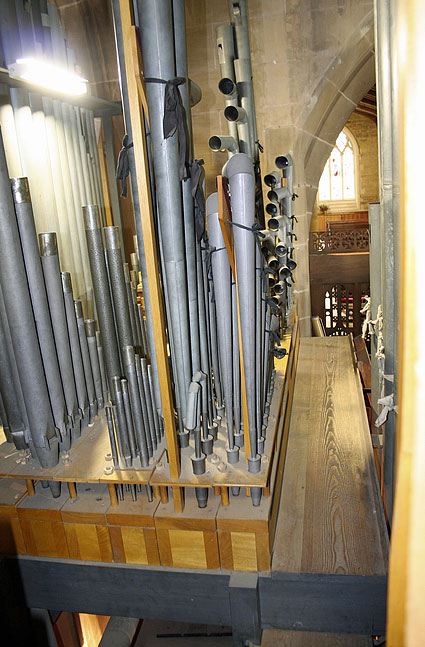
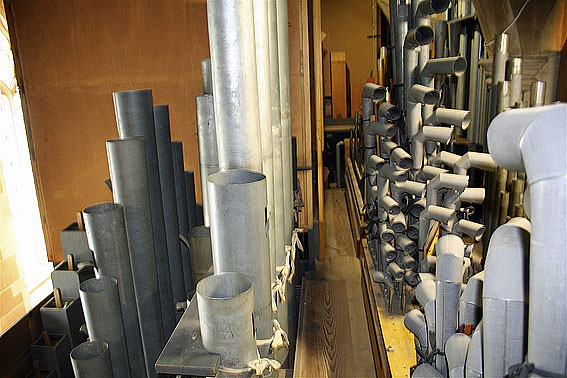
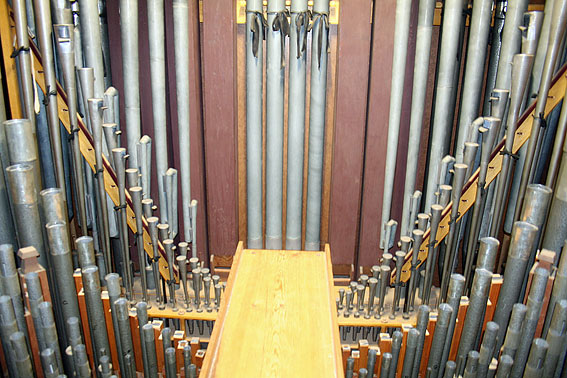
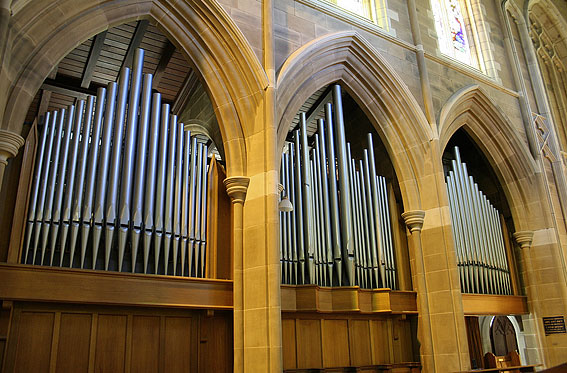
Most of the existing pipework was retained unaltered, but there were substantial additions to all departments, including high-pressure reeds available on the Great, Choir and Pedal. The organ now occupied all three bays of the north choir aisle, with a new case-front.
Between 1999 and 2005 substantial tonal renovation was carried out by the local firm of Gibbs & Thomson. The specification is little changed, but much rescaling and revoicing have been undertaken: in particular, the Great and Swell Mixtures and all the Choir pipework have been remodelled, the reedwork revoiced, and the Pedal Open Wood rescaled.
In 2017, Peter D.G. Jewkes Pty Ltd undertook some mechanical upgrading of the instrument, including restoration of the organ console and the installation of a new multi-level capture system.[2]
The specification is:
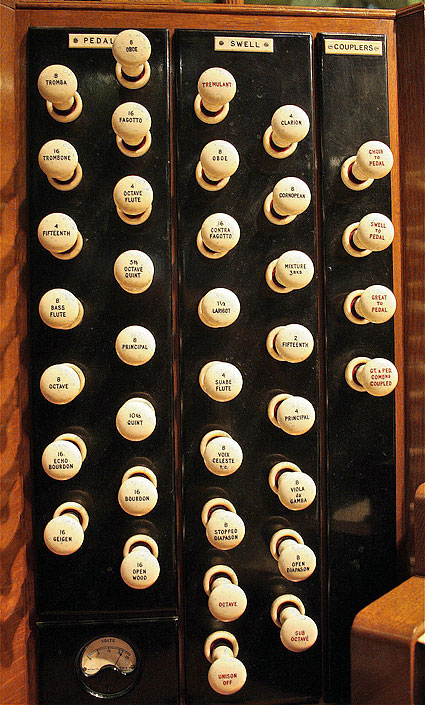
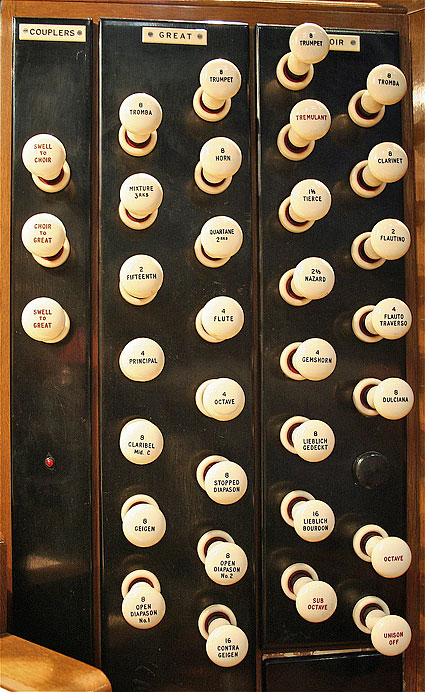
| GREAT Contra Geigen Open Diapason no. 1 Open Diapason no. 2 Geigen Clarabel (Mid. C) Stopped Diapason Octave Principal Flute Fifteenth Quartane Mixture Horn Tromba Trumpet SWELL Open Diapason Stopped Diapason Viola da Gamba Celeste (tenor C) Suabe flute Principal Fifteenth Larigot Mixture Contra Fagotto Oboe Cornopean Clarion Tremulant CHOIR Lieblich Bourdon Gedackt Dulciana Flauto Traverso Gemshorn Nazard Flautino Tierce Clarinet Tromba Trumpet Tremulant PEDAL Open Wood Contra Geigen Bourdon Echo Bourdon Quint Octave Principal Bass Flute Octave Quint Fifteenth Octave Flute Contra Fagotto Trombone Tromba Oboe |
16 8 8 8 8 8 4 4 4 2 II III 8 8 8 8 8 8 8 4 4 2 1-1/3 III 16 8 8 4 16 8 8 4 4 2-2/3 2 1-3/5 8 8 8 16 16 16 16 10-2/3 8 8 8 5-1/3 4 4 16 16 8 8 |
A A A B E C C D D D D B E G A F D F G H F F H F C B C |
COUPLERS
Sw. to Gr.
Sw. to Ch.
Sw. to Ped.
Gr. to Ped.
Ch. to Gr.
Ch. to Ped.
Sw. Octave, Suboctave & Unison off
Ch. Octave, Suboctave & Unison off
ACCESSORIES
Thumb pistons: 6 each to Sw., Gr. and Ch.; Sw. to Gr., Sw. to Ped., Gr. to Ped., 3 generals, Gen. cancel.
Toe pistons: 6 each to Sw. and Gr.: Gr. to Ped.; 3 generals.
|
||
 |
 |
|
 |
 |
|
 |
 |
|
|
||
|
||
|
||
|
||
|
||
 |
 |
|
|
||
Photos: Trevor Bunning (Dec 2008)
[1] The Heritage of Australia – The Illustrated Register of the National Estate by: Australian Heritage Commission. Published: The Macmillan Company of Australia p/l 1981
[2] 'Off the Chest: News from Organ Builders,' The Sydney Organ Journal, vol. 48, no. 3 (Winter 2017), p. 43.