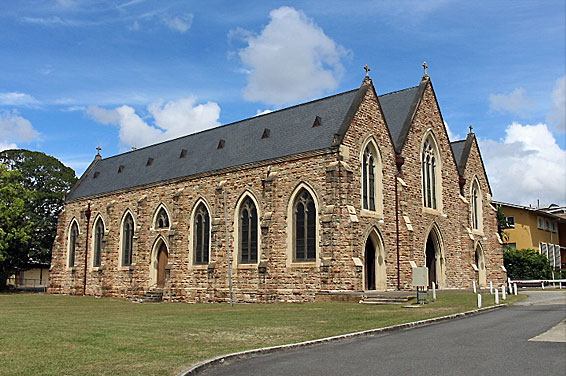
St Patrick's Catholic Church, Fortitude Valley
[Photograph by Trevor Bunning (September 2014)]
St Patrick's Catholic Church, Fortitude Valley
[Photograph by Trevor Bunning (September 2014)]
Historical and Technical Documentation by Geoffrey Cox
© OHTA 1989, 2011, 2014, 2018 (last updated August 2018)
The first St Patrick's Church in Fortitude Valley was a wooden structure built around 1860 with a frontage in Wickham Street, opposite where Duncan Street now adjoins it.1 The foundation stone of the present church, in Morgan Street, was laid by Bishop O'Quinn in September 1880, and the building was consecrated on 3 December 1882 by Archbishop Dunne. A Victorian Gothic church comprising a nave and two wide side-aisles, it is constructed of local porphyry, faced with Murphy's Creek stone.2 The building was designed by the Italian architect, Andrea Stombuco, who had settled in Brisbane in the 1870s.3
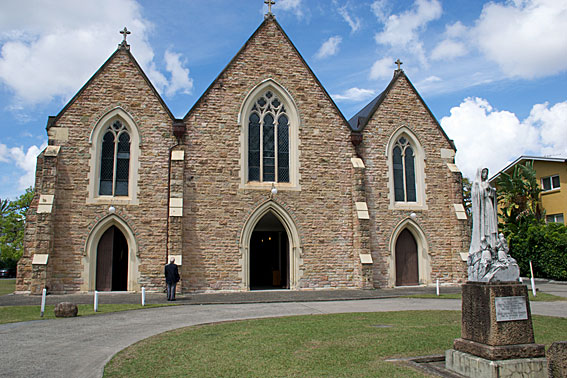
The triple-gabled west front of St Patrick's Catholic Church
[Photograph by Rodney Ford (September 2014)]
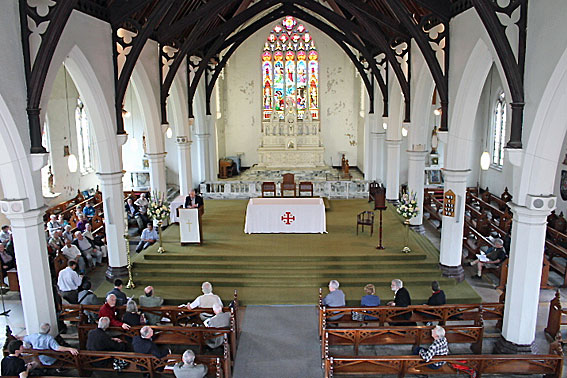
The interior of St Patrick's Catholic Church
[Photograph by Trevor Bunning (September 2014)]
The ornate casework of the organ, with its non-speaking (though real) façade pipes, together with the size and layout over three manuals, suggests strongly that it was designed as a residence instrument. It has been conjectured that Stombuco, the architect of the church, may also have been responsible for the casework, which is unusual in its mannered clutter of classical detail.4
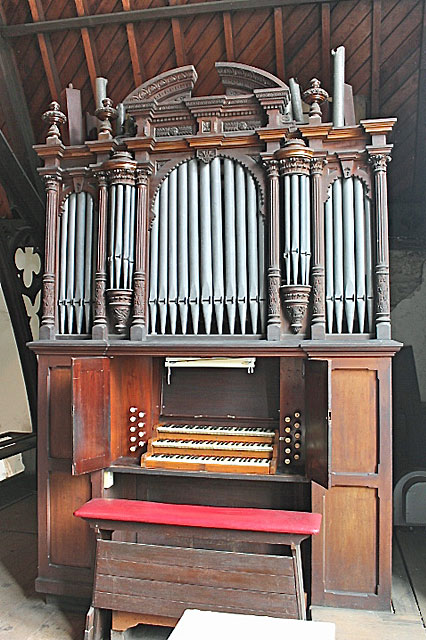
The organ of St Patrick's Catholic Church, Fortitude Valley
[Photograph by Trevor Bunning (September 2014)]
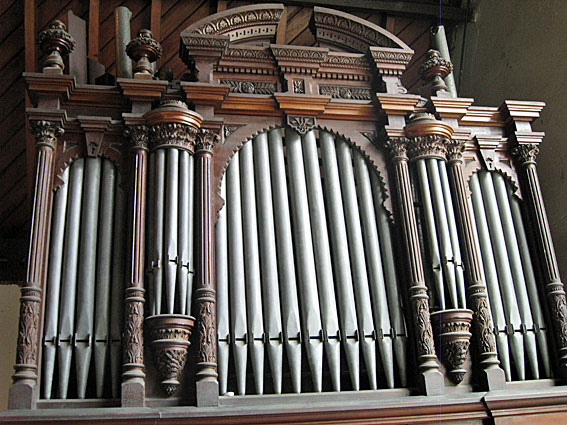
The ornate casework, possibly designed by Stombuco
[Photograph by Geoffrey Cox (September 2014)]
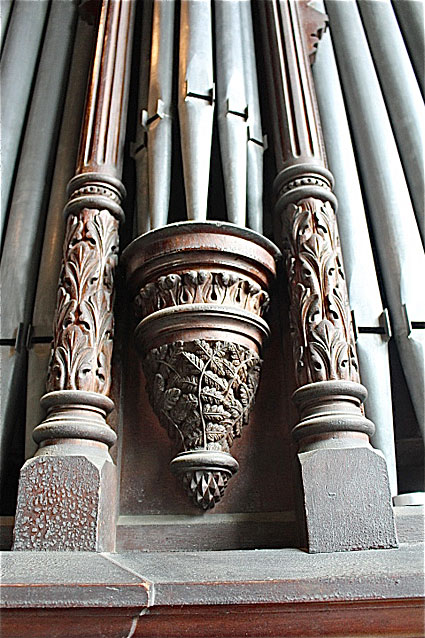
Detail of the casework
[Photograph by Trevor Bunning (September 2014)]
E.J.T. Barton's Jubilee History of Queensland (c.1910) records that the organ 'was originally built to the order of the Hon. W.H. Wilson, a musician of no mean order, from whom it was purchased.'5 The Welsh-born solicitor, Walter Horatio Wilson (1839-1902) had migrated with his family to Melbourne in 1853, and moved with his wife to Brisbane in 1865. After a period of ill health, he left in 1880 for the USA and England, but returned to Brisbane in 1881. He was organist at St Thomas' Anglican Church, Toowong, for twelve years.6
Wilson's name is associated also with the Willis organ now at the Uniting (formerly St Andrew's Presbyterian) Church, Gympie, which he purchased in 1884 for his own residence, but disposed of it in 1887 to the Wickham Terrace Presbyterian Church, Brisbane. Graeme Rushworth's conjecture that the Fortitude Valley instrument dates from c.1888 is presumably based on the assumption that Wilson acquired it after disposing of the Willis instrument.7 This date can now be shown to be incorrect.
The identity of the builder of the organ and the date of its installation at St Patrick's have long been the subject of conjecture.8 A newspaper report of the opening and consecration of St Patrick's Church in December 1882 reveals, however, that the organ was installed at this time. The builder of the organ is named, both in the church records,9 and in the newspaper report of the consecration, as Thomas Christmas:
CONSECRATION OF ST. PATRICK'S CHURCH.
The Roman Catholic Church of St. Patrick, Fortitude Valley, was consecrated yesterday by his Lordship the Right Rev. Dr. Dunne, and dedicated to the purposes of divine worship. The church is situated in Ann-street, Valley, on the site of what was formerly called the Paragon Nursery. The foundation stone was laid by the late Bishop O'Quinn about two years ago, and the edifice as it now stands reflects great credit on the architect, Mr. Stombuco, and Mr. O'Keeffe, the contractor. The building - a handsome one of Gothic architecture - is of the best description of dressed rock-work, faced with stone from Murphy's Creek. It is composed of a centre and two side aisles with chancel and vestry.
. . . A gallery for the organ and choir is placed opposite the high altar at the east end of the building, and the instrument, which cost about £360, and was built almost entirely by Mr. Christmas, of Petrie's Bight, seems, both in tone and power, to be very suitable.10
Now that the date of the organ's installation at St Patrick's is known, it appears that it may have been built for W.H. Wilson around 1881, when he returned to Brisbane.
Thomas C. Christmas was born in Stoke Newington, London, in 1849, and emigrated to South Australia in 1855 before moving to Melbourne in 1856.11 In Melbourne he was listed in 1877 as an organbuilder working in partnership with John Abbott as 'Abbott & Christmas, Clarendon Street, Emerald Hill.'12
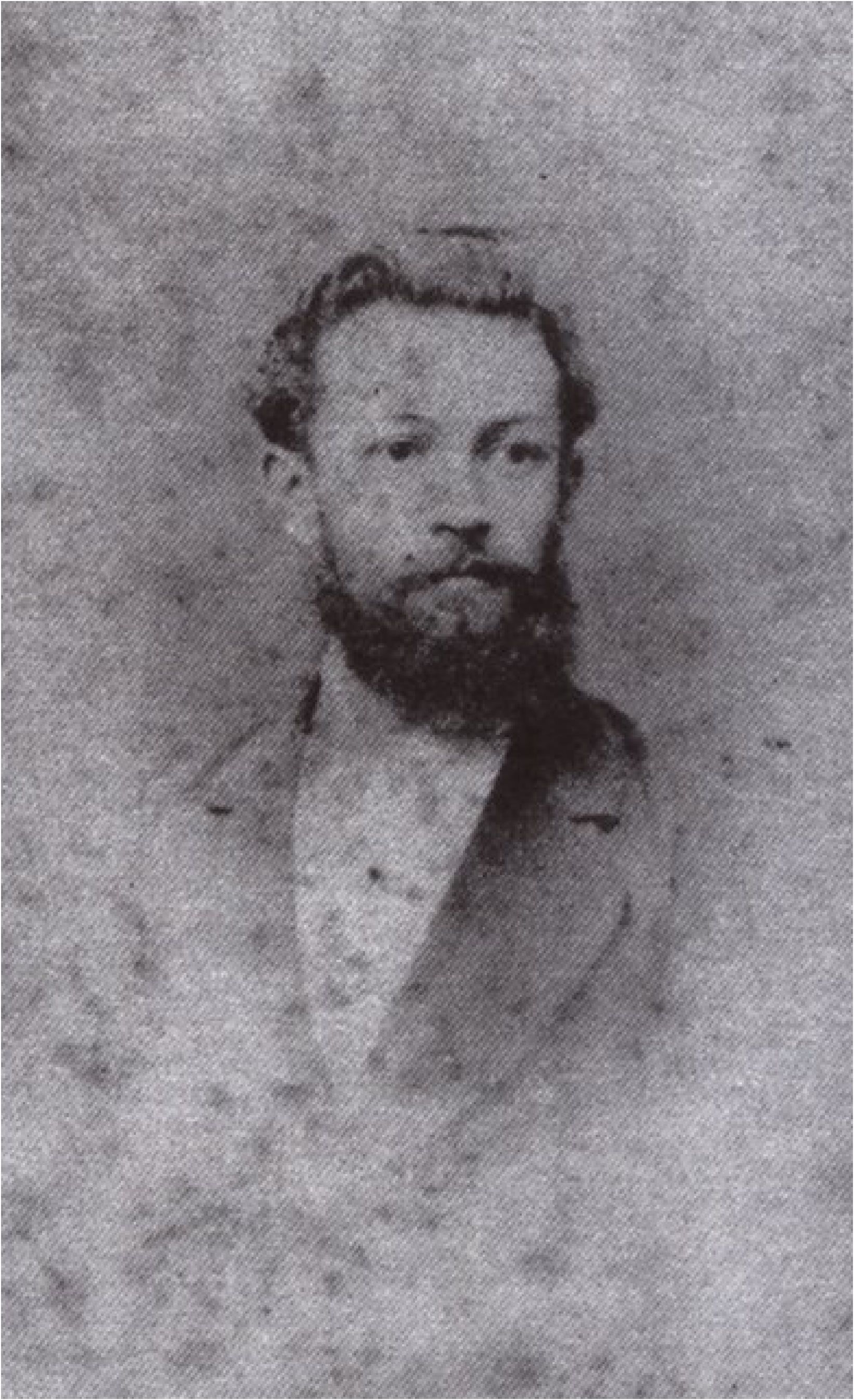
[Photograph of Thomas C. Christmas by P&B Thompson, reproduced in
G. Rushworth, A Supplement to Historic Organs of New South Wales
(OHTA, 2006), p. 102]
Christmas's involvement in 1882 at St Patrick's, Fortitude Valley, is the earliest record of his activities in Queensland, and this is the only instrument he is reported to have built. He was responsible for installing a number of organs in Brisbane, Rockhampton and Townsville between 1883 and 1885, and was listed in the Queensland Post Office Directory from at least 1883 until as late as 1902. Christmas described himself in advertisements in 1893 as 'Pianoforte Maker, Wickham-street.'13 A few years later his 'Pianoforte, Organ, and Musical Instrument Warehouse' was located at 174 Queen Street.14
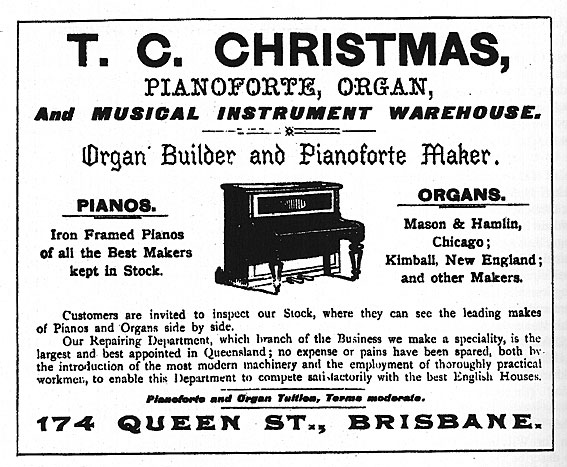
[The Queensland [Wise's] Official Directory 1896-1897]
Christmas's work as an organbuilder seems to have been eclipsed after the arrival of Mr B.B. Whitehouse in the mid-1880s. He is reported to have completed Edward Waldron's organ at the Wesleyan Church, Fortitude Valley, in late 1888 or early 1889 after Waldron died of typhoid fever.15 In 1896, Christmas tendered (unsuccessfully) to move the organ at Holy Trinity Anglican Church, Fortitude Valley, from the gallery to the chancel.16 He died in Brisbane in May 1905.17
Work of cleaning and maintaining the St Patrick's organ was undertaken by Messrs Brown and Arkley of Sydney in the late 1980s,18 and again in 1995 by Ian D. Brown and Associates, when Ian Brown noted that the name 'W. Davidson' is stamped on some of the Clarionet pipes.19 It would appear, therefore, that Christmas obtained at least some of his pipework from William Davidson of Sydney.
The Swell and Choir, which are both enclosed, are on a common chest, with the Choir opening to the back of the organ. The bottom pipes of the Great Open Diapason, of spotted metal, are tubed off to the rear of the organ, and sit on the same chest as the Pedal Bourdon.
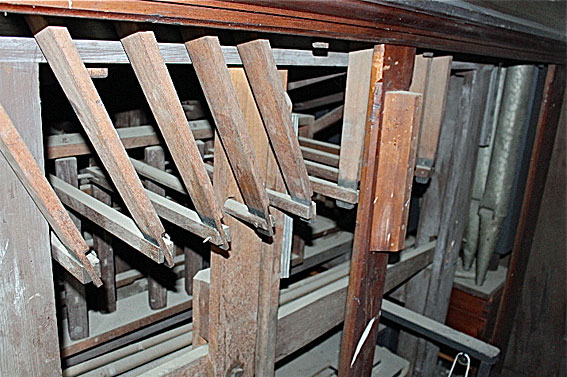
Stop action for the Swell and Choir Organs
[Photograph by Trevor Bunning (September 2014)]
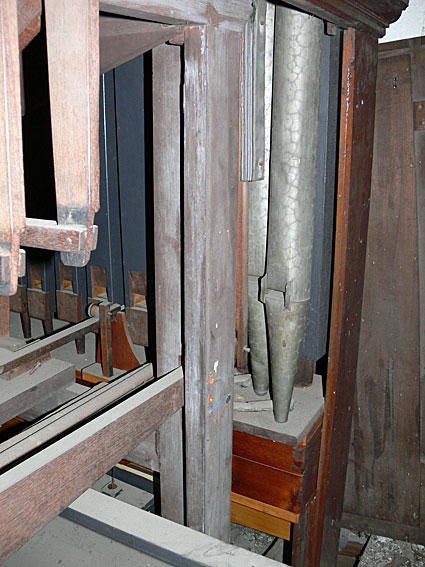
Spotted metal pipes of the Open Diapason
on the Pedal Bourdon chest at the rear of the organ
[Photograph by John Maidment (September 2014)]
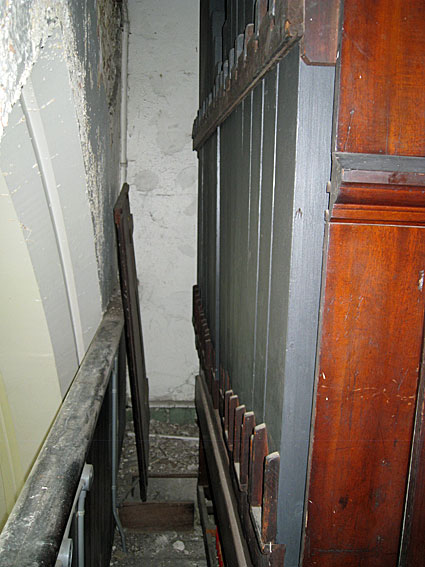
Bottom pipes of the Pedal Bourdon
at the rear of the organ
[Photograph by Geoffrey Cox (September 2014)]
The timbers in the organ suggest a mixture of Australian and imported materials. The case panels and console are of Australian red cedar, but the key cheeks (and entire key sets) are of imported oak. The building frame is of pine.20
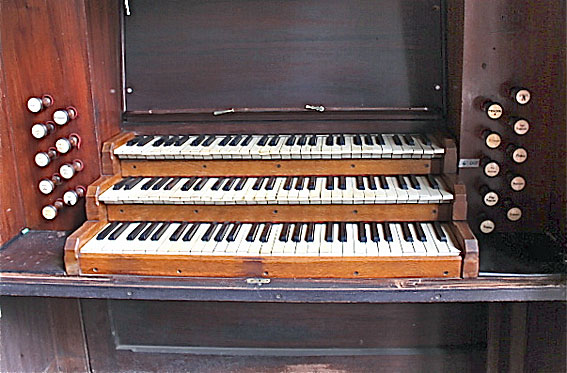
The console of the organ
[Photograph by Trevor Bunning (September 2014)]
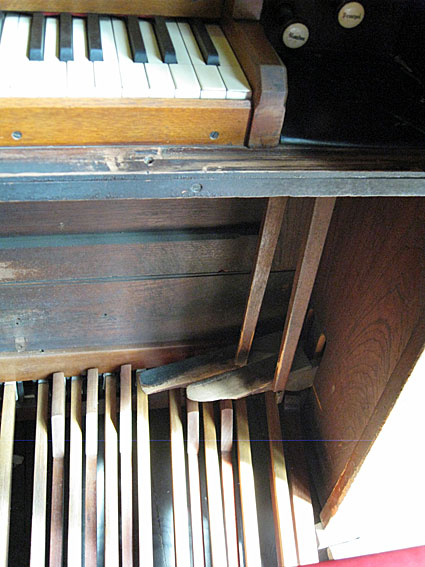
Lever pedals for the Swell and Choir
[Photograph by Geoffrey Cox (September 2014)]
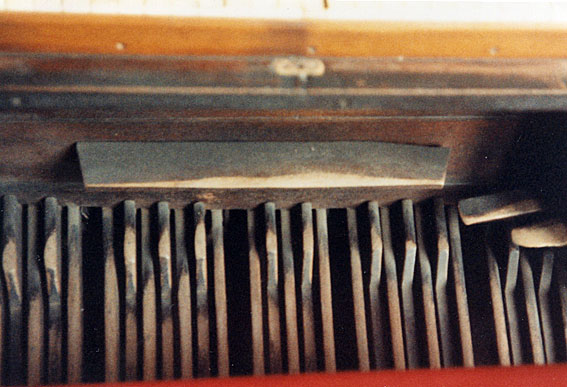
The pedalboard
[Photograph by Howard Baker (September 1989)]
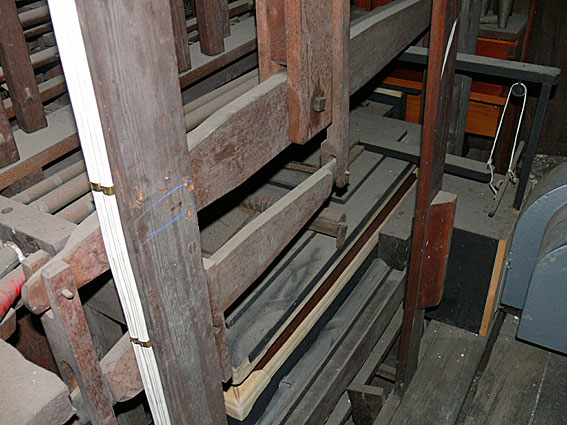
Building frame, lever Swell and Choir action and bellows
[Photograph by John Maidment (September 2014)]
As will be evident by comparison with the organ at Christ Church Anglican Church, Lavender Bay, NSW, several constructional features are reminiscent of William Davidson. These include the open metal flue pipes, the stop jamb profiles, the stop knob shapes and possibly even the maroon felt bushings.21 It appears that Christmas imported much of his material from William Davidson of Sydney.
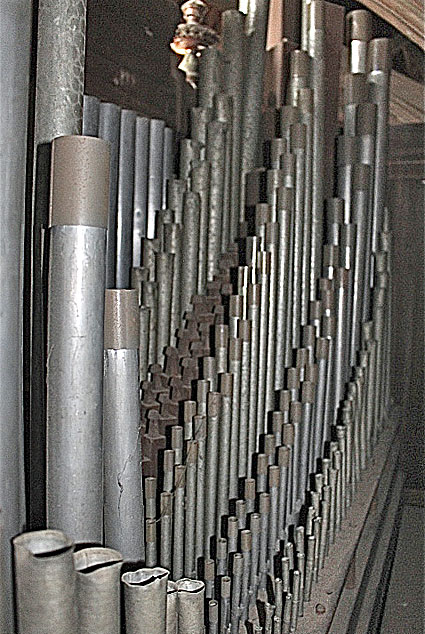
The Great pipework
[Photograph by Trevor Bunning (September 2014)]
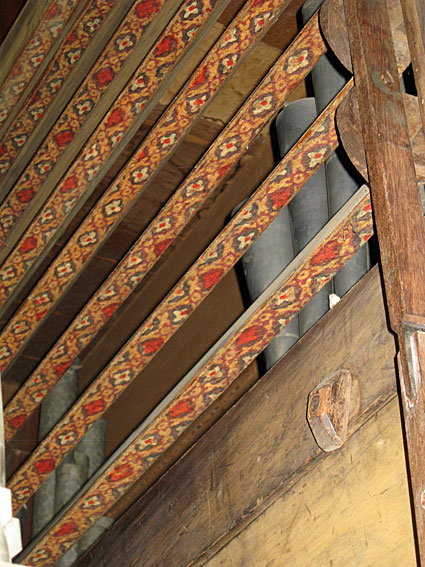
The Swell shutters
[Photograph by Geoffrey Cox (September 2014)]
The stop labels, as photographed in 2014, appear not to have been altered since the early 1950s, although some had been replaced at an earlier stage. Others may have been moved around or swapped, as will be conjectured below.
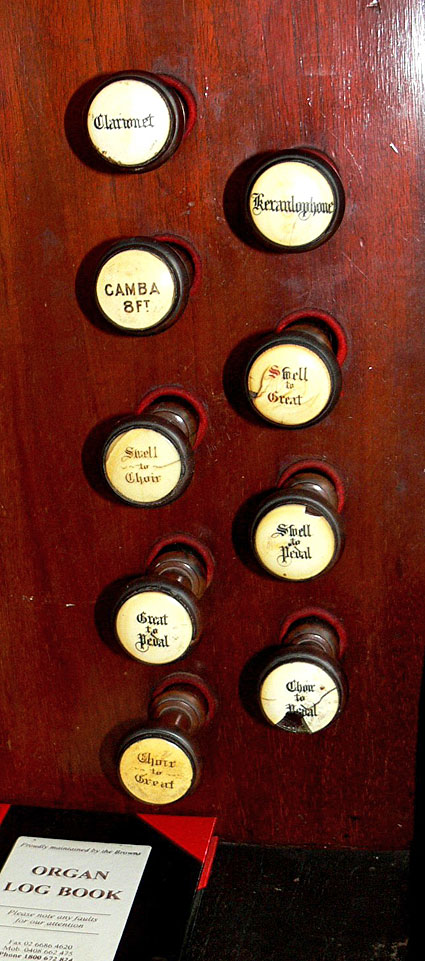
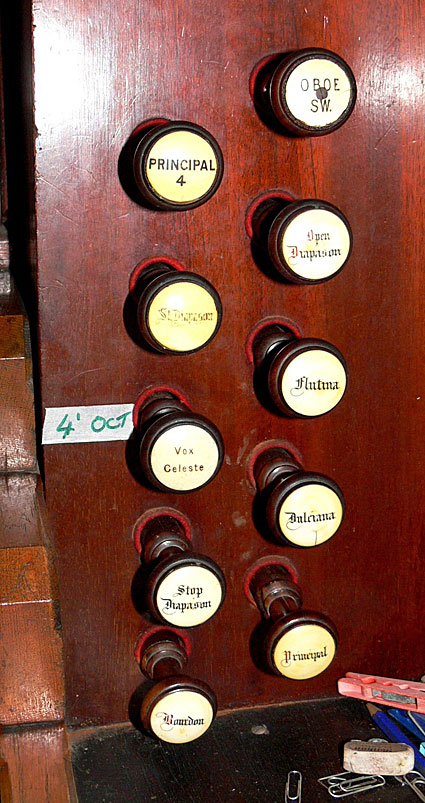
The current stop jambs
[Photographs by John Maidment (September 2014)]
There are minor differences between the specifications recorded variously by Brohan (c.1952), Molloy (1970), Cox (1973 and 2014), and Cook (1988). The stop names below reflect the stop labels as noted in 1973 and 2014, and they are given in the order in which they appear on the jambs. The spelling of stop names was, to varying degrees, standardised by Brohan, Molloy and Cook. Apart from spelling differences, significant variants and other comments are given to the right.
| GREAT Principal Stop Diapason Dulciana Vox Celeste [Tenor C] Flutina SWELL St[op] Diapason Open Diapason Principal Oboe (Tenor C) CHOIR (enclosed) Gamba Keraulophone Clarionet (Tenor C) PEDAL Bourdon COUPLERS Swell to Great Swell to Choir Choir to Great Swell to Pedal Great to Pedal Choir to Pedal |
[8] [8] [8] [4] [2] [8] [8] 4 [8] 8 [8] [8] [16] |
[presumably originally 'Open Diapason'] [gvd bass] [label unchanged, but 4' Oct sticker attached to jamb] [recorded as 4ft by Brohan (c.1952), but 2ft by all others] [gvd bass] [described as 'Horn (Cornopean)' by Cook (1988) only] [gvd bass] [actually a Stop Diapason or Gedact; recorded as 'Lieblich Gedackt' by Brohan (c.1952)] |
Drawstop console
Compass: 56/30
Trigger swell and choir levers
Pedalboard: radiating and concave
Mechanical action.22
Significant changes appear to have been made before the 1950s on both the Great and Choir Organs.
The presence of a stop labelled 'Celeste' on the Great (using a different style of lettering on the stop label), along with the presence of a 2ft rank without a 4ft rank, and an 8ft rank labelled 'Principal' immediately suggests that the specification has been altered. These anomalies were recognised in the late 1970s by Robert Heustis, an organist associated with St Stephen's Cathedral from 1974 who was paid to do some restoration work on the organ at St Patrick's. Presumably on the basis of pipe markings or other internal evidence, Heustis considered that the Celeste pipes had originally served as the Dulciana, and restored them to this position. He arranged for the Dulciana pipes (by then used as a Celeste) to be sent to Finchams in Melbourne and converted into a Principal 4ft.23 Christopher Cook recorded that these pipes were cut in half to produce the present 4-ft stop,24 but they may merely have been transposed (with the addition of top notes) or rescaled. The original label 'Principal' can be conjectured to have been moved to the Open Diapason 8ft, which had presumably lost its original label. The original Great Organ, therefore, appears to have comprised:
| GREAT Open Diapason Stop Diapason Dulciana [Principal] Flutina |
8 8 8 4 2 |
Bernie Brohan (c.1952), David Molloy (1970) and the present author (1973) observed that the Vox Celeste and Dulciana drew together. The mechanism whereby this occurred was removed or dismantled by Heustis in the late 1970s. At the same time, the façade pipes were sent to Melbourne for repair, dents were removed and the heavy lacquering from an earlier period was removed.25
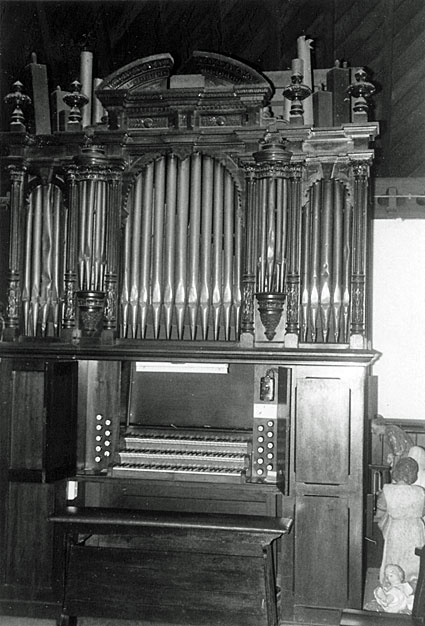
The organ in an earlier state of disrepair
[Photograph by Geoffrey Cox (c.1973)]
There appears also to have been a swapping of ranks on the Choir Organ before the 1950s. This is suggested both by the replacement label 'Gamba', and the fact that the pipes of the stop labelled 'Keraulophone' are actually a Stop Diapason or Lieblich Gedact. The label 'Keraulophone' appears to be original, and the Choir Organ, therefore, can be conjectured originally to have comprised:
| CHOIR [Lieblich Gedact] Keraulophone Clarionet |
8 8 8 |
This is clearly an instrument that deserves further internal investigation and, ultimately, restoration. If it was 'built almost entirely' by Christmas, as was claimed in 1882, this was arguably the first organ built in Queensland.
________________________________________________________________
1 Denis W. Martin, The Foundation of the Catholic Church in Queensland (Toowoomba: Church Archivists' Society, 1988), pp. 139, 142.
2 Queensland Heritage Council, Queensland Heritage Register, location 600210; E.J.T. Barton (ed.), Jubilee History of Queensland: a Record of Political, Industrial, and Social Development, from the Landing of the First Explorers to the Close of 1909 (Brisbane: H. J. Diddams, [c.1910]), p. 138.
3 The Heritage of Australia: The Illustrated Register of the National Estate (South Melbourne: Macmillan, 1981), 4/18.
4 John Maidment, Letter to the Editor, Organ Society of Queensland Newsletter, vol. 15, no. 8 (October 1988), p. 41.
5 E.J.T. Barton, p. 138.
6 J.C.H. Gill, 'Wilson, Walter Horatio (1839-1902)', Australian Dictionary of Biography, Vol. 12 (Melbourne University Press, 1990), p. 531. Online version at http://adbonline.anu.edu.au/biogs/A120597b.htm, accessed March 2011.
7 Graeme Rushworth, A Supplement to Historic Organs of New South Wales: The Instruments, Their Makers and Players, 1791-1940 (OHTA, 2006), p. 103. Rushworth's address for Wilson is based on unauthorised access to an unpublished revised draft of the present author's Gazetteer of Queensland Pipe Organs, in which W.H. Wilson had been temporarily confused with the Hon William Wilson, who lived at Wilston House, 42 Watson Street, Wilston. W.H. Wilson lived at Toowong.
8 Geoffrey Cox, Letter to the Editor, Organ Society of Queensland Newsletter, vol. 16, no. 3 (December 1988), pp. 39-41.
9 St Patrick's Church Fortitude Valley: The Early Years, cited in Christopher Cook, 'St Patrick's, Fortitude Valley,' Organ Society of Queensland Newsletter, vol. 15, no. 5 (April 1988), p. 5.
10 The Brisbane Courier (4 December 1882), p. 5.
11 Rushworth, pp. 102-04.
12 Sands & McDougall Directory (1877), p. 231.
13 The Brisbane Courier (19 April 1893), p. 2; The Brisbane Courier (17 July 1893), p. 4.
14 The Queensland [Wise's] Official Directory 1896-97.
15 Personal communication to G. Cox from Mr E.R. Salisbury (organist of the Fortitude Valley Methodist Church, 1935-42.
16 Minutes of the Parochial Council Meeting, Holy Trinity Church, Fortitude Valley (February 1896), cited in Charles Clark & Geoffrey Cox, 'The Organs of Holy Trinity Church, Fortitude Valley, 1874-1974,' Organ Society of Queensland Newsletter, vol. 1, no. 2 (May 1974), pp. 2-4.
17 Rushworth, p. 104.
18 Christopher Cook, p. 7.
19 Noted by Ian Brown in The Sydney Organ Journal, vol. 26, no. 4 (Spring 1995), pp. 6-7.
20 Observations by David Cahill and John Maidment, September 2014.
21 Observations by Kelvin Hastie, September 2014.
22 Specification noted by G. Cox, 1973 and 2014; additional details from the Collected Organ Specifications of Bernie Brohan (c.1952); specification noted by David Molloy (1970); and Christopher Cook, p. 5.
23 David Molloy (Organist of St Stephen's Cathedral 1977-79), personal communication to G. Cox, August 2018.
24 Cook, p. 7.
25 Molloy, op. cit.