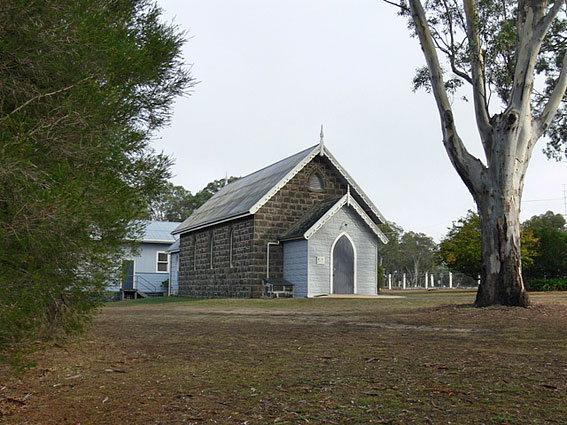
St Luke's Lutheran Church, Cavendish: exterior
[photograph by John Maidment (18 April 2009)]
Historical and Technical Documentation by John Maidment
© OHTA, 2009 (last updated October 2020)
St Luke's Lutheran Church, Cavendish: exterior
[photograph by John Maidment (18 April 2009)]
St Luke's Church, constructed in bluestone in 1857, is a former Presbyterian Church that was bought by the local Lutheran congregation following the formation of the Uniting Church.1 The building consists of a three-bay nave. There is an entrance porch clad in pressed metal (stamped to resemble stone) and decorative barge boards in the main and porch gables.
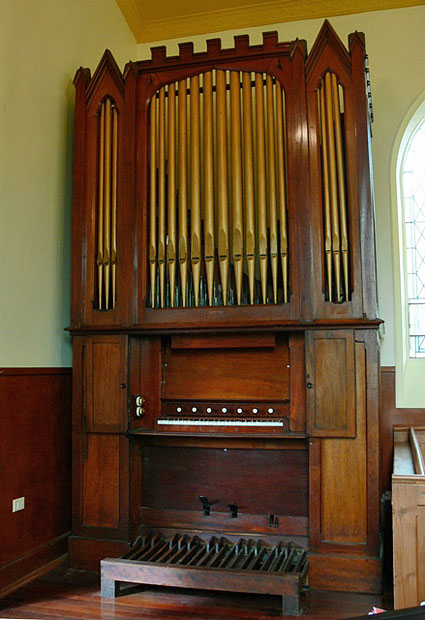
St Luke's Lutheran Church, Cavendish: organ
[photograph by John Maidment (18 April 2009)]
The organ is among the two earliest of indigenous manufacture in Victoria to survive and is very likely to have been built in the late 1850s by Jesse Biggs, an English organbuilder who had trained with Gray & Davison, London before his arrival in Melbourne in 1856.2 It was one of the organs advertised for sale by Biggs at this time.3 The instrument was opened at the United Free Methodist Church, Collingwood in 1858 where the organist was Jesse Biggs's first cousin Alfred Barrett Biggs who later emigrated to Tasmania. It is comparable with the James Moyle organ at St Linus' Anglican Church, Merlynston that also dates from the 1850s. Biggs went on to construct several organs in Tasmania, such as those now at Latrobe and East Devonport. It predates anything made by George Fincham from the early 1860s onwards. The cedar casework in the Gothic style is outstanding and includes two narrow flats placed under gables and a wide central flat. The flats are all filled with gilt dummy 'flatback' pipes. The top of the casework is boldly crenellated and the case panels are chamfered. It appears that pinnacles surmounting the case posts have been removed, maybe to accommodate the instrument in a room of lesser height.
There are scrolled keycheeks and script drawstop engraving – one of the knobs has the antiquarian spelling Stop Bafs: the capitals are engraved in red. The sharp keys have rounded ends: the keyboard is likely to have been imported, maybe from Edward Violette, London who made the keyboard for the Samuel Joscelyne organ now at St James-the-Great Anglican Church, East St Kilda.
The organ appears to have been in private ownership in Bendigo up to 1913.4 It was then placed in the Methodist Church, Arnold Street, Bendigo from where it was removed in 1957 by Douglas Price and installed at the Methodist Church, Ararat.5 In 1983 it was moved to the Uniting Church, West Ararat and in 1984 to the residence of Ivan Puls, Miga Lake. It was installed at Cavendish in 2001 as a gift from Ian Puls in memory of his brother.6 It is located at the (ecclesiastical) north-west corner of the building at the rear.
The metal pipework is certainly imported, with florid scribed note markings and made from black metal: it has been fitted with tuning slides. The Keraulophon is slotted. The wooden pipework is made from pine with cedar caps. This was quite an up-to-date instrument for the period with its Clarabella, Keraulophon and two composition pedals.
The organ was registered by Heritage Victoria in 2020, VHR number PROV H2404 as a very rare and significant example of early organbuilding in the state of Victoria.
MANUAL |
[8] [8] [8] [8] [8] [4] [2] |
bottom octave open wood at rear CC-BB TC TC TC |
Manual compass: CC-G 56 notes
Pedal pulldowns: 30 notes CC-F (this is unlikely to be the original pedals which would have been of shorter compass: the present pedal board is slightly cut into the console sides)
2 composition pedals
Lever swell pedal (the swell box, shutters and mechanism are in storage but have not currently been installed)
Mechanical key and stop action7
St Luke's Lutheran Church, Cavendish: wooden pipework – Clarabella and Stop Bafs
[photograph by John Maidment (18 April 2009)]

St Luke's Lutheran Church, Cavendish: organ viewed from the side
[photograph by John Maidment (18 April 2009)]
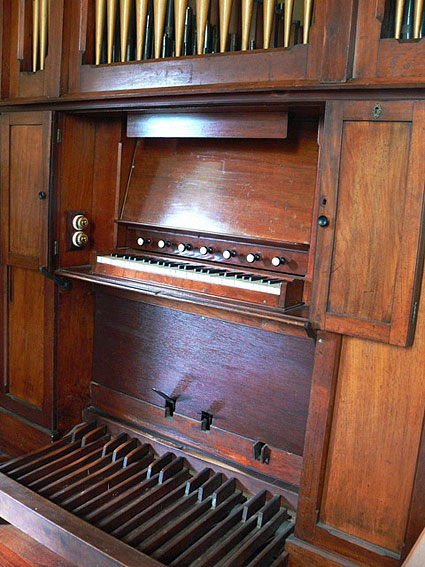
St Luke's Lutheran Church, Cavendish: console
[photograph by John Maidment (18 April 2009)]
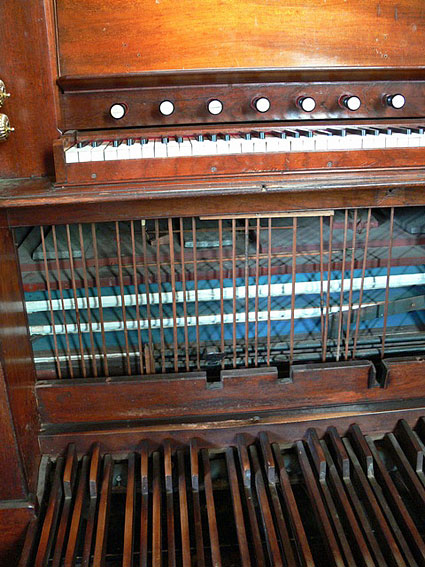
St Luke's Lutheran Church, Cavendish: manual to pedal coupling and reservoir
[photograph by John Maidment (18 April 2009)]

St Luke's Lutheran Church, Cavendish : script drawstop engraving showing the Stop Bafs
[photograph by John Maidment (18 April 2009)]
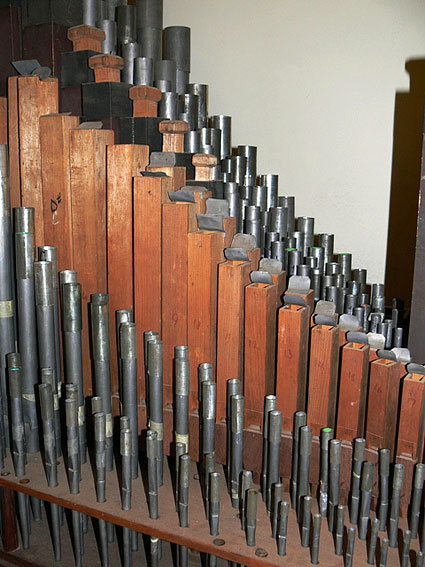
St Luke's Lutheran Church, Cavendish: internal pipework
[photograph by John Maidment (18 April 2009)]
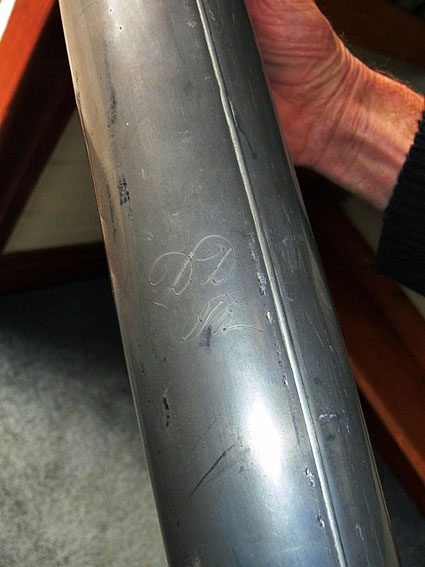
St Luke's Lutheran Church, Cavendish: metal pipe marking
[photograph by John Maidment (18 April 2009)]
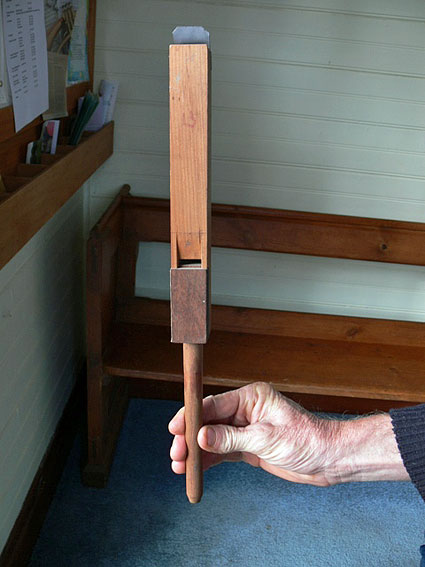
St Luke's Lutheran Church, Cavendish: wooden pipework – Clarabella
[photograph by John Maidment (18 April 2009)]
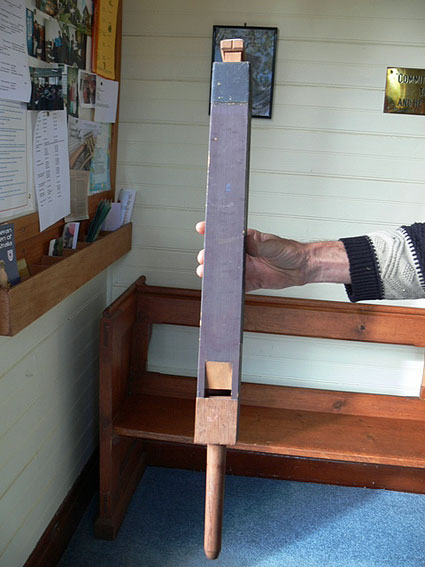
St Luke's Lutheran Church, Cavendish: wooden pipework – Stop Bafs
[photograph by John Maidment (18 April 2009)]
1 Victorian Heritage Database http://vhd.heritagecouncil.vic.gov.au/places/69649
2 The Argus 10 May 1856 p.6 includes an advertisement placed by Biggs at the time of his arrival in Melbourne
3 The Age 11 March 1858, p.2
4 The Argus 10 July 1913, p.3 includes an advertisement for the sale of an organ, almost certainly this one
5 Information provided to John Maidment by Douglas Price 6 February 1970 and plaque on the right side of the console
6 Plaque on the right side of the console
7 Details noted by John Maidment: visits to organ 2004, 2009