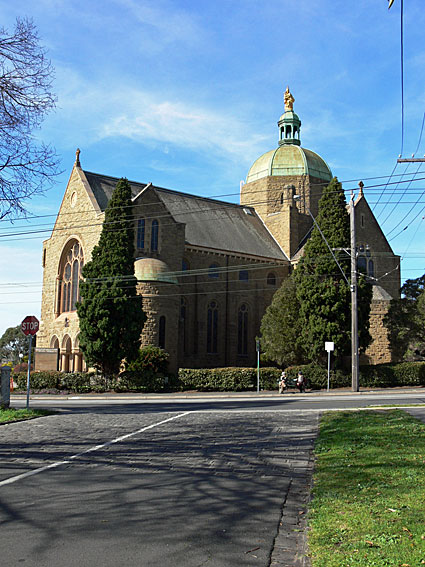
Basilica of Our Lady of Victories, Camberwell: the façade viewed from Campbell Road
[photograph by John Maidment (8 August 2009)]
Basilica of Our Lady of Victories, Camberwell: the façade viewed from Campbell Road
[photograph by John Maidment (8 August 2009)]
Historical and Technical Documentation by John Maidment
© OHTA, 2006 (last updated November 2012)
The foundation stone of the Church of Our Lady of Victories was laid on 25 May 19131, replacing an earlier church-school building dedicated to St John Berchman opened in 1887.2 The cost of the building was worked out at 45,869 stones at a cost of 10 shillings each. The building was opened on 6 December 1918 before a crowd estimated at 80,0003 and it was consecrated on 26 May 1925.4
The building was fully described in 1918:
The dedication of Our Lady of Victories Church at Camberwell was carried out with impressive ceremonial yesterday afternoon. On May 25, 1913, the foundation-stone of the building was laid by the late Archbishop Carr. Built of Barrabool Hills stone, the new church is of the Romanesque style of architecture and is well proportioned. Sydney stone has been used for the window dressings. A large central copper-plated dome bears a statue of Our Lady of Victories. The distance from the ground to the top of the statue is 135ft., and the statue itself is 14ft. from the base to the top of the head, weighs over a ton, and is carved out of a huge block of wood. Signor Vincenzo Cadorin, of Venice, designed and executed the statue, which is sheathed in copper and covered in gold leaf. The main window is the work of Mr. John Hardman, of Birmingham, and represents Our Lady of Victories shedding rays of protection over the Christian fleet. It cost £800. In the north transept there is another fine stained- glass window, also supplied by Mr. Hardman. The subject treated is the coronation of the Mother of God. An organ is being built for church, at a cost of £2 500 by Mr. T.W. Magahy, of Cork, Ireland. The steps leading to the high altar are of Sicilian marble and the Communion rails are of alabaster with rich French columns. The floor of the sanctuary is paved with mosaic marble. The altar is of alabaster on French marble columns with a table of Harcourt granite. The reredos rests on a set of Verona marble columns. At the back of the altar is an opening into which a huge oil painting after Raphael's transfiguration can be lowered when required. The three main doors are supported by four columns of polished South Australian granite. Hand-beaten brass tablets emblematic of the Deity have been let into the doors, and all the doors display the Cross. The brass work was executed in Yokohama. Four fine Sicilian marble fonts have been provided. The original plans were drawn up by Mr. A.A. Fritsch, but were amended by Mr. R. Harper, who supervised the whole work. The total cost is about £30,000, and support was received by Father Robinson from all parts of the world.5
The church was designed by the prominent Catholic architect A.A. Fritsch, a local resident, whose family owned the Fritsch Holzer brickworks in Camberwell Road, East Hawthorn. Augustus Andrew Fritsch (1866-1933) FRVIA was Victoria's premier Catholic architect and designed impressive churches at Rochester, Middle Park and Bairnsdale; he was also associated with Walter Burley Griffin in the building of Newman College, Parkville.6 The initial design included a massive campanile, later pruned from the plan7; Sacré-Coeur in Paris may have been an influence. The style was stated to be Lombardic Romanesque and demonstrated a strong departure from Gothic, also shown in Melbourne from the1880s with Sacred Heart, St Kilda and in 1890s Sacred Heart, Carlton. The building is diagonally placed across its elevated site and the prominent dome, clad in copper and crowned by a gilt statue of Our Lady of Victories, is a local landmark. Internally, the space under the crossing is notable with the focus on the massive reredos and its entablature placed within an elegant enclosing apse. The stained glass is entirely the work of John Hardman & Sons, Birmingham. The overall dimensions of the building are: 170ft long, width across transepts 110ft; dome 135ft high.
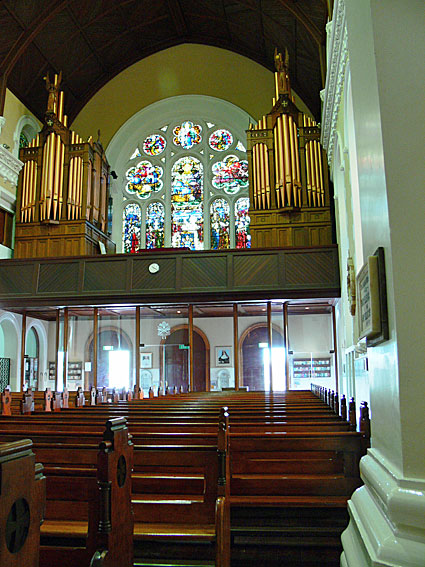
Basilica of Our Lady of Victories, Camberwell: the organ viewed from the nave
[photograph by John Maidment (31 March 2006)]
The organ was built by T.W. Magahy & Son, of Cork, Ireland in 1920 at a cost of £3,000. This firm was established in the 1870s and was located at Merchant Street, Cork from 1917. It was prominent in southern Ireland and rebuilt the Hill & Son organ at St Fin Barre's Cathedral and the Bryceson organ in SS Peter & Paul's Church, both in Cork.8 The Camberwell organ was opened with a series of recitals given by Thomas Walter Magahy in 1921, who went to Australia to supervise the erection. At the conclusion of the series there was a plebiscite programme, the results of the voting being as follows: Overture, Tannhauser (Wagner), Storm Fantasia (Lemmens), Pomp & Circumstance (Elgar), Funeral March, The Lost Chord (Sullivan), Vorspiel to ACT III and the Bridal Music, Lohengrin (Wagner), Andantino (Lemare), Death of Ase and Morning (Grieg).9
The organ was placed on a rear gallery and divided on either side of the massive window depicting the Battle of Lepanto. The drawstop console was placed centrally and connected to the windchests by tubular-pneumatic action. The Great and Choir were behind the left case, and the Swell and Pedal to the right. The oak casework includes the bass pipes of the Great Double Open Diapason 16 surmounted by two trumpet-blowing angels. The instrument was of particular note for the brilliance of its Great flue chorus, the rich array of string and flute registers, and its heavy pressure reeds, the Tuba being on 12 inch pressure.10
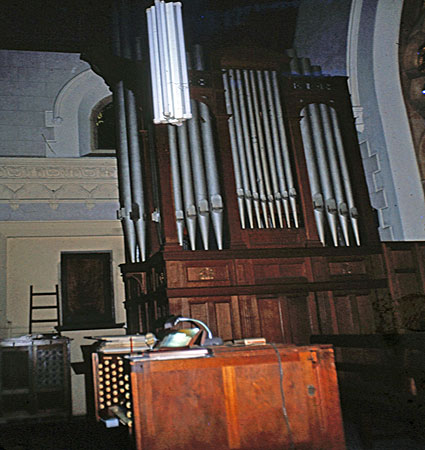
Basilica of Our Lady of Victories, Camberwell: the Magahy console
[photograph by John Maidment (circa 1969)]
The 1920 specification follows:
| GREAT Double Open Diapason Open Diapason I Open Diapason II Doppel Flöte Octave Harmonic Flute Octave Quint Super Octave Tuba Swell to Great Sub Octave Tuba Octave Tuba SWELL Lieblich Bourdon Open Diapason Stopped Diapason Salicional Voix Celeste Principal Fifteenth Mixture Oboe Contra Fagotto Trumpet Clarion Octave to Swell Tremulant CHOIR (enclosed) Flauto Traverso Lieblich Gedact Viol d'Orchestra Voix Celeste Dulciana Suabe Flute Piccolo Clarionet Vox Humana Tuba Sub Octave Swell to Choir PEDAL Harmonic Bass Open Diapason, Wood Open Diapason, Metal Bourdon Octave Flute Contra Fagotto Great to Pedal Swell to Pedal Choir to Pedal |
16 8 8 8 4 4 2-2/3 2 8 16 8 8 8 8 4 2 III 8 16 8 4 8 8 8 8 8 4 2 8 8 32 16 16 16 8 8 16 |
A B TC C TC B D D A E D E C |
Compass: 61/30
16 thumb & toe pistons
tubular-pneumatic action
balanced swell pedals to Swell and Choir
George Fincham & Sons reported on the Magahy organ in November 1923 and quoted £550 for refurbishment of the chests, action and bellows.11 A new Swell soundboard was made in May 1924.12 In August 1924, the Choir soundboard was reconstructed and the Great removed for similar work.13 It is possible that the windchests had been adversely affected by low humidity or had been saturated with water on the voyage to Australia.
The organ was used for concerts and on 31 July 1927, the noted organist Arthur E.H. Nickson performed the Sonata Pontificale of Lemmens and St Francis Preaching to the Birds, by Liszt.14
The 1980 rebuild by George Fincham & Sons Pty Ltd saw the original slider chests discarded and replaced by new slider chests for the three manual divisions and the Pedal. Electro-pneumatic action was installed and the console refitted with new keys and drawstops. A number of additional ranks were provided, particularly upperwork, and independent chorus reeds placed on the Great and Pedal. Reflecting panels were fitted around the unenclosed pipework. All of the Magahy pipework was revoiced by Danish-trained Knud Smenge, who was the firm's voicer at the time.15 In the 1990s, Australian Pipe Organs Pty Ltd revoiced the original heavy pressure reeds to recapture the original tonal quality, reinstating the original resonator lengths cut down in 1980, and replaced the 1980 Great and Pedal Trumpets with new pipework more suited to the romantic style of the original organ, and revoiced the 1980 Pedal Trombone with full-length resonators to give a more foundational quality. The mouths of the Great Open Diapason I were lowered to restore the principal tonality removed in 1980.16 The firm also replaced the Great slider machines with new units in 2012.
The present specification of the organ follows:
| GREAT Double Open Diapason Open Diapason I Open Diapason II Doppel Flute Octave Harmonic Flute Octave Quint Super Octave Mixture 19.22.26.29 Cornet 12.15.17 Trumpet Swell Sub Octave to Great Swell to Great Swell Octave to Great Choir to Great Tuba to Great |
16 8 8 8 4 4 2-2/3 2 IV-V III 8 |
A * * TC + |
|
| SWELL Bourdon Open Diapason Stopped Diapason Viol d'Orchestre Voix Celeste Principal Fifteenth Mixture 15.19.22.26 Tremulant Contra Fagotto Trumpet Oboe Clarion Sub Octave Unison Off Super Octave Tuba on Swell |
16 8 8 8 8 4 2 IV-V 16 8 8 4 |
TC * revoiced APO revoiced APO revoiced APO |
|
| CHOIR (unenclosed) Gedeckt Salicional Vox Angelica Principal Suabe Flute Piccolo Larigot Scharff 22.26.29 Clarionet Vox Humana Tremulant Tuba Swell to Choir Tuba to Choir |
8 8 8 4 4 2 1-1/3 III-IV 8 8 8 |
TC * * revoiced APO |
|
| PEDAL Open Diapason Wood Open Diapason Metal Subbass Quint Octave Gedeckt Choral Bass Hohl Flute Rauschquint 19.22.26.29 Trombone Trumpet Great to Pedal Swell to Pedal Choir to Pedal Choir Octave to Pedal Tuba to Pedal |
16 16 16 10-2/3 8 8 4 2 IV 16 8 |
A * * * * * * (2-2/3) * revoiced APO + |
Pedal to Great thumb pistons
Great to Pedal toe pistons
Compass: 61/30
Electro-pneumatic action
5 adjustable thumb pistons to Great
5 adjustable thumb pistons to Swell
5 adjustable thumb pistons to Choir
5 adjustable thumb pistons to Pedal
5 toe pistons duplicating Swell thumb pistons
5 toe pistons duplicating Pedal thumb pistons
Reversible thumb pistons for:
Swell to Great, Choir to Great, Swell to Choir, Great to Pedal, Swell to Pedal, Choir to Pedal
Reversible toe pistons for:
Swell to Great, Great to Pedal
General cancel thumb piston
Balanced mechanical swell pedal
WIND PRESSURES:
Great & Pedal 87mm
Swell fluework & Choir 85mm
Swell reeds 140mm
Tuba 300mm
* new ranks by George Fincham & Sons Pty Ltd 1980
+ 1980 ranks replaced by Australian Pipe Organs Pty Ltd 1990s17
The instrument speaks into a very generous acoustic and the sound projects very well, thanks to the tone boxes placed around the unenclosed pipework in 1980. The reeds now sound with enormous distinction and are some of the finest to be found in Melbourne. The fluework, too, has great brilliance and drive.
1 The Argus, 26 May 1913, p.11
2 Mary Sheehan, Victories in Camberwell: A History of Catholics in Camberwell (Pakenham, Vic.: Pakenham Gazette, c.1989), pp. 14-15
3 The Argus, 7 October 1918, p.6
4 Ibid, 27 May 1925, p.10
5 Ibid, 7 October 1918, p.6
6 The Encyclopedia of Australian Architecture, edited by Philip Goad and Julie Willis. Port Melbourne: Cambridge University Press, 2012, p.264
7 Illustrated in Sheehan, op cit, p.28
8 The Freeman-Edmonds Directory of British Organ Builders (Oxford: Positif Press, 2001), vol 3, p.598; both the Cork organs inspected by John Maidment 1989
9 Musical Opinion, April 1921, p.612
10 Harold Fabrikant, 'The Art of the Irish Organbuilder…', Society of Organists (Victoria) Incorporated Newsletter, (February 1968), pp.6-10
11 George Fincham & Sons letter 20 November 1923 (State Library of Victoria)
12 George Fincham & Sons letter 13 May 1924 (State Library of Victoria)
13 George Fincham & Sons letter 18 August 1924 (State Library of Victoria)
14 The Argus 26 July 1927, p.18
15 John Maidment, 'The Rebuilt Organ in the Church of Our Lady of Victories, Camberwell', Victorian Organ Journal, vol.8, no.9 (August 1980), pp.3-8
16 Notes by John Maidment who advised Monsignor Brian Walsh, Parish Priest, for much of this work
17 Specification from article by John Maidment cited above, with later changes noted
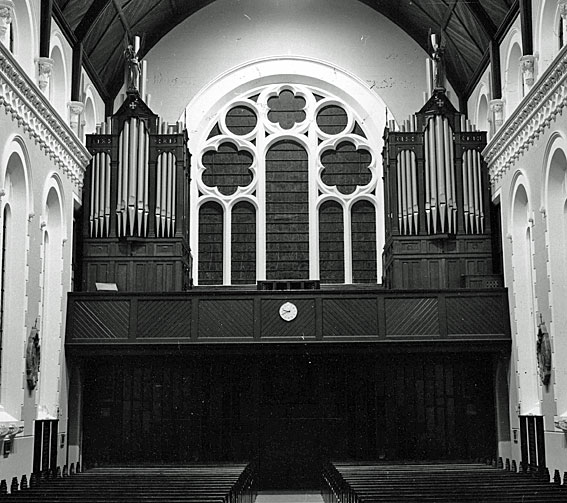
Basilica of Our Lady of Victories, Camberwell: the organ viewed from behind the high altar
[photograph by David Fincham (1980)]
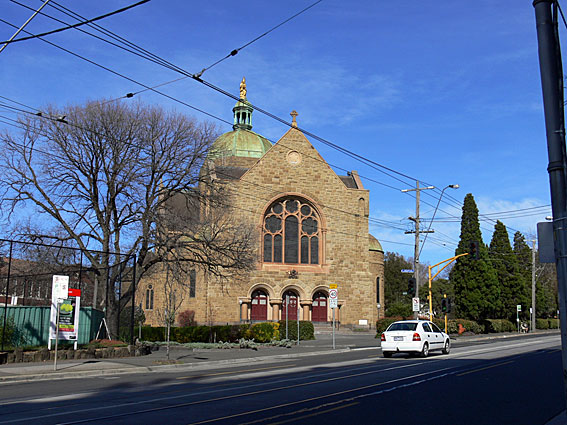
Basilica of Our Lady of Victories, Camberwell: the exterior viewed from the north-west
[photograph by John Maidment (31 March 2006)]
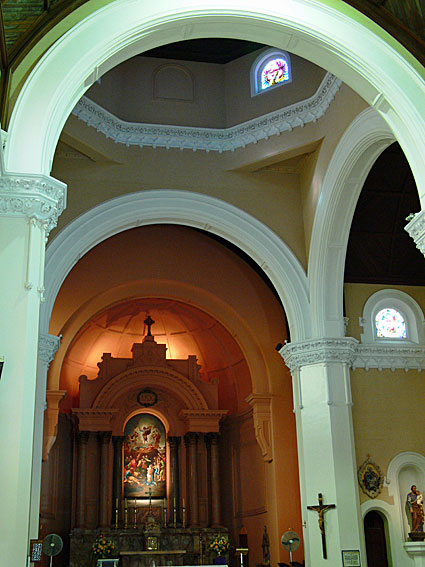
Basilica of Our Lady of Victories, Camberwell: the sanctuary and crossing viewed from the nave
[photograph by John Maidment (31 March 2006)]