Brunswick
FIRST ORGAN: Alfred Fuller, 1889
Removed 1898 from western side of chancel to the transept
Rebuilt 1934 Hill Norman & Beard (Aust.) Pty Ltd (o/n V25)
2 manuals, 11 speaking stops, 8 couplers, tubular-pneumatic action
Removed and broken up 1972
PRESENT ORGAN: Roger H Pogson, 1972
2 manuals, 15 speaking stops, 3 couplers, mechanical action
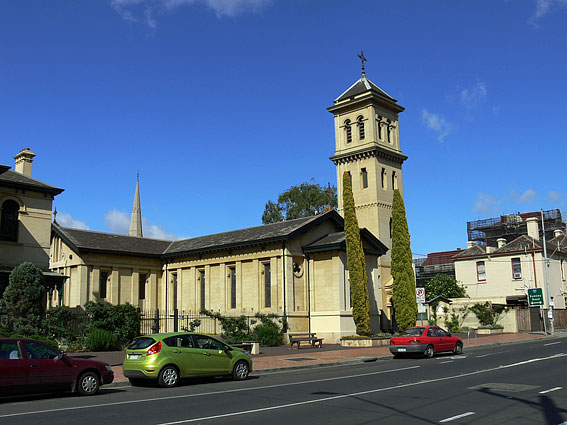
Christ Church Anglican Church, Brunswick
[Photograph by John Maidment (November 2009)]
Historical and Technical Documentation by John Maidment
© OHTA 2001, 2018 (last updated May 2018)
The nave of Christ Church was designed by Purchas & Swyer in 1857 and was stuccoed
at a later date. The church is quite exceptional for its Picturesque Italianate character, though it is unclear whether this was intended at the onset.
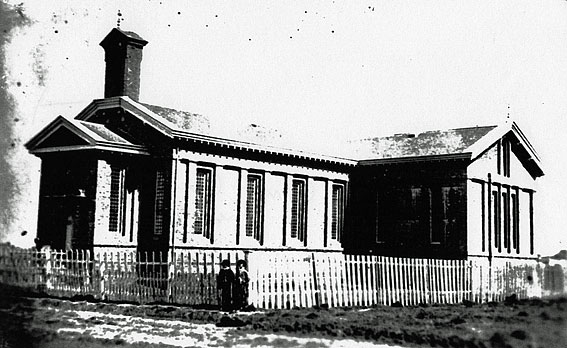
The earliest photograph of Christ Church, Brunswick
before the addition of the campanile
[Photograph from the Architecture, Building and Planning Library, University of Melbourne]
The transepts, chancel and vestry were designed by Smith & Watts in 1873-4, and the transept elevation has something of the character of the designs in N.H. Parker's book Villa Rustica of 1835. This is consistent with the use of Parker's motifs by Thomas Watts at the homestead 'Bontharambo' near Wangaratta. The campanile of 1870-1, also by Smith & Watts, continues the Italianate character, and the apse was completed by another architect, Frederick Wyatt, in 1875.1
The interior contains many outstanding fittings including the carved Gothic font, stained glass by Ferguson & Urie and Napier Waller, and the carved rood figures over the chancel.
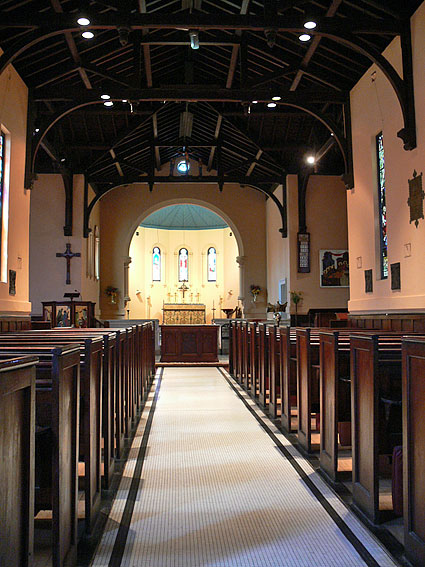
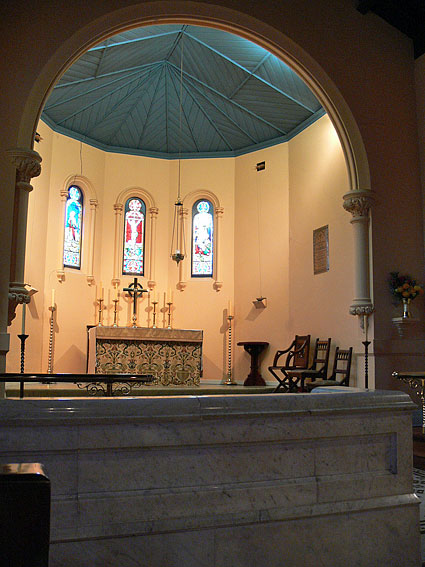
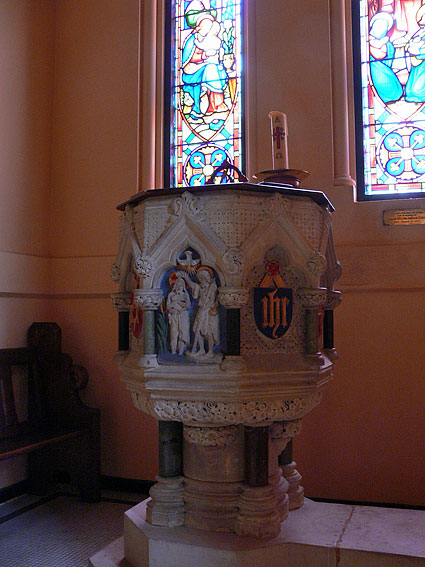
[Photographs by John Maidment (November 2009)]
First Organ.
The first organ at Christ Church was built by Alfred Fuller and opened on 24 November 1889.2 It was initially sited on the right wall of the chancel where space was extremely constricted and it was moved to the right transept in 1898.3 The façade pipes (including the wooden pedal pipes at the end of the case) were elaborately stencilled.
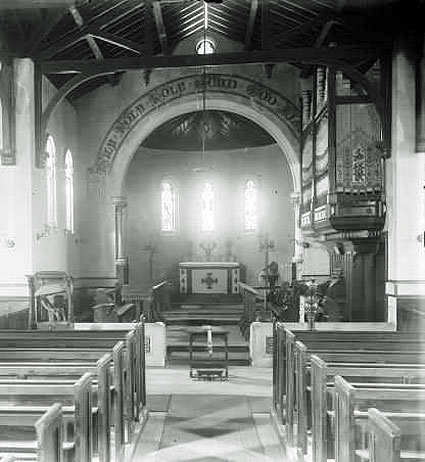
Alfred Fuller organ
[Photograph from an unknown source (between 1889 and 1898)]
-Whinfield.jpg)
Alfred Fuller organ
[Photograph by Arthur Henry Whinfield (organist), 1889,
reproduced by kind permission of the Worcester Diocesan Church House Trust]
It was rebuilt in 1934 by Hill, Norman & Beard (Australia) Pty Ltd (order number V25) who converted the original mechanical action to tubular-pneumatic with an attached stopkey console. At this time the façade pipes were covered in gold paint. It was removed in 1972 and the parts dispersed.
| GREAT Open Diapason Lieblich Gedeckt Claribel Dulciana Harmonic Flute Swell Sub Octave to Great Swell to Great Swell Octave to Great SWELL Violin Diapason Salicional Celeste Principal Piccolo Sub Octave Unison Off Octave Tremulant PEDAL Bourdon Great to Pedal Swell to Pedal |
8 8 8 8 4 8 8 8 4 2 16 |
TC |
Compass: 56/30.4
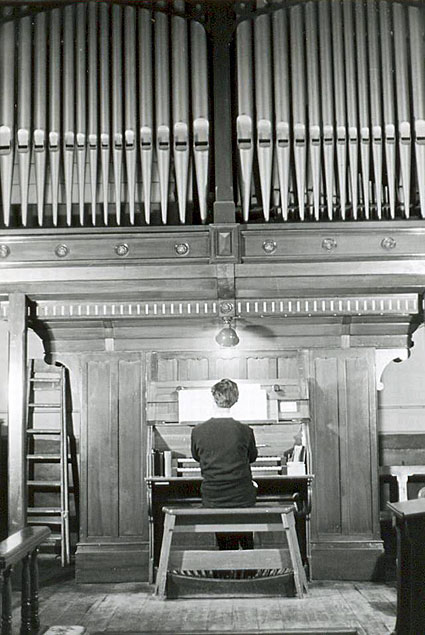
The Alfred Fuller organ, located in the transept
after its rebuilding in 1934
[Photograph from Picture Australia ?]
Present Organ.
The present organ was designed to provide adequate support to the liturgy and the congregation, and to provide a clarity and variety of tone appropriate to the performance of the classical organ repertoire. Built by the Sydney organbuilder, Roger H. Pogson, it was opened in 1972. It has a solid cedar case of classical design, incorporating burnished tin pipework, and fully mechanical key & stop action. Widely used for recitals and teaching, this instrument has exerted a wide influence upon the music of Melbourne. It was the first two-manual modern mechanical action organ, designed along classical principles, to be installed in a Melbourne church.5 Commencing with his organ for Futter Hall, King's School, Parramatta in 1968, Pogson had already built several organs in this style for locations in New South Wales, but this was his first organ for Victoria.6
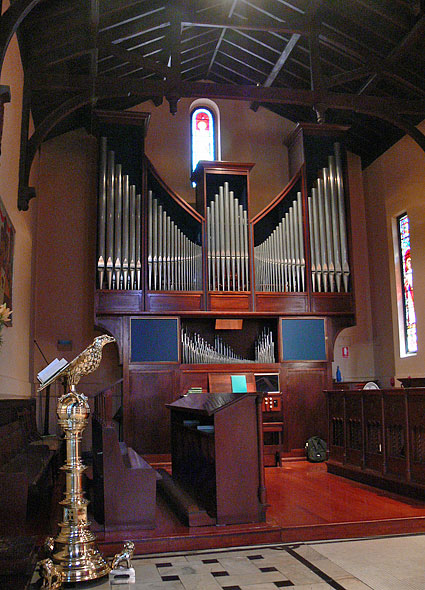
[Photograph by John Maidment (November 2009)]
The specification of the organ was drawn up by the organist at the time, Edward King and the consultant was Sergio de Pieri. The organ was built largely through the generosity of Mrs. Isobel Finchett, in memory of her late husband Albert Leslie Finchett, and by gifts, large and small from the congregation and the public. The Cymbel pipes are the gift of John Larter, in memory of his late wife Eileen Larter. The reed stops were the gift of the organist, Edward King. The project commenced in April 1967, and came to fruition in April 1972.7
The specification of the current organ is as follows:
| Manual I (Great) Gedackt Principal Sifflute Mixture Dulzian II-I (by catch pedal) Manual II (Positive) Gemshorn Rohrflute Principal Quint Cymbel Sesquialtera Tremulant Pedal Sub-bass Principal Choral-bass Fagott I – Ped (by catch pedal) II-Ped (by catch pedal) |
8 4 2 III 8 8 4 2 1-1/3 III II 16 8 4 16 |
Action: Mechanical
Pressures: Great 60 mm, Positive 50 mm.
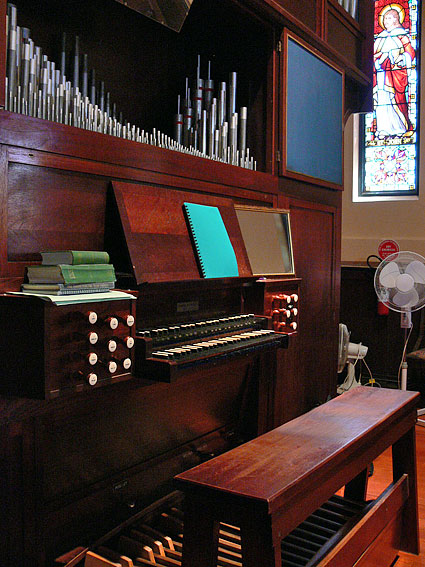
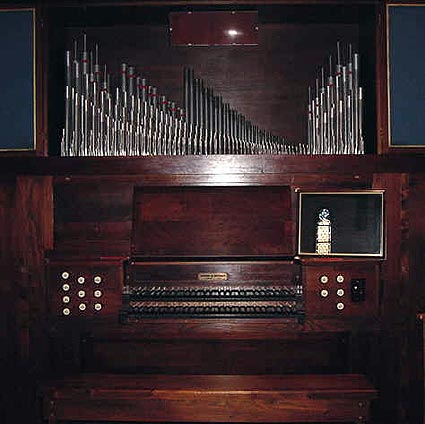
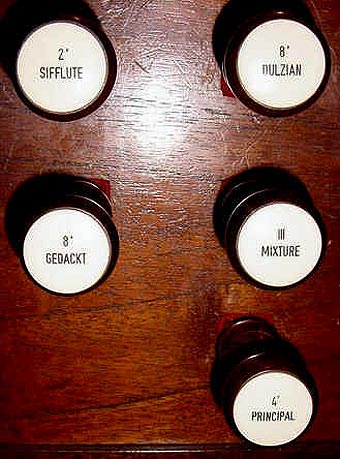
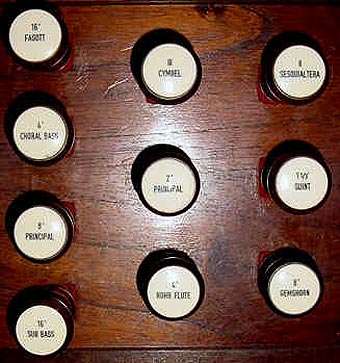
[Photographs by John Maidment (November 2009)]
1 Victorian churches : their origins, their story & their architecture, edited by Miles Lewis (East Melbourne: National Trust of Australia (Victoria), 1991), p. 61; see also: http://vhd.heritage.vic.gov.au/search/nattrust_result_detail/66195
2 The Church of England Messenger (6 December 1889), p. 211.
3 E.N. Matthews, Colonial Organs and Organbuilders (Carlton: Melbourne University Press, 1989), p. 123.
4 Specification noted by John Maidment, 1966.
5 http://vhd.heritage.vic.gov.au/search/nattrust_result_detail/66195
6 Kelvin Hastie, 'An Organbuilding Career in Summary: Roger Pogson, Our Honorary Life Member,' OHTA News, vol. 17, no. 1 (January 1993), pp. 10-12.
7 http://www.christchurchbrunswick.org/worship/the-organ/