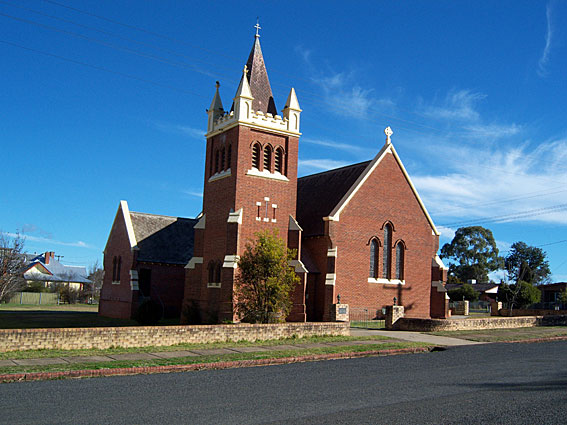
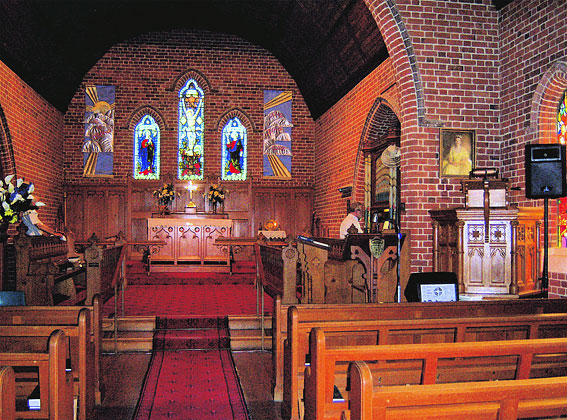
St Laurence's Anglican Church, Barraba
[Photograph by Richard Ward (October 2007)]
St Laurence's Anglican Church, Barraba
[Photograph by Richard Ward (October 2007)]
Historical and Technical Documentation by Richard Ward1
© OHTA 2014 (last updated April 2014)
The present building of St Lawrence's Church, Barraba [sic.]2 was designed by architect Sir Charles Rosenthal (1875-1954) and completed in 1909 using locally baked bricks. Rosenthal had been made the architect for the Anglican diocese of Grafton and Armidale in 1906 and it is significant that a number of houses designed by Rosenthal survive in the town of Barraba.
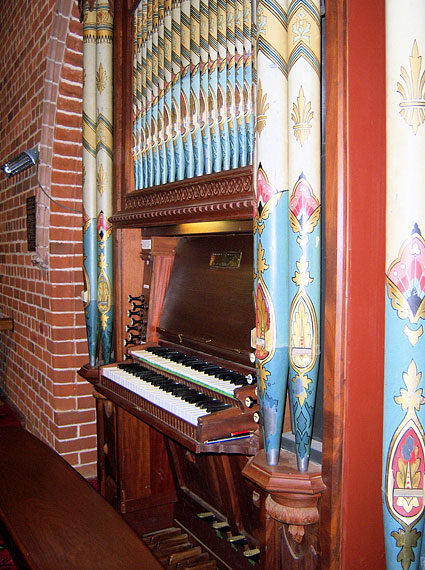
The Thomas S. Jones & Sons organ
[Photograph by Richard Ward (October 2007)]
The Thomas Jones & Sons organ was purchased by Mr James Smith, a local storekeeper, whilst on a visit to England and presented to the church in October 1919. The [Armidale] Diocesan News of November 1919 reported that:
. . . The Pipe Organ is the gift of Mr & Mrs J. C. Smith of Barraba and is presented to the church as a memorial to the men who enlisted from this parish, and were called upon to make the "supreme sacrifice." The instrument has two manuals, thirteen speaking stops, and is blown by an electric motor and rotary fan. It has a very sweet tone, and the number of stops makes possible a splendid variety of effect. It was built by Messrs Jones & Sons, London and was purchased by Mr. Smith while in England. This fine instrument will make our services more dignified and impressive. It will be a worthy memorial of those who laid down their lives in the Great War.3
The Bishop of Armidale dedicated the organ and other memorials, including the east window, at a special service on 15 October 1919.
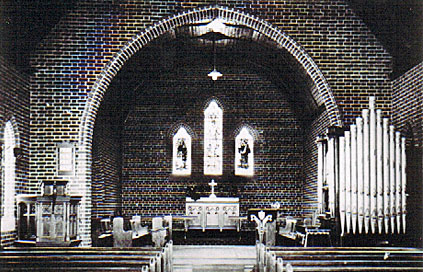
The church interior in 1920
[Photograph courtesy of Nandewar Historical Society]
The Tamworth Daily Observer reported that:
The Anglican Bishop of Armidale (Dr. Wentworth-Shields) paid a visit to Barraba on Wednesday, 15th October, and officiated at a service in St. Lawrence's Church, dedicating the following gifts to the Church: - A Stained-glass Window, presented by Mrs. Wilson in memory of the late Mr. Plumpton Wilson; an Altar Cross, the gift of Mrs. Simshauser in memory of her son, the late Private Wilfred Simshauser; and a Pipe Organ, as a memorial to the men who enlisted from this Parish and fell on the battle-fields of the Great War . . . The Pipe Organ is a very fine-toned instrument . . . It is blown by an electric motor operating upon a rotary fan, which, together with the bellows, are placed in a specially-erected building outside the Church, thus eliminating all noise from the interior of the Church.4
The organ building firm of Thomas Sidwell Jones (1830-1899) was founded in London in 1854 and specialised in small organs for village churches and residences. Thomas Jones had served his apprenticeship under his brother, organ builder Henry Jones, who built six organs for NSW during the nineteenth century.5 This organ is one of two instruments by Thomas S. Jones known to have been brought to Australia.6
The original nameplate on the organ is shown below:
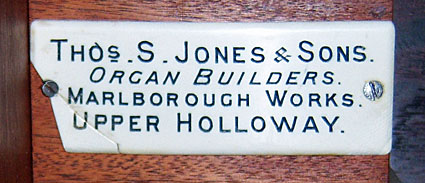
Original nameplate on the organ
[Photograph by Richard Ward (October 2007)]
This would indicate a date for the organ of between 1896 and 1902 when the firm was located at Upper Holloway.7 In documenting the organ in 1985 John Stiller (then research officer of the Organ Historical Trust of Australia) favoured an early date, as the instrument owed its mechanical and tonal style to the late-nineteenth century.8
A handwritten note in St Peter's Cathedral Archives, Armidale, claiming the organ to have been 100 years old in 1969 has been examined by the present author and it is evident that this was based on erroneous material in an article in the Barraba Gazette of 27 August 1969. There is also no foundation to claims made in this article that the organ was imported in 1906 by Mr Truman of Melbourne, purchased for the ballroom in his home.
The organ was installed in the church by John B. Holroyd,9 organ builder of Sydney, and the probable specification of the organ at that time was:
| Great Open Diapason Clarabella Dulciana Stopped Bass Principal Lieblich Flute Clarionet Swell Lieblich Gedact Viol d’Gamba Stopped Bass Vox Angelica Gemshorn Oboe Pedal Bourdon Couplers Swell to Pedals Great to Pedals Swell to Great |
8 8 8 8 4 4 8 8 8 8 8 4 8 16 |
Ten.C Ten.C CC-BB Ten.C Ten.C CC-BB Ten.C |
Compass: 58/30
Tracker action (manuals), tubular-pneumatic action (pedals)
4 composition pedals
Tremulant (operated by a stop-control)
Swell (foot hitch control)
The bass octaves of the Open Diapason rank on the Great and the Oboe on the Swell are placed on separate tubular-pneumatic chests, which may indicate that these were later additions.10
When installed, the organ was sited in the body of the church. However, in 1923 it was moved to a small vestry in the chancel. It was reported in the Diocesan News that:
The pipe organ in St. Laurence's Church has been removed from the nave, and placed in the Chancel. The alteration has made an improvement in the appearance of the church, while the organ sounds very much better in its new position.11
At the time of this move, the Swell windchest was lowered and this resulted in problems with the tracker action. In 1924, work (not detailed) costing £41 was carried out by Whitehouse Bros of Brisbane who made regular tuning visits from 1924 to 1937.12
During these years, two ranks of pipes (probably the Oboe and Clarionet) were removed from the organ and in 1939 it was reported in the Armidale Diocesan News that:
Our organ in St Lawrence Church has been the subject of much thought for some time. From now on we can think differently. The Parochial Council asked Mr. C. W. Smith to take the matter in hand. He began by collecting the sum of £36 to meet the expense. Mr. A. Rose, of Sydney, was then communicated with, and the work is now finished. The organ has been thoroughly overhauled and tuned. There were two sets of pipes stowed away. These were brought from their storage, and will be forwarded to Sydney, where Mr. Rose will complete a set of pipes, now lacking, and at a later period will return and install them.13
The Oboe and Clarionet ranks (if returned) were again removed at a later stage and were missing for many years.14
The organ gave faithful service until 1959 when essential repairs were found to be necessary at a quoted cost of £4,000.15 This was considered beyond the means of the church and the organ was dismantled and removed and replaced with an electronic instrument. During the process of removal and storage under the church much damage was done; many pipes were crushed or bent and other pipes and small components of the action lost.
In 1968, Bill Bright (now a well-known harpsichord maker) retrieved the surviving organ parts, which had further deteriorated under the church, and re-assembled the organ in his family home. The Barraba Gazette reported that he wanted to see if it was possible to get the organ working again:
After three weeks he knew it was, even though he had to MAKE about 1,000 parts, most of which were destroyed during the dismantling. For example, the top keyboard and the pedal board just weren't there, leaving a three manual (sic) organ with only one. He made the top keyboard from an old garage shelf, some bits of keyboard, and the ivory from the old Harmonium . . .
Bill also made a new set of pedals:
. . . Bill Bright found an old gramophone spring, cut it up, and used it to make the pedals return to position after being depressed. Then he made a "coupler" to swell top and bottom manuals, from a broom handle, and 20 feet of dowelling, and polished it with stove polish to make it slide easily.16
Bill found parts of the Swell keyboard at the local tip – just enough for him to accurately make the replacement. Bill's keyboard has been retained in the restored organ, however, the pedal board was later replaced by one purchased by Bill from Whitehouse Bros.
The organ was returned to its former location in the chancel of the church in 1969 with the permission of the Parish Council. No funds were available for a complete restoration at this time and the organ was used in this state until the 1990s. During these years, Bill devoted a great deal of time and energy to raising awareness of the plight of the organ and organising fund-raising activities, eventually resulting in $90,000 towards restoration of the organ.
The Thomas S. Jones & Sons organ in the chancel
[Photograph by Richard Ward (October 2007)]
On 29 August 1987, Bill launched the organ restoration appeal by performing J.S. Bach's Goldberg Variations at the church, on a harpsichord he had built for the Sydney Opera House and Musica Viva. This recital resulted in over $8,000 towards the organ fund (including a donation of $5,000 from Mrs Ethel Bright, in memory of James Allan Bright).17
In 1988, again through the efforts of Bill Bright, an application was made by the church to the Heritage Council of NSW for a grant to restore the organ and $20,000 was awarded. Another application was made in 1990 and a further grant of $15,000 resulted.18 Mark Fisher, with his experience with severely damaged and altered organs, was engaged for the restoration, on the recommendation of the Heritage Council.
Kelvin Hastie, who was appointed by the church in 1991 to act as consultant to the Heritage Council, writes:
The instrument had suffered extraordinary damage, far more so than any other organ hitherto restored in New South Wales: the organ therefore bears some of the scars of its mistreatment, providing a permanent reminder of the vicissitudes through which it had passed. In addition, the organ had been modified and enlarged decades before the current project (e.g. through the addition of bass extensions to two ranks using tubular-pneumatic action and through the alteration of its tonal disposition). In carrying out the work, Mark Fisher has exercised great patience and integrity in solving many of the mechanical and tonal idiosyncrasies which presented themselves and has managed to produce and outstanding result given the extraordinary condition of the organ and its confined space.19
Writing about the restoration of organs, Mark Fisher comments on the clues found:
… Whilst sifting through a box of dirt and rubble, after the organ was brought to Sydney, the discovery of a small piece of fretwork alerted me to the possibility of the presence of pipe shades. This fact was confirmed by laying the façade pipes out again and discovering the faint outline of the shades from where the last painting of the casework, whilst the pipes were in place, had left faint brush-marks.20

Façade of the Thomas S. Jones & Sons organ
showing restored pipe shades
[Photograph by Richard Ward (October 2007)]
Kelvin Hastie comments on the tonal disposition of the organ:
Tonally, the organ is firmly in the Romantic style with characteristic stops such as the Dulciana, Clarabella, and imitative Viol d'Gamba. The narrow scaling does produce, however, a more gentle sound which reminds one of an earlier period of British organ-building.
Pipes in the organ required either repair, restoration, or reconstruction through replacement. At all times consideration of the original style was a priority and virtually all original surviving pipes were re-used in the registers intended for them.21
On the repair to the damaged pipes, Hastie writes:
The repair of the surviving pipework is to be considered a highlight of the project. Although Australian Pipe Organs of Keysborough in Melbourne (sub-contractors for the pipework) were initially hesitant to work on such badly mutilated pipes, they responded to the challenge and the result was amazing.22
Work was completed in 1992 at a total cost of $110,000 and an Inaugural Recital on the fully restored organ was given by John O'Donnell on 20 February 1993.23 During the restoration, an 8ft Principal rank was added to the pedal division, at the suggestion of John O'Donnell.24
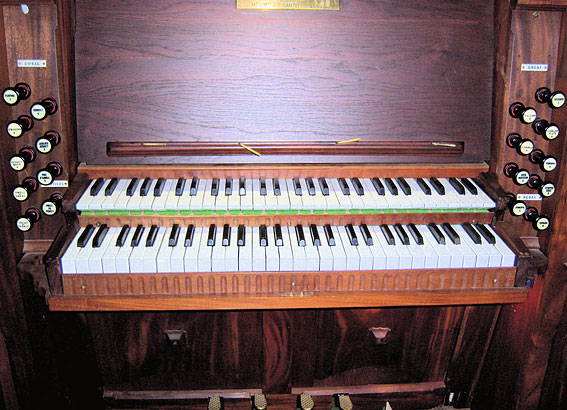
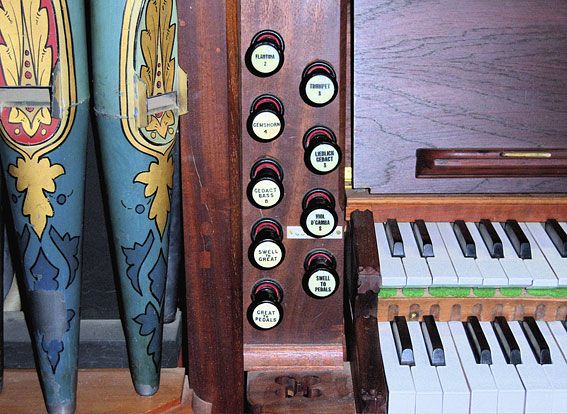
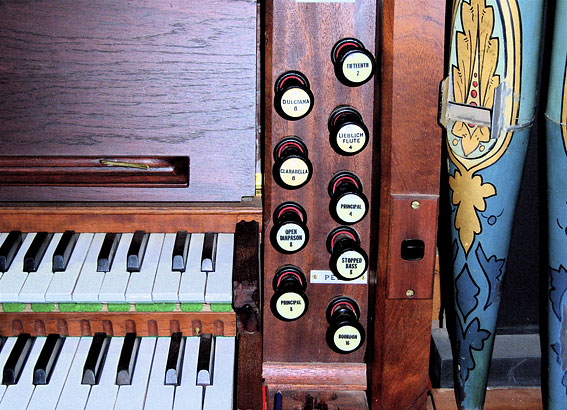
The console and stop jambs
[Photographs by Richard Ward (October 2007)]
The specification of the organ after restoration is as follows:
| Great Open Diapason Clarabella Dulciana Stopped Bass Principal Lieblich Flute Fifteenth Swell Lieblich Gedact Viol d’Gamba Gedact Bass Gemshorn Flautina Trumpet Pedal Bourdon Principal Couplers Swell to Pedals Great to Pedals Swell to Great |
8 8 8 8 4 4 2 8 8 8 4 2 8 16 8 |
(bass octave completed before 1959) Ten.C (many missing pipes replaced 1992) Ten.C CC-BB (missing, all pipes replaced 1992) Ten.C (not original; installed before 1959) Ten.C CC-BB (missing, all pipes replaced 1992) (replaced missing Oboe Ten.C 8ft) (added 1992) |
Lever swell pedal
Hitch control for tremulant
Compass: 58/30
2 composition pedals each to Great
2 composition pedals each to Swell.25
The restored organ gives an excellent tonal range for a small instrument but the ornate pipework of the organ is partially obscured in its chancel location. This is not ideal, either acoustically or visually; at some stage consideration should be given to moving the organ to the body of the church where it was originally located.
However, the restoration of the organ has been a huge achievement for a small rural community and its survival is remarkable, in no small part due to the dedication of Bill Bright and members of the Barraba community..
The historic importance of this instrument was commented on by John Stiller:
This organ is a unique Australian example of a Thomas Jones & Son organ. Its beautiful case is highlighted by some of the most ornate display pipe decorations to be found in Australia. This is enhanced by decorative casework . . . [It is a] superb and picturesque example of the organbuilder's art.26
1 The material presented here was published originally as part of: Richard Ward, 'The Thomas S. Jones & Sons Organ in St Lawrence's Church, Barraba,' The Sydney Organ Journal, vol. 41, no. 1 (Summer 2009-2010), pp. 13-16.
2 Although the church is now 'St Laurence', it was known as 'St Lawrence' when the organ was installed.
3 [Armidale] Diocesan News (November 1919), p. 13.
4 Tamworth Daily Observer (1 November 1919).
5 Graeme D. Rushworth, A Supplement to Historic Organs of NSW (Melbourne: Organ Historical Trust of Australia, 2006), p. 61. Two of the six were lost at sea.
6 Personal communication to Richard Ward from Mark Fisher, 11 July 2008. The other organ in Australia by Thomas S. Jones, imported secondhand in the 1980s, is now at the residence of Hartley Davey, Moliagul, Victoria. It has been rebuilt and enlarged with electric action and some extension.
7 'The Freeman-Edmonds Directory of British Organ Builders,' British Institute of Organ Studies (BIOS) website, http://www.bios.org.uk/resources/directory.php - accessed April 2014.
8 John Stiller, 'St Laurence's Anglican Church, Barraba, NSW; Detailed documentation of pipe organ built by T.S. Jones & Son' (1985), p. 4 - in possession of University of Melbourne Archives.
9 Loc. cit.
10 Loc. cit.
11 [Armidale] Diocesan News (December 1923), p. 11.
12 Whitehouse Bros Ledger (1922-1940), p. 180.
13 [Armidale] Diocesan News (December 1939), p. 24.
14 Stiller, op. cit., p. 5.
15 Programme Notes: Inaugural Recital, 20 February 1993.
16 'Restoration of St. Laurence's pipe organ,' Barraba Gazette (27 August 1969).
17 Personal communications to Richard Ward from Bill Bright, 18 October 2007 and 22 October 2007.
18 Kelvin Hastie, 'A Rural Organ Restored: The Thomas S Jones & Son Organ of St Laurence's Anglican Church, Barraba, N.S.W,' The Sydney Organ Journal, vol. 24, no. 2 (April/May 1993), p. 32.
19 Loc. cit.
20 Mark Fisher, 'Reversing the Past,' OHTA News, vol. 20, no. 3 (July 1996), pp. 13-16.
21 Hastie, op. cit., p. 33.
22 Hastie, op. cit., p. 34.
23 Programme Notes: Inaugural Recital, 20 February, 1993.
24 Personal communication to Richard Ward from Bill Bright, 18 October 2007.
25 Specification from Hastie, op. cit., p. 33.
26 Stiller, op. cit., p. 6.