St Peter's Anglican Cathedral
cnr King William Road & Pennington Terrace, North Adelaide
First organ: Bishop & Son 1877, moved to St Augustine’s Church, Unley
Present organ: William Hill & Son and Norman & Beard Ltd, opened 1930
Restored 2018 Harrison & Harrison Ltd
4 manuals, 53 speaking stops, 28 couplers, electro-pneumatic action
Lady Chapel Organ
Roger Jones c.1977
1 manual, 3 speaking stops, no pedals, mechanical action
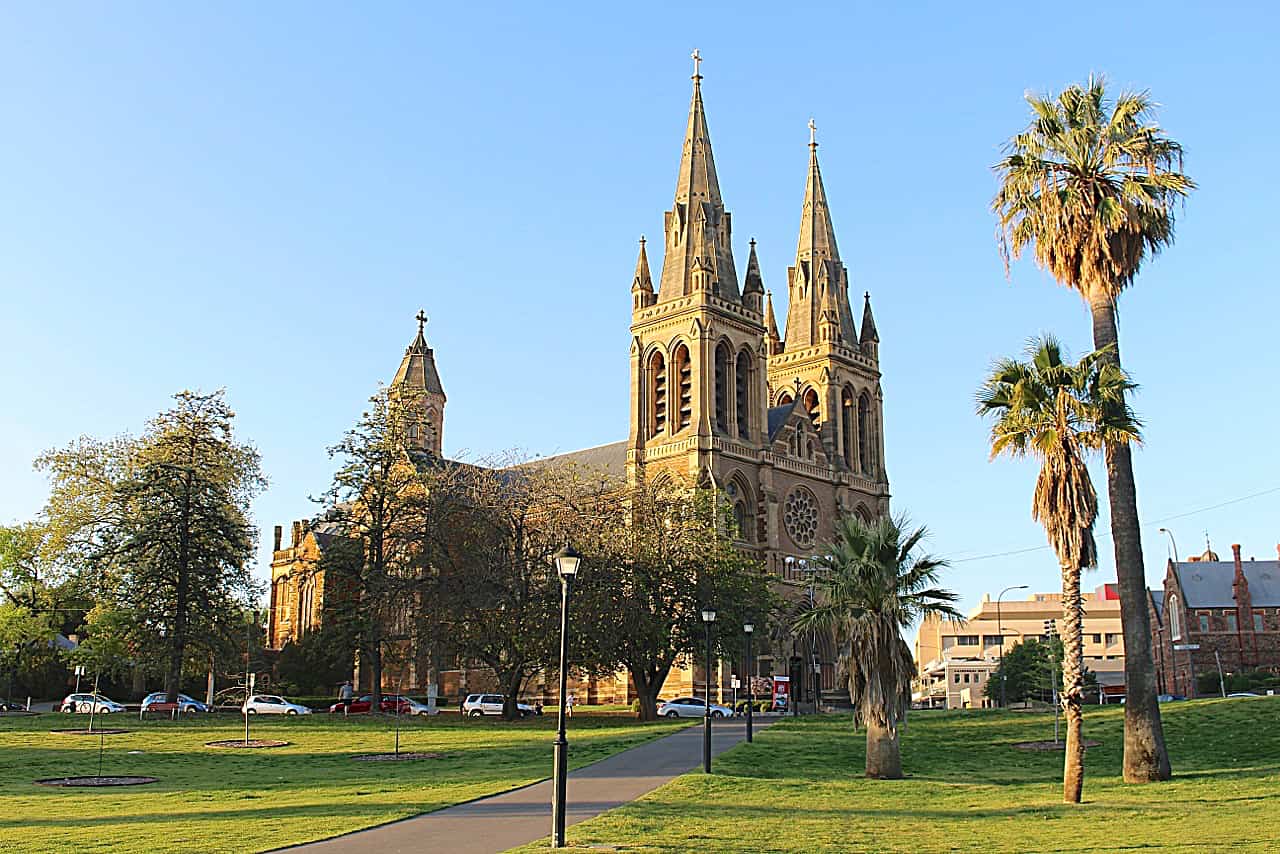
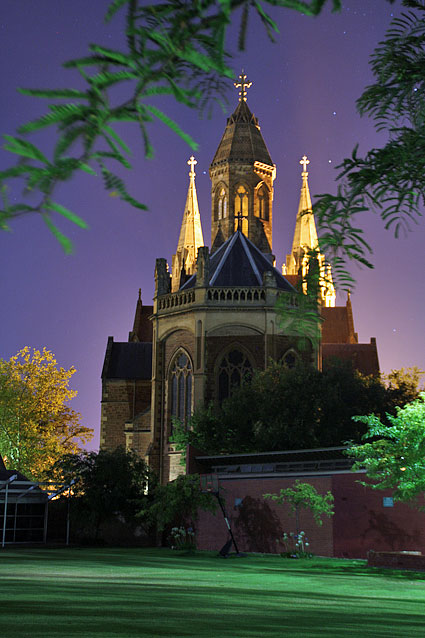
St Peter’s Cathedral, Adelaide – exterior from north-west
[photograph by Trevor Bunning (October 2019)]
Historical and Technical Documentation by John Maidment
© OHTA, 2019 (last updated October 2019)
| The foundation stone of St Peter’s Cathedral was laid on 29 June 1869.1,2 Plans for the building had been prepared by the noted British architect William Butterfield, but his predilection for polychrome brick did not please the local authorities who handed his design to E.J. Woods, of Wright, Woods & Hamilton. Woods modified Butterfield’s design principally through the adoption of stone for the exterior and insertion of windows into the aisles. The first part of the building, consisting of a single bay of the nave, choir, double transepts and square-ended sanctuary, was consecrated on 1 July 1878.3 In 1901 the nave was completed and in 1903 the towers and spires.4 An apse was introduced at the east end, incorporating a lady chapel5, all of which was consecrated on 7 April 1904. The massive reredos was designed by English architect T.H. Lyon and made at St Sidwell’s Arts Works, Exeter at a cost of £4,000. The first organ, used at the 1878 consecration,6 was built in London by Bishop & Son in the preceding year. It was placed on the floor of the right-hand choir transept and unusually had a reversed console.7 In 1931 it was moved to St Augustine’s Anglican Church, Unley where it was rebuilt with electro-pneumatic action although tonally it remained unaltered. |
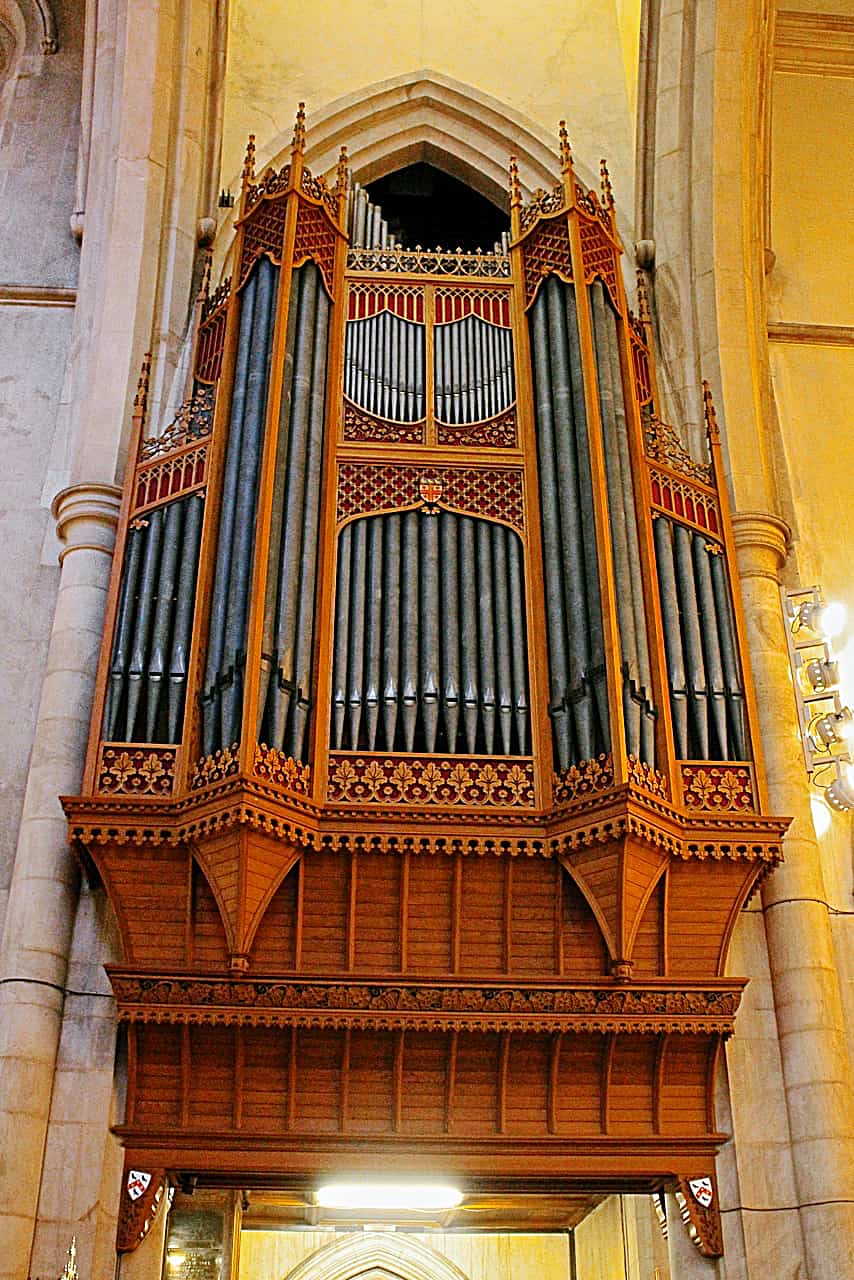
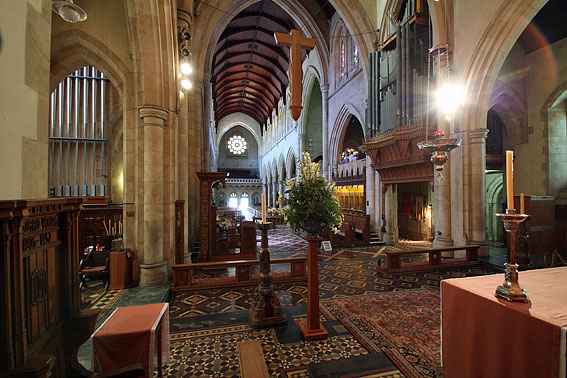
St Peter’s Cathedral, Adelaide – organ viewed from the choir
[photograph by Trevor Bunning (October 2019)]
The present organ, opened on 6 July 1930,8 was built by William Hill & Son and Norman & Beard Ltd who established its Australian subsidiary in 1927 after it won the contract for a £32,000 organ at Melbourne Town Hall. The firm set up a branch factory at Clifton Hill, Melbourne which was directed by Eustace Ingram junior (c1863-1953), a well-experienced English organ builder. The St Peter’s organ was partly built in London and partly in Melbourne. The consultant was the Melbourne organist A.E.H. Nickson FRCO.
Earlier drawings indicate that it was to be divided in each of the choir transepts, but this was not proceeded with, probably on the grounds of cost. It had to be very carefully planned to economise on space with the Choir and Solo sharing a common swell box. The Great Organ is placed on two levels, the highest speaking into the Cathedral completely unimpeded, the lower level behind the façade. The organ had to be placed on three levels and in order for the sound to transmit to the nave, wind pressures for much of the fluework is far higher than normal, with the Great and Swell unison and octave Diapasons placed on the reed chests, speaking on seven and eight inches pressure.
Very few alterations took place to the organ. The original pitch A = 435 was slightly raised almost 50 years ago, but the pipework was certainly damaged as a result (and this has been rectified in the recent work, which saw it revert to the original). The original Duplex blowing plant was replaced in 1986 with a Discus unit. One rank on the Choir Organ had been transposed to form a mutation, but this was able to be reversed very easily.
The restoration contract was awarded to Harrison & Harrison Ltd, of Durham, whose expertise in handling instruments built in this style is very extensive. Most of the instrument was shipped to Durham in mid-2017 and it arrived back a little over 12 months later. Many of the original mechanisms were restored. However, the original piston action, driven by book motors and partially adjustable, was changed to solid-state with electro-magnetic action to the drawstops. Major work on the slider windchests took place and these were fitted with new electro-mechanical slider motors. Two Mixtures were added to the Great and Swell, with orthodox unison and quint compositions: the originals, containing a Tierce, remain unaltered. A metal Principal at 8 and 4ft pitch was added to the Pedal to give increased definition. The work has included the completion of the organ case, designed by cathedral architect Walter Bagot in April 1929. Clearly influenced by the chancel cases of the near-contemporary Willis organ at Liverpool Cathedral, it includes two projecting towers containing the Great Double down FF# where the central pipes have two adjacent mouths. The original low pitch of the organ was reinstated.
| GREAT Double Open Diapason Open Diapason I Open Diapason II Claribel Corno Dolce Principal Harmonic Flute Quint Flute Fifteenth Sesquialtera 17.19.22 Mixture 19.22.26 Trumpet Clarion Swell Sub Octave to Great Swell to Great Swell Octave to Great Choir Sub Octave to Great Choir to Great Choir Octave to Great Solo Sub Octave to Great Solo to Great Solo Octave to Great |
16 8 8 8 8 4 4 3 2 III III 8 4 |
A harmonic (2018) |
|
| SWELL Lieblich Bourdon Open Diapason Rohr Flöte Viol d’Orchestre Voix Celeste Principal Flute Fifteenth Sesquialtera 12.17.19 Mixture 15.19.22 Contra Fagotto Cornopean Oboe Clarion Tremulant Sub Octave Unison Off Octave Solo to Swell |
16 8 8 8 8 4 4 2 III III 16 8 8 4 |
(73 note windchest) stopped metal trebles with chimneys open wood bass stopped metal trebles TC stopped metal trebles (2018) |
|
| CHOIR Gedeckt Gamba Unda Maris Salicet Suabe Flute Harmonic Piccolo Clarinet Orchestral Oboe Tremulant Sub Octave Unison Off Octave Swell to Choir Swell Octave to Choir Solo to Choir |
8 8 8 4 4 2 8 8 |
(enclosed with Solo) TC, canistered metal flute |
|
| SOLO Harmonic Flute Violoncello Salicional Harmonic Flute Vox Humana Tremulant Tuba Clarion Sub Octave Unison Off Octave |
8 8 8 4 8 8 4 |
(enclosed with Choir, except Tubas) B B |
|
| PEDAL Double Open Diapason Open Diapason Contra Bass Bourdon Principal Bass Flute Violoncello Fifteenth Contra Trombone Trombone Trumpet Great to Pedal Swell to Pedal Choir to Pedal Solo to Pedal |
32 16 16 16 8 8 8 4 32 16 8 |
C C A D E (2018) D E (2018) F (1-12 1989, revoiced 2018) F F |
Great & Pedal Pistons Coupled
Generals on Swell Foot Pistons
Pitch: A = 435 @ 19° C
Compass: 61/32
WIND PRESSURES
Pedal flue 178mm (7”)
Pedal Trombone 305 mm (12”)
Pedal Contra Trombone 1-12 203mm (8”)
Choir 102mm (4”)
Lower Great (including chorus reeds) 178mm (7”)
Upper Great 102mm (4”)
Back Swell 102mm (4”)
Front Swell (including chorus reeds) 203mm (8”)
Solo 152mm (6”)
Solo Tuba 305mm (12”)9
1 Express and Telegraph, 30 June 1869, p.2
2 South Australian Register, 30 June 1869, p.3
3 Ibid., 2 January 1878, p.5
4 Advertiser, 7 April 1903, p.4
5 South Australian Register, 9 May 1903, p.10
6 Evening Journal, 15 October 1877, p.3
7 Ibid., 10 December 1877, p.2
8 Advertiser, 7 July 1930, p.17
9 Technical details supplied by Andy Scott, Harrison & Harrison Ltd
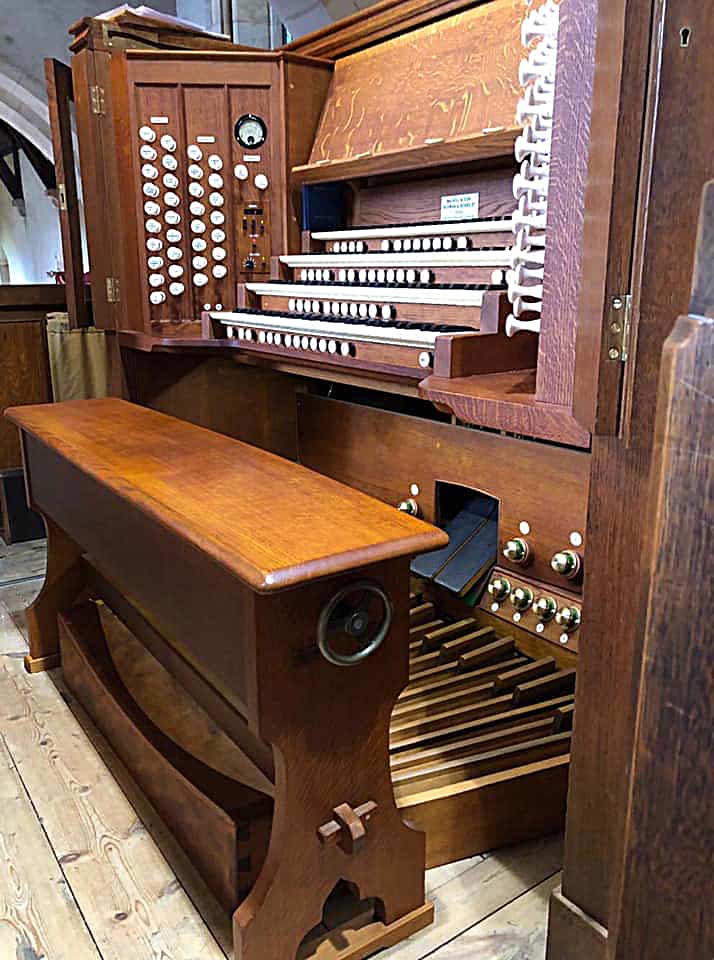
St Peter’s Cathedral, Adelaide – console
[photograph by David Heah (October 2019)]
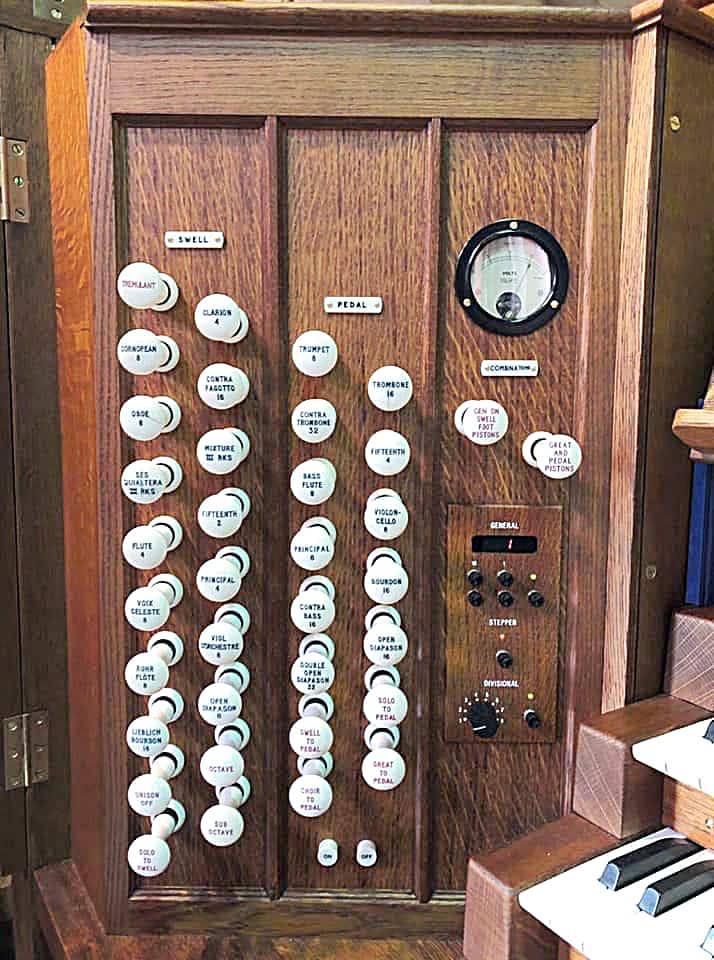
St Peter’s Cathedral, Adelaide – left-hand stop jamb
[photograph by David Heah (October 2019)]
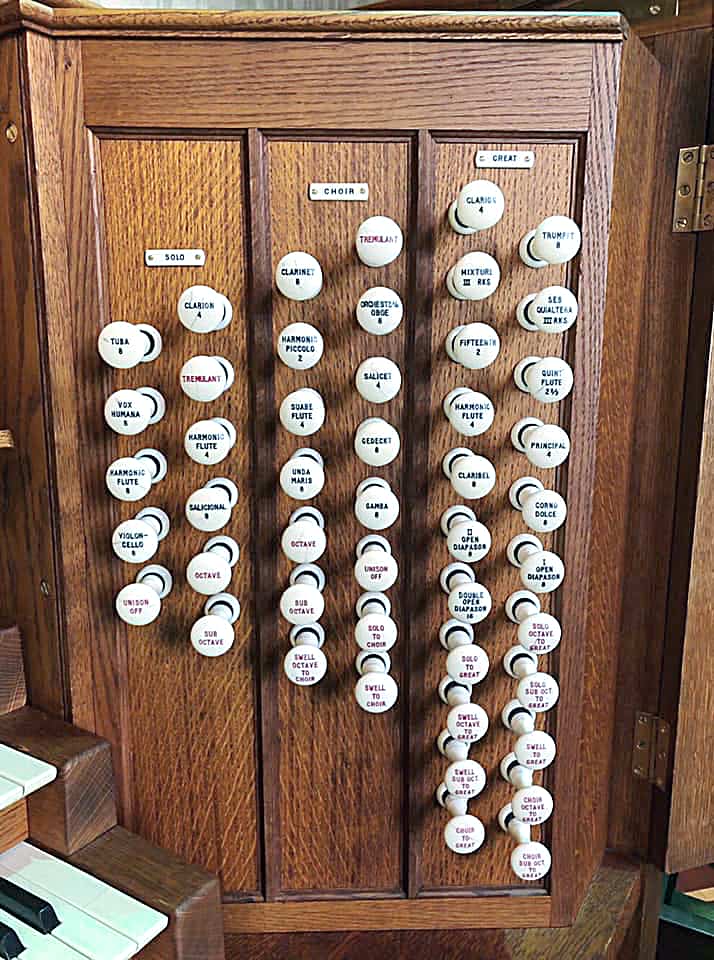
St Peter’s Cathedral, Adelaide – right-hand stop jamb
[photograph by David Heah (October 2019)]
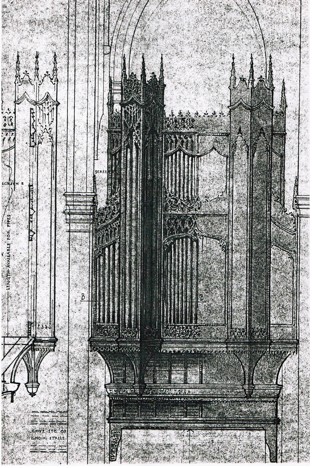
St Peter’s Anglican Cathedral, North Adelaide:
unexecuted case design by Walter Bagot
(supplied by Roger Lewis)
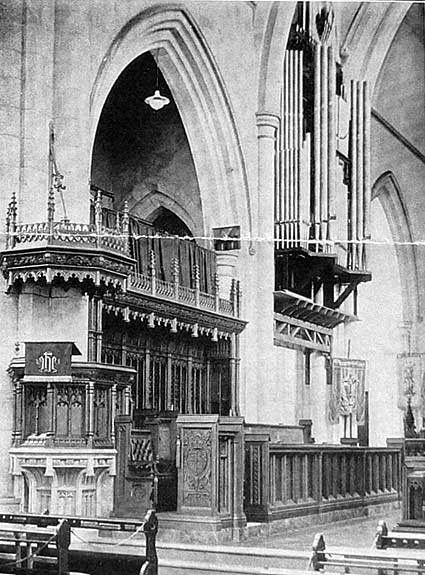
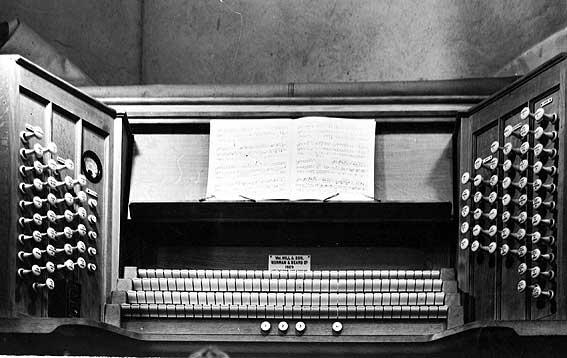
St Peter’s Cathedral, Adelaide – the organ in 1930
[records of Hill, Norman & Beard (1930)]
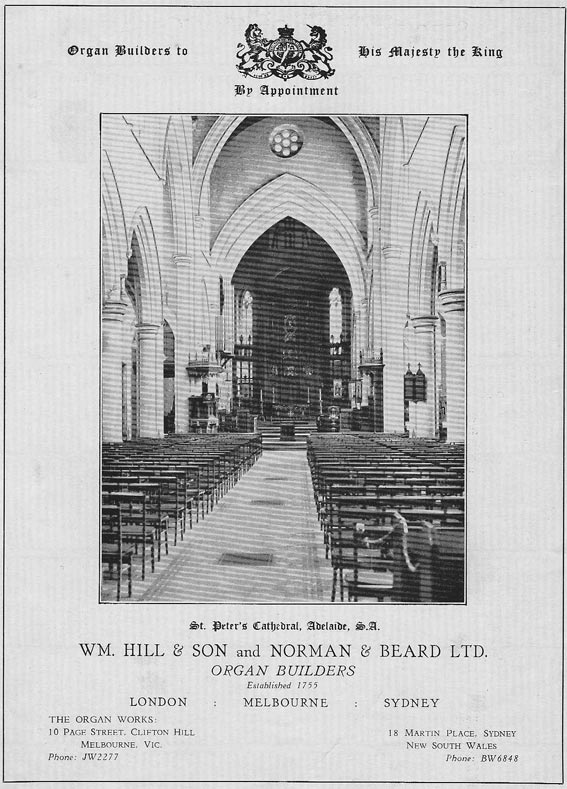
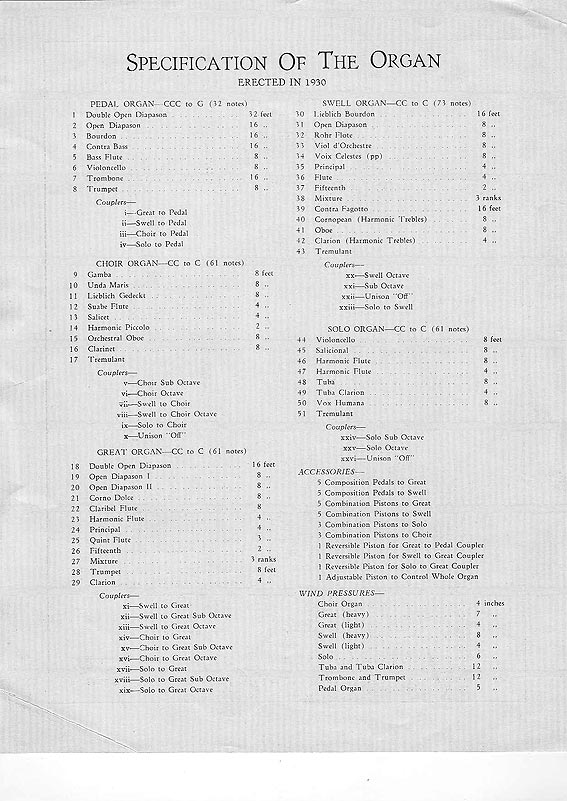
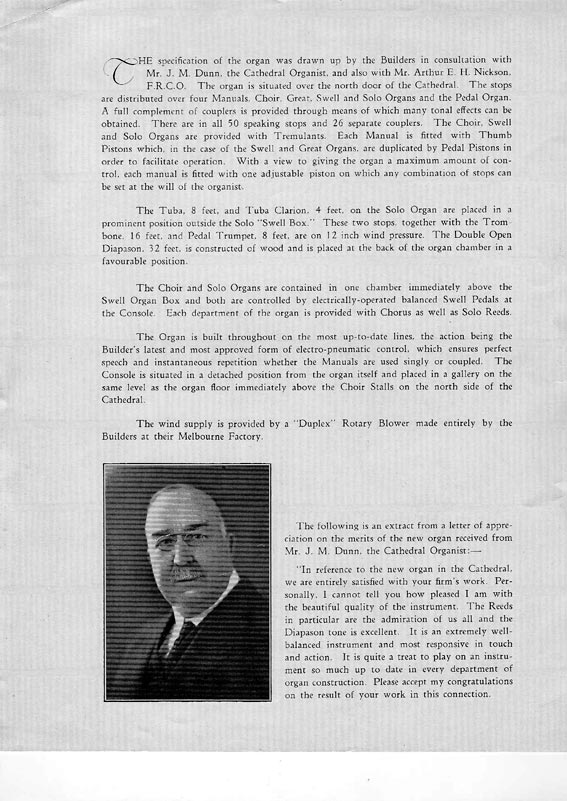
1930 Hill, Norman & Beard brochure and photos taken c.1930 (supplied by John Maidment)
Further images on the Harrison & Harrison website at:
http://www.harrisonorgans.com/gallery/archived-completed-work/completed-work-2018/adelaide-st-peters-cathedral/
Lady Chapel Organ
Roger Jones c.1977
1 manual, 3 speaking stops, no pedals, mechanical action
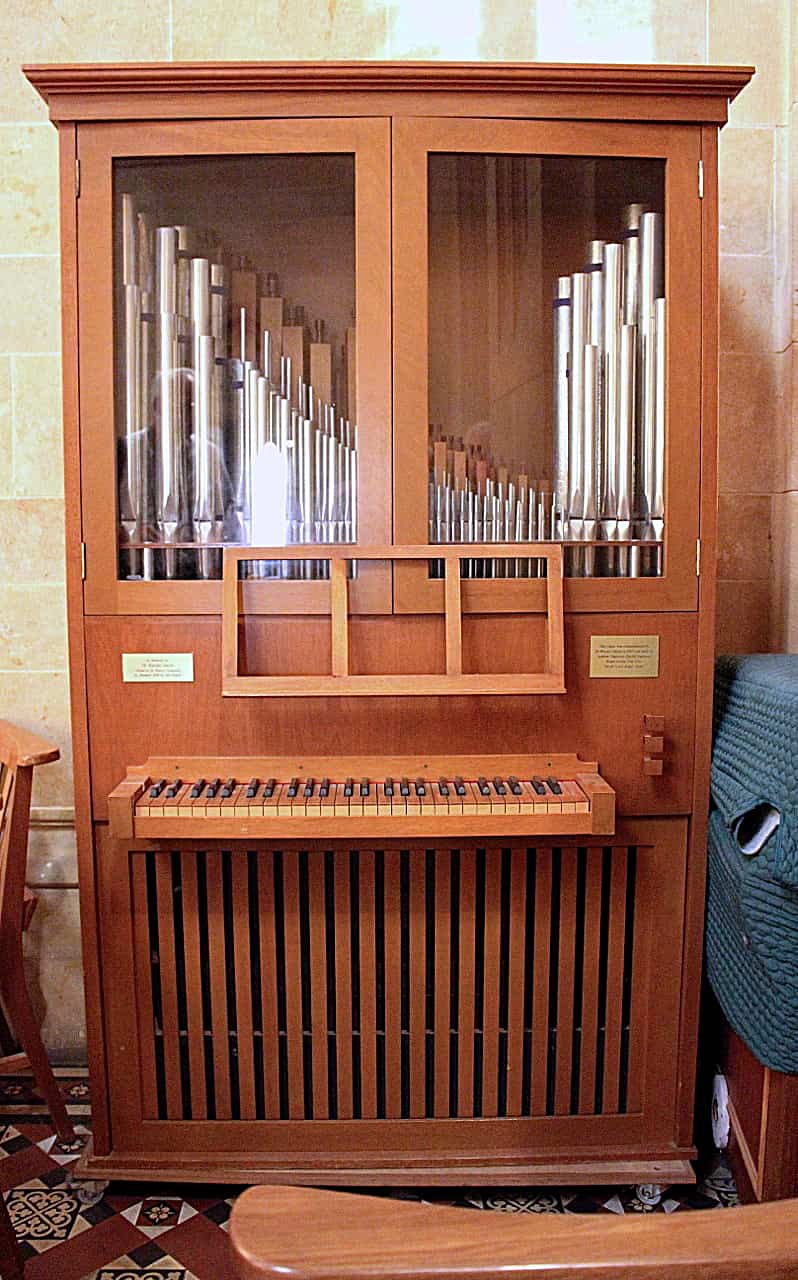
St Peter’s Cathedral, Adelaide – chamber organ
[photograph by Trevor Bunning (October 2019)]
Historical and Technical Documentation by Steve Kaesler
© OHTA, 2019 (last updated October 2019)
In the early 1970s a small group of aspiring young organ reform movement advocates gathered to consider a new style of small organ. The consortium, initially led by Mr Baghurst (senior), also consisted of his son Andrew, Tom Way, David Lowe and Roger Jones. Each member had a particular skill to add to the strength of this group, setting out to combat the takeover of electronic organs within churches, halls and homes.
The aim was to design and construct a small pipe organ of three ranks of pipes with neo-baroque voicing and pleasing casework that would fit through a normal domestic door opening for installation. The engineering approaches of uniformity in design and “production line” type construction techniques were developed to ensure the model instrument could be cost effective and more affordable to the general population.
After finalizing the design, two instruments were initially built, completed circa 1977. One was installed in the residence of Andrew Baghurst and the other sold to Rayner Smith, which was eventually placed in the Lady Chapel of St Peter’s Cathedral, Adelaide, where it still currently resides.
| MANUAL [Gedackt] [Chimney Flute] [Principal] |
8 4 2 |
Compass: 54 notes
Wind pressure: 2 inches
Mechanical key and stop action
Organ mounted on moveable platform
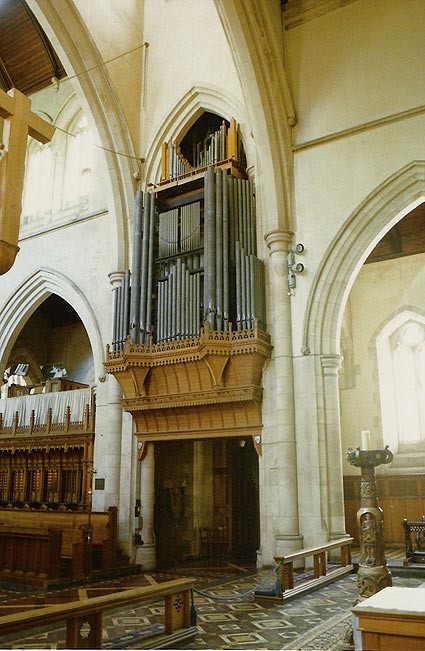
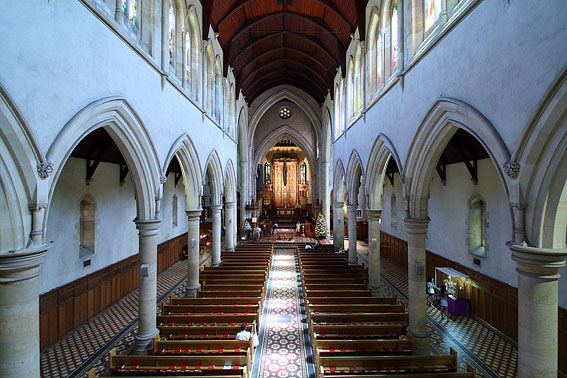
St Peter’s Cathedral, Adelaide – organ viewed from the sanctuary
[photograph by Mark Quarmby (October 2013)]
 |
 |
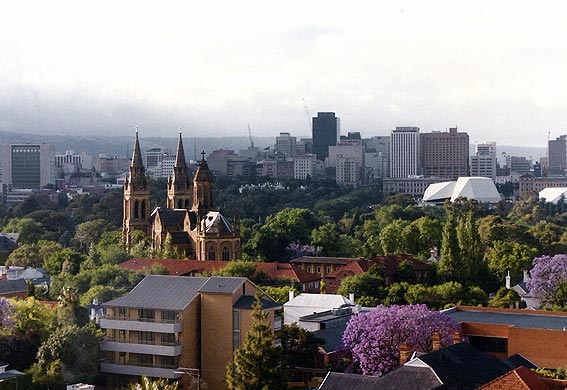 |
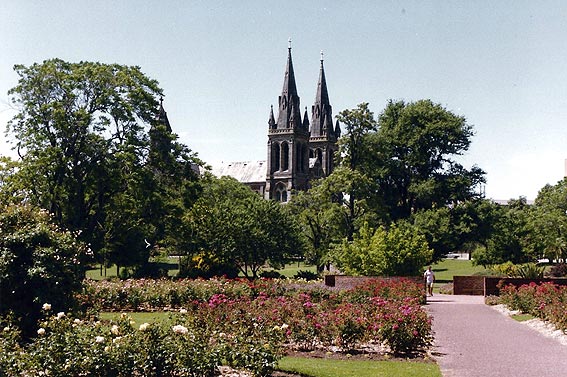
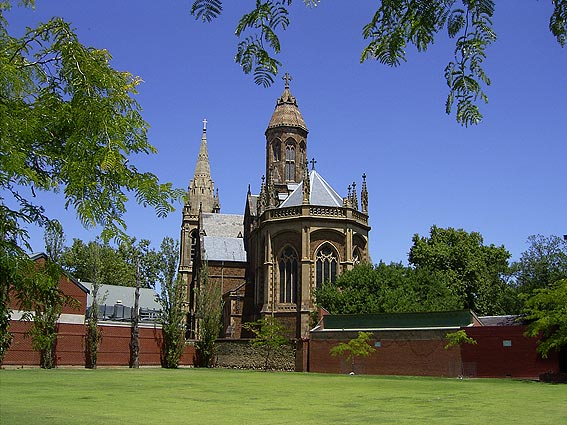
Photos: Trevor Bunning (October 2013)
Three photos above: Simon Colvin (Jan 2010)