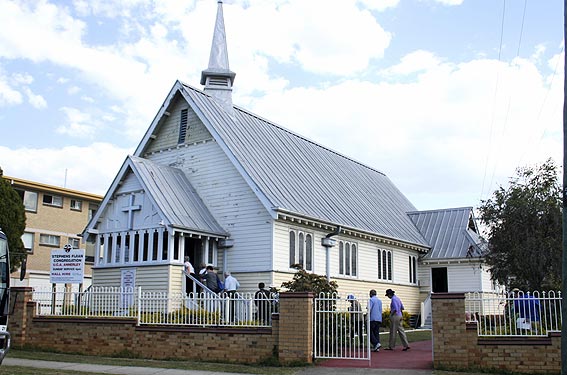
Cracknell Road Uniting Church, Annerley
[Photograph by Trevor Bunning (October 2007)]
Cracknell Road Uniting Church, Annerley
[Photograph by Trevor Bunning (October 2007)]
Historical and Technical Documentation by Geoffrey Cox
© OHTA 1989, 2007, 2012, 2013 (last updated May 2013)
The organ formerly in this church is currently in storage. It was built originally for the Wharf Street Congregational Church, Brisbane, which had been opened in 1860, enlarged in 1872 and renovated in 1883 with the addition of a schoolroom.1

Wharf Street Congregational Church, Brisbane, c.1909
[Photograph: John Oxley Library, State Library of Queensland]
An organ for the Wharf Street church was described in January 1899 as 'nearing completion' in the workshop of Messrs Whitehouse & Marlor of George Street, Brisbane, where it was being built 'directly under the personal supervision' of Mr B.B. Whitehouse:
ROUND THE SHOPS.
MESSRS. WHITEHOUSE AND MARLOR.
One of the business features of the New Year is the important stock of pianos and musical instruments now on view at the establishment of Messrs. Whitehouse and Marlor, of George-street, and immediately opposite the Treasury Building. The firm are agents for the famous Bell planes, which for durability, tone, and workmanship are said to occupy a high position. True, there are many other patterns of pianos to choose from, all possessing that brilliancy of tone and finish characteristic of up-to-date pianos. The organ department is also a branch of the business in which Messrs. Whitehouse and Marlor excel. At the present time they are building a large two-manual and pedal pipe organ to the order of the Wharf-street Congregational Church. The instrument, which is nearing completion, is built entirely of Queensland timbers, and is being constructed directly under the personal supervision of Mr. B. B. Whitehouse, one of the great "Willis" men, which fact justifies the expectation of the success of the Instrument. Mr. J. S. Marlor, the well-known and popular flautist, has charge of the military and orchestral instrument department, where some finely finished instruments are on view, stamped with the renowned name of Rudall, Carie and Co., London. Included in Messrs. Whitehouse and Marlor's large and varied musical stock are violins by G. Mougenot, maker to the Royal Conservatoire of Music, Brussels. Accordions and other popular goods are in strong evidence, and have been imported direct from the factories.2
This report reveals, interestingly, that Benjamin B. Whitehouse claimed his organ-building lineage from the Willis firm. Having arrived in Brisbane in 1883, he had worked initially for two other firms before setting up his own business in 1895, and then forming a business partnership in 1896 with John S. Marlor as 'Whitehouse & Marlor' at 185 George Street, Brisbane. This partnership continued until September 1902, when the firm became known as 'B.B. Whitehouse & Co.' at the same address.3 Benjamin was joined in Brisbane in 1897 by his younger brother, Joseph Howell Whitehouse (1874-1954),4 who was also undoubtedly involved in the construction of the Wharf Street instrument. Although it was described at the time as having been built by 'Whitehouse & Marlor,' both in The Brisbane Courier and in the church records,5 it bears the unique nameplate 'B.B.Whitehouse, Organ Builder, Brisbane'.
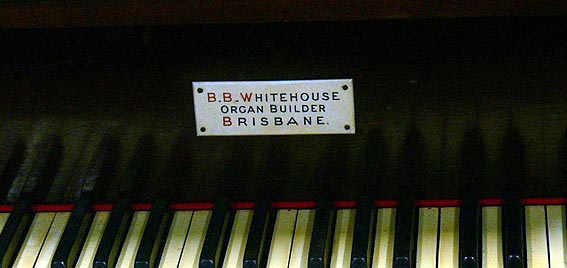
The builder's nameplate on the organ
[Photograph by John Maidment (October 2007)]
The organ was opened with a sacred concert on Thursday 16 March 1899.6 The organist for the occasion was Mr S.G. Benson, R.A.M. (at that time organist of the Albert Street Methodist Church in Brisbane), and he was joined by Miss Theo. Benson (violinist), Mr J. Marlor (flautist), four vocal soloists and the church choir. The vocal items appear to have included a sacred song by Benson himself, "I will sing of Thy great Mercy", which was sung by Mrs Spencer Browne.7 The flautist was Mr John S. Marlor, with whom Benjamin Whitehouse worked in partnership.

Programme for the opening of the organ
at the Congregational Church, Wharf Street
[supplied by David Vann]
The organ and the opening concert were described in detail in The Brisbane Courier the following day:
OPENING OF NEW ORGAN.
WHARF-STREET CONGREGATIONAL CHURCH.
The new organ which has been built by Messrs. Whitehouse and Marlor for the Wharf-street Congregational Church was opened last evening, when an enjoyable concert was given in honour of the occasion. Particular interest attached to the function from the fact that the instrument had been designed and built in Brisbane. Only one local church possesses an organ of similar origin and that is the Valley Wesleyan Church. That instrument was partly built by the late Mr. Waldron some years ago, but he died before it was completed, and the work of finishing it was carried out by Mr. Christmas. The organ just built for the Wharf-street Congregational Church again shows what can be done with colonial material by an experienced workman. Mr. B. B. Whitehouse, the builder, has every reason to be proud of his work, for he has turned out an instrument of excellent quality, both as to tone and workmanship. The specifications were drawn by Mr. S. G. Benson. R.A.M., with special attention to the requirements of the purchasers and the building in which the instrument was to be placed. Both designer and builder worked with the idea of demonstrating that organ building can be carried on successfully in Queensland, and the result is beyond question. With the exceptions of the manual pipes, ivory knobs and keys, which were imported, the whole of the organ has been built here, and only Queensland timber used in its construction. A feature about the internal mechanism is that the squares in the action are made of aluminium instead of wood. By substituting metal for wood the action or mechanical parts of the instrument has been rendered damp proof. Every part of the mechanism is "bushed," so as to insure easy and silent working; all the glued joints are secured with screws, the swell-box is double lined, and the pedal action tubular pneumatic. In short, the organ has been built with all the latest improvements. It has been placed immediately behind the pulpit, to which it forms a handsome and striking background. The case protrudes some few feet into the church, but the greater part of the instrument is, so to speak, built into a recess specially constructed for its reception. The large metal pipes, which are tastefully decorated, rise from a plain panelled base, and stretch up to the roof. The woodwork is thus made to form the back of the pulpit. The console is placed immediately under the latter, and the pedals are let into the platform. By this arrangement very little more space, if any, is taken up than was occupied by the American organ formerly used. The organist therefore sits with his back, to the congregation, immediately under the overhanging ledge of the pulpit, and the area within the communion rails is available for the choir. The pulpit, of course, stands somewhat higher than it did before. As already remarked, the organ has been designed especially to suit the church and so as to obtain with the requisite power richness and sweetness. There are two manuals, eight stops in the swell, six in the great, the large scale (bourdon on the pedal, three couplers, four combination pedals, and a tremulant. The following are the stops:- Swell organ: Open diapason 8ft., salicional 8ft., gemshorn 4ft., oboe 8ft., harmonic piccolo 2ft., lieblich gedact 8ft., and voix celeste 8ft.; couplers - swell to great, swell to pedal, and great to pedal. Great organ: Dulciana 8ft., principal 4ft., fifteenth 2ft., lieblich flute 4ft., clarabella 8ft., and open diapason 8ft.; tremulant, pedal, pedal bourdon. There are also two combination pedals to the great and two ditto to the swell organ. An excellent substitute for the vox humana is supplied by the voix celeste in combination with salicional. The sweet and beautiful tone produced by that means was the subject of general remark. The flute and oboe stops are also exceptionally good. Very appropriately, the organ was opened by Mr. Benson, and the audience were indebted to him for a most enjoyable demonstration of the good qualities of the instrument. The beauty and variety of the stops, and the sweetness of the tone. The playing of Bendel's exquisite "Nocturne" exhibited the soft stops to the very best advantage, and the number was so artistically interpreted that the audience insisted upon its repetition. Batiste's "Pilgrim's Song of Hope" met with an almost equally appreciative reception. Lemmen's "Marche Triumphale" served to exhibit the rich and sonorous quality of the full organ. Mr. Benson also played "Grande Offertoire" (Wely), "Bouree" (Bach), "Cantilene Pastorale" (Guilmant), and "Caprina" (Munro), each of which was listened to with great pleasure. He was assisted by Mrs. Spencer Browne and Mrs. Reeve, Mr. Longbottom, and Mr. H. Hutledge (vocalists), Miss Theo. Benson (violiniste), and Mr. J. Marlor (flautist), and by the church choir, under the conductorship of Mr. H. J. Oxley. The concert as a whole was warmly appreciated, and the consensus of opinion seemed to be that the church had obtained an admirable instrument. The cost of the organ was something over £400.8
The claim that this organ and the one at the Wesleyan Church, Fortitude Valley were the only two that had been built in Queensland by this time is, in retrospect at least, somewhat surprising. Others in Queensland before this date included the organ at St Patrick's Catholic Church, Fortitude Valley, built by Thomas Christmas around 1882, the instrument built by B.B. Whitehouse himself in 1886 while employed by the Queensland Piano, Organ and Music Warehouse Company, later installed at St Thomas' Anglican Church, Toowong, and one built in Gympie by Alfred Cobby around 1890, subsequently displayed at Wickham Hall, Fortitude Valley.
A photograph of the new Congregational organ was published in 1906, along with the following description:
WHARF-STREET CONGREGATIONAL
The organiste at this church is Mrs. Harry Reeve, and the choirmaster is Mr. G. Gordon Searle. This organ was built by B.B. Whitehouse and Co., Brisbane and was opened in March 1899. The cost of the instrument was £420, and it contains 16 stops: 6 on swell organ; 5 on great organ; 1 on pedals (pneumatic action) and tremulant, and 3 couplers and 4 composition pedals.9
The accompanying photograph shows the console separated from the case with the pulpit in between.
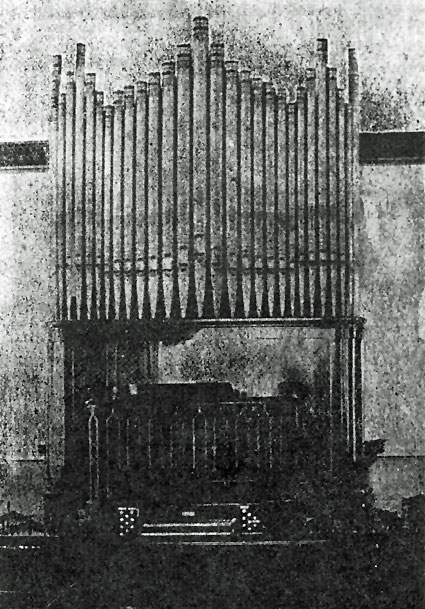
The organ in its original location at the Wharf Street Congregational Church
[Photograph: The Daily Mail (Brisbane, 10 March 1906), p. 13]
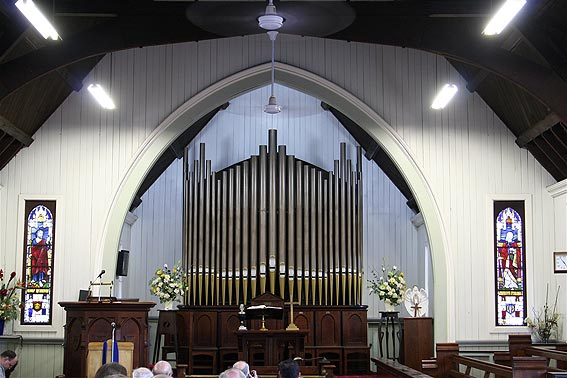
The organ in its new location after 1927
at the Cracknell Road Congregational Church
[Photograph by Trevor Bunning (October 2007)]
As was the case with later Whitehouse organs, the pipework appears to derive from A. Palmer & Son of London, and the console fittings from Thomas Harrison of London.10 There is no casework above the impost, and the façade pipes (which were originally stencilled) have 'French' mouths, as distinct from the 'bay-leaf' mouths found on later Whitehouse organs such as that at Wesley Church, Kangaroo Point (1903).
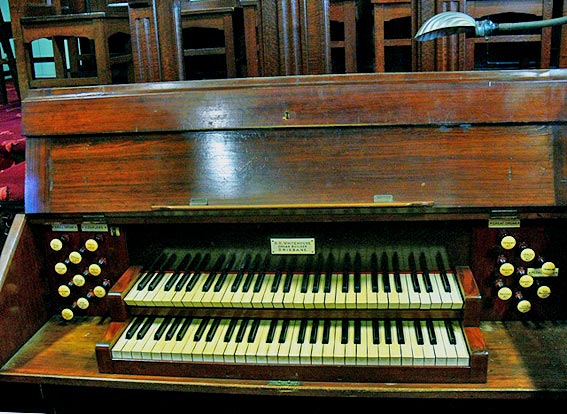
[Photograph by John Maidment (October 2007)]

[Photograph by Trevor Bunning (October 2007)
The organ was installed at the Congregational Church, Cracknell Road, Annerley, by Whitehouse Bros in October 1927,11 when the Wharf Street church was replaced by the Congregational Church Hall, Adelaide Street.12 It was opened and dedicated on Sunday 13 November by Mr. R.M. King, M.L.A., and Rev. G. McChesney Clark, the President of the Congregational Union of Queensland.13
The instrument was recessed into the floor at Cracknell Road in order to fit within the sanctuary arch, and the mechanical action was possibly modified in order to accommodate the positioning of the console. Whitehouse Bros carried out repairs to the Great soundboard in November 1935 at a cost of £40, and further repairs in October 1951 at a cost of £220.14 The instrument was overhauled by David Hudd in 1985.15

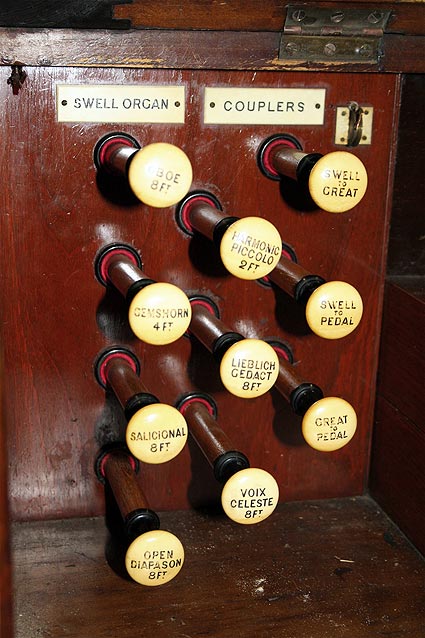
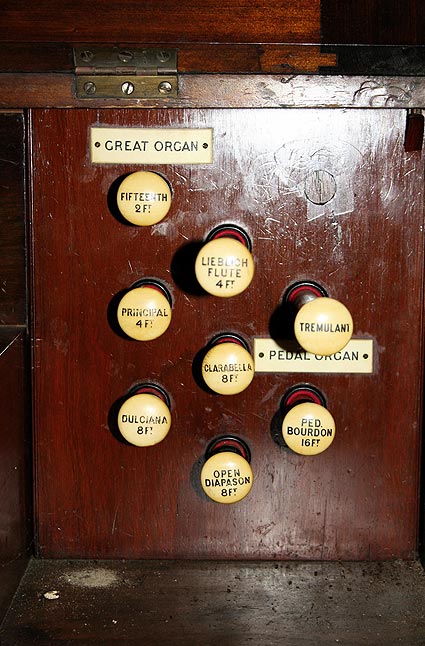
[Photographs by Trevor Bunning (October 2007)]
| GREAT Open Diapason Dulciana Clarabella Principal Lieblich Flute Fifteenth SWELL Open Diapason Salicional Voix Celeste Lieblich Gedact Gemshorn Harmonic Piccolo Oboe PEDAL Bourdon COUPLERS Swell to Great Swell to Pedal Great to Pedal |
8 8 8 4 4 2 8 8 8 8 4 2 8 16 |
Compass: 56/30
Drawstop console (with telltale)
2 composition pedals to Swell Organ
2 composition pedals to Great Organ
Swell tremulant
Trigger swell lever
Pedalboard: radiating & concave
Mechanical action (manuals); pneumatic action (pedals).16
The Annerley church is now used by the Fijian congregation, and the instrument was listed for sale in 2001.17 It was purchased around 2008 by Mr David Vann, and has since been in storage.
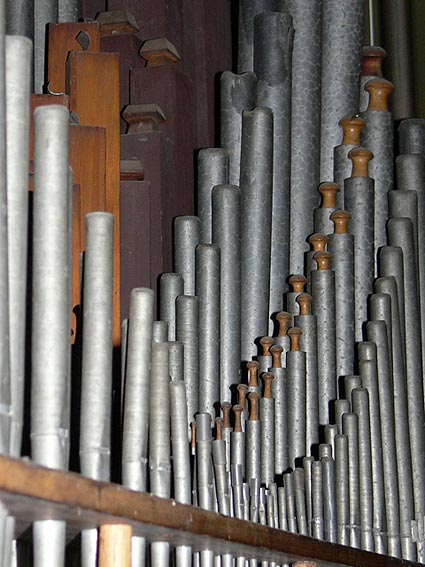
Pipework of the Great Organ, showing the stopped metal pipes
of the Lieblich Flute 4ft
[Photograph by John Maidment (October 2007)]
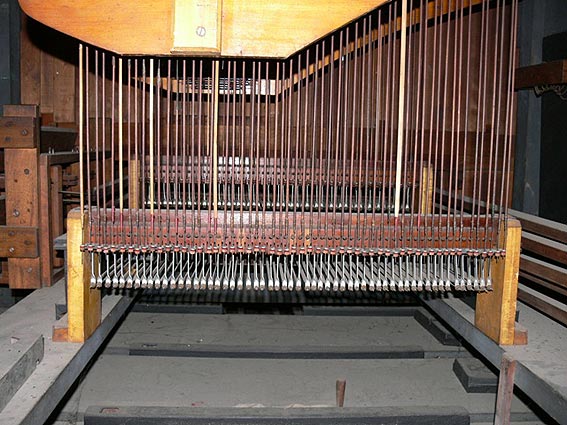
Swell key action and bellows
[Photograph by John Maidment (October 2007)]
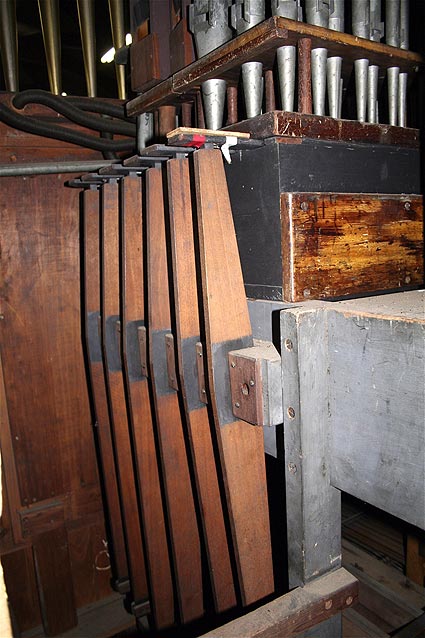
Stop action and windchest of the Great Organ
[Photograph by Trevor Bunning (October 2007)]
_____________________________________________________________________
1 E.J.T. Barton, ed. Jubilee History of Queensland: a Record of Political, Industrial, and Social Development, from the Landing of the First Explorers to the Close of 1909 (Brisbane: H.J. Diddams, [c.1910]), p. 145.
2 The Brisbane Courier (7 January 1899), p. 9.
3 Geoffrey Cox, 'B.B. Whitehouse and the First Organ Built in Queensland,' OHTA News, vol. 35, no. 1 (January 2011), pp. 19-24.
4 Queensland State Archives, cited in Graeme D. Rushworth, Historic Organs of New South Wales (Sydney: Hale & Iremonger, 1988), pp. 203-04.
5 The Brisbane Courier (16 March 1899), p. 5; City Congregational Church records, cited by David Vann.
6 The Brisbane Courier (15 March 1899), p. 8.
7 Original concert programme supplied by David Vann, 2001.
8 The Brisbane Courier (17 March 1899), p. 6.
9The Daily Mail (10 March 1906), p. 13.
10 Personal communication to G. Cox from W.J. Simon Pierce, October 1989.
11 Whitehouse Bros Ledger (1922-1940), pp. 187, 354.
12 David G. Vann, 'History of the City Congregational Church Organs' (pamphlet, c.1974); also in Organ Society of Queensland Newsletter, vol. 1, no. 4 (July 1974), pp. 2-4.
13 The Brisbane Courier (10 November 1927), p. 7; The Brisbane Courier (14 November 1927), p. 11.
14 Whitehouse Bros Ledger (1940-1954), pp. 458, 608.
15 Personal communication to G. Cox from David Hudd, c.1986.
16 Specification noted by G. Cox, 1973 & 1989.
17 The Organ Voice, vol. 27, no. 1 (March 2001), p. 6.